
PMP® certification, are respected by UK employers, particularly in multinational and technology-driven sectors.
Is PMP accepted in the UK?
Yes, PMP® is accepted in the UK, but PRINCE2 and APM certifications are more widely used domestically. The PMP® certification remains highly regarded globally and particularly valuable for professionals working with international organisations or global projects.
Is PMP better than APM?
Whether PMP® is better than APM depends on the industry. APM qualifications are common in construction and engineering, whereas PMP® is more recognised in IT, finance, and global industries. Both demonstrate professional capability, but PMP® has stronger international recognition.
Is PMP recognised in the UK?
Yes, PMP® is recognised in the UK, although PRINCE2 remains the most widely adopted methodology. The APM PMQ is also respected among UK employers. PMP® tends to be favoured by international companies operating within the UK.
Is PMP certification worth it in the UK?
Yes, PMP® certification is worth pursuing in the UK if you aspire to work on global projects or with multinational organisations. Although it requires a significant investment of time and money, it offers strong career advantages, particularly in sectors such as IT, consulting, and finance.
Is the PMP exam multiple choice?
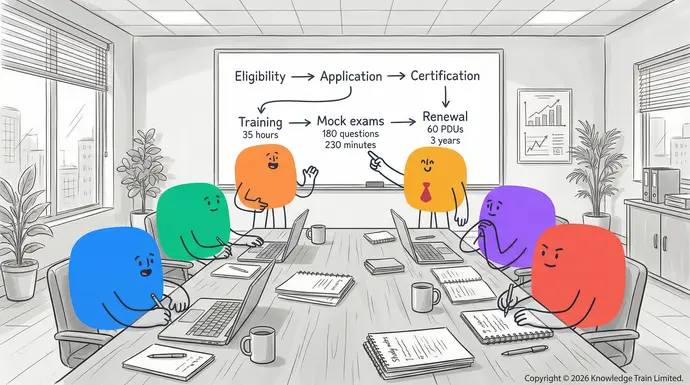
Yes, the PMP® exam consists of 180 multiple-choice questions covering three domains: people, process, and business environment. The test includes both situational and knowledge-based questions, and you have 230 minutes to complete it.
What are the eligibility requirements for the PMP certification?
Applicants need either:
- A secondary degree (e.g. high school diploma) and at least 60 months of project leadership experience; or
- A four-year degree with 36 months of project management experience.
In both cases, 35 contact hours of formal project management education or a CAPM certification are required.
What is the cost of the PMP exam?
As of 2024, the PMP® exam costs USD $555 for non-PMI members and USD $405 for PMI members. Additional expenses may include PMI membership, training courses, and study resources.
What is the difference between AgilePM and PMP?
The main difference between AgilePM and PMP® lies in their approach. AgilePM focuses on adaptability and iterative delivery, whereas PMP® follows PMI’s structured, process-driven framework. Both certifications complement each other and are valuable in hybrid project environments.
What is the difference between PMP and PMBOK?
The PMP® certification is an exam-based credential demonstrating mastery of project management principles, whereas the PMBOK® Guide is a reference book that outlines PMI’s standard framework of best practices and terminology.
What is the difference between PMP and PMI-PBA?
The PMP® certification validates broad project management leadership skills, while the PMI-PBA® certification focuses specifically on business analysis and requirements management within projects. Professionals managing both strategy and execution may benefit from holding both.
What is the UK equivalent of PMP?
There is no direct UK equivalent to PMP®. However, the closest alternatives are APM PMQ and PRINCE2. While PMP® is more globally recognised, PRINCE2 remains the preferred framework for project management in the UK.
What percentage of PMP exam is Agile?
The PMP® exam content is split approximately 50% Agile and hybrid methods and 50% traditional (waterfall) approaches. Understanding both methodologies is critical to success.
Where can I find official PMP resources and guidance?
Authoritative PMP® resources are available on PMI.org. These include:
- The PMBOK® Guide (latest edition)
- PMI’s Authorised Training Partners (ATPs)
- Practice exams and exam content outlines
These official materials are the best way to prepare effectively and stay up-to-date with PMI’s standards.