
Key takeawaysThe Scrum Master is accountable for team effectiveness and acts as a servant leader who improves how work flows.
A strong business case turns a proposal into a decision by making value, costs, and risk explicit.Daily stand-ups expose blockers early, reduce siloed working, and create better decisions for the next 24 hours.
- Use a business case when resources are limited and there are credible alternatives, including a do-nothing baseline.Backlog clarity improves when the Scrum Master supports the Product Owner with refinement, user stories, and planning in uncertainty.
- Make roles clear: an author drafts, finance and risk challenge, and an executive sponsor owns benefits and alignment.The Scrum Master role is different from product direction and traditional project oversight, so responsibilities must stay clearly separated.
- Anchor the case in a measurable baseline, defined objectives, and KPIs so outcomes can be tracked after delivery.Strong facilitation, observation, listening, and knowing when to step back build self-management and predictable delivery.
- Compare options transparently using full costs, quantified benefits, and appraisal methods such as ROI, NPV, IRR, and payback.
- Separate risks, assumptions, constraints, and dependencies, and include mitigations and a post-implementation review plan.
| Executive sponsor and operations leadSix Sigma offers tools for improving business processes and quality. Read on to see how it can benefit your projects. | |||
| Data quality issues | Errors, low trust in reporting | Data profiling, cleansing, acceptance criteria | Data owner |
| Supplier delivery delay | Timeline slippage, higher costs | Milestone-based contract, contingency, parallel workstreams | Project managerAgile transformation: What should ‘good’ look like (and what to be wary of)? |
Example business case
Scenario:Sevcan Yasa A mid-sized service business proposes implementing a CRM to reduce manual admin, improve sales follow-up, and increase conversion rates.23 Feb 2026
Assumptions and baseline
- 40 sales and service users.Unlock the secrets of successful Agile transformation. Scroll down to watch the insightful webinar video now.
- Current admin time lost to manual updates: 2 hours per user per week.
- Average loaded labour cost: GBP 35 per hour.
- Expected time saving after rollout: 60% of current admin time.
- Revenue uplift from better follow-up: GBP 60,000 per year (conservative estimate).
- Discount rate for NPV: 8% per year (illustrative only).
Estimated costs
| Cost item | Timing | Amount |
|---|---|---|
| Implementation and configurationDSDM principles: A visual guide | Year 0 (one-off) | GBP 45,000Simon Buehring |
| Training and change management19 Feb 2026 | Year 0 (one-off) | GBP 10,000Learn about DSDM principles through our visual guide and see their response to traditional process flaws. Scroll for more insights. |
| Licences and support | Annual | GBP 24,000 |
Estimated annual benefits
- Time saving: 40 users x 2 hours/week x 52 weeks x 60% x GBP 35/hour = GBP 87,360 per year.
- Revenue uplift: GBP 60,000 per year.Benefits of Agile methodologies
- Total benefits: GBP 147,360 per year.Simon Buehring
- Net annual benefit after licences:23 Feb 2026 GBP 147,360 minus GBP 24,000 = GBP 123,360 per year.
Simple ROI, payback and NPV illustrationDiscover the benefits of Agile methodologies and how they streamline project management. Scroll down for a detailed overview.
- Initial investment (year 0): GBP 55,000.
- Payback period: GBP 55,000 divided by GBP 123,360 is about 0.45 years (about 5 to 6 months).
- Simple ROI (year 1): (GBP 123,360 minus GBP 55,000) divided by GBP 55,000 is about 124%.
- NPV (3 years, 8% discount, simplified): NPV = -55,000 + 123,360/(1.08) + 123,360/(1.08^2) + 123,360/(1.08^3) = approximately GBP 262,000.Scrum development
Interpretation: Under the stated assumptions, the business case supports approval because value is positive, payback is short, and risks can be mitigated through adoption and data-quality controls. In practice, include sensitivity analysis (best case, expected, worst case) for decision confidence.Simon Buehring
Further 19 Feb 2026business case examples are available on our web site.Uncover the roles and activities in Scrum development post-planning. Enhance your understanding of Scrum by reading on.
Business case template
Use this template as a starting point. Keep language factual and include sources for material numbers.
Download a business case template from our web site.
1. Summary and decision request
- Decision required
- Recommended optionHow to become a Scrum Master
- Funding/resources requested
- Target decision dateSimon Buehring
2. Background and context19 Feb 2026
- Current situation and baseline performance
- Problem/opportunity statementBecoming a certified Scrum Master is straightforward. Learn about the role and its requirements by reading further.
- Strategic alignment
3. Objectives and success measures
- Objectives
- KPIs and targets
- Benefits owners and timing (benefits realisation)
4. Scope, constraints and dependencies
- In scope
- Out of scopeScrum: A visual guide
- Constraints (budget, time, technology, compliance)
- Dependencies (data, suppliers, approvals)Simon Buehring
5. Stakeholders and governance19 Feb 2026
- Executive sponsor
- Key stakeholdersNew to Scrum? Our visual guide explains the methodology clearly. Download the accompanying poster to share with your team.
- Decision-making forum (board/committee)
- Reporting cadence
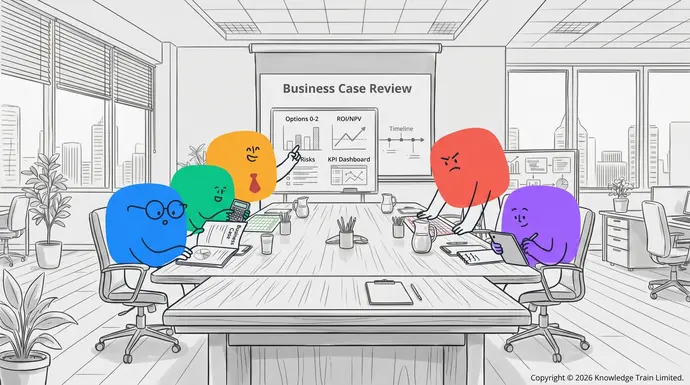
6. Options analysis (alternatives)
- Option 0: do nothing / do minimum
- Option 1
- Option 2
- Evaluation criteria (value, risk, feasibility, time to benefit)
7. Recommended option and rationaleAgile methodologies
- Why this option is preferred
- Trade-offs acceptedSimon Buehring
8. Benefits, costs and investment appraisal23 Feb 2026
- Benefits (quantified and qualitative)
- Costs (one-off and ongoing)Discover the variety of Agile methodologies and their unique implementations across sectors. Read more to see which fits your needs.
- Opportunity cost considerations
- ROI
- NPV (discount rate and period)
- IRR
- Payback period
9. Risks and mitigations
- Top risks
- Mitigations and ownersAgile vs waterfall project management
- Residual risk
10. Implementation planSimon Buehring
- Approach and phases23 Feb 2026
- High-level timeline and milestones
- Resourcing planCompare Agile and waterfall methodologies to see why many industries prefer Agile. Discover the benefits by reading more.
- Change management
11. Review plan
- How KPIs will be tracked
- Post-implementation review date and method
Business case vs business plan
These documents are related but serve different purposes. Clarifying the difference helps prevent rework and mismatched expectations.
Business case vs business plan
| Business caseAgile principles | Business plan |
|---|---|
| Justifies a specific investment, change, or project.Simon Buehring | Explains how a business or product will operate and grow over time.19 Feb 2026 |
| Centres on options analysis, investment appraisal, and approval. | Centres on market, strategy, operations, and financial forecasts.Understand how Agile principles revolutionize project delivery and quality. Read on to learn about their application in various industries. |
| Often used for internal governance and funding decisions. | Often used for external funding, partners, or internal planning. |
| Includes KPIs for benefits realisation and post-implementation review. | Includes broader performance targets and business milestones. |
Business case vs project charter
| Business case | Project charter |
|---|---|
| Explains why the work should be done and whether it is worth doing. | Authorises the project to start and defines roles, scope, and high-level plan. |
| Focuses on value, options, costs, benefits, and decision-making. | Focuses on delivery authority, governance, and initial project boundaries. |
Business case vs feasibility study
CookiesHow long should a business case be?
Length depends on complexity and risk. Many internal business cases are 2 to 10 pages plus appendices for calculations and evidence. The key is that decision-makers can understand the recommendation, numbers, risks, and obligations quickly.Privacy
Who approves a business case?Terms
Approval is usually given by a governance body such as a steering group, investment committee, portfolio board, or senior leadership team. The executive sponsor is typically accountable for endorsing the case and ensuring benefits owners and stakeholders commit to delivery and measurement.Customer Support
What is the difference between a business case and a business plan?
A business case justifies a specific initiative and asks for approval, focusing on options, value, and risk. A business plan describes how an organisation, product, or business unit will operate and grow, covering market approach, operating model, and broader financial forecasts.[email protected]
How do you calculate ROI and NPV in a business case?Join Our Team
ROI is commonly calculated as (total benefits minus total costs) divided by total costs over a defined period. NPV discounts future cash flows using a chosen discount rate and sums them with the initial investment; a positive NPV indicates value under the model. Document the discount rate, time horizon, and key assumptions, and consider sensitivity analysis.
What makes a business case compelling?[email protected]
A compelling business case has a clear baseline, credible options analysis, transparent assumptions and constraints, realistic costs and benefits with sources, an explicit risk and mitigation plan, and measurable KPIs with named benefits owners. It also explains opportunity cost and shows how governance will control change. Copyright © 2005-2026 Knowledge Train Limited.
When is a business case required? Registered in UK: 5566983.
A business case is often required when requesting funding, committing significant resources, changing customer-facing services, or introducing material operational or compliance risk. It is also commonly required for projects that compete for prioritisation in a portfolio. Registered VAT: GB872413526.