How to write a business case

Key takeawaysBoth roles rely on shared skills like communication, problem-solving, and stakeholder management, but apply them differently.
A business case helps decision-makers judge whether an investment is worth the time, money and risk.Clear role boundaries, shared documentation, and regular touchpoints reduce conflict and keep delivery aligned to product value.
- State the reason for the activity and ensure it aligns with organisational strategy.
- Compare realistic options, including doing nothing, and clearly justify the preferred choice.
- Separate project costs and timescales from ongoing operational costs and benefit realisation timescales.
- Define benefits in measurable terms and distinguish outcomes from benefits so performance can be tracked.Contents
- Include known dis-benefits and major risks, plus mitigations, to avoid one-sided decisions.
- Use an investment appraisal, such as net benefits and break-even timing, to test viability.
Introduction
This article explains how to write a business case. It includes 2 business case examples and a free business case template for you to Conclusiondownload .FAQs
You’re probably reading this article because you want to know how to write a business case. Perhaps your organisation is embarking on a major project to develop a new product. Or, perhaps you’re thinking of moving house so your family can enjoy a better life. In either case, you write a Introductionbusiness caseProject management and product management to ensure the investment is worthwhile. are two essential aspects of any business that are often used interchangeably, even though they are distinct from each other. Both play a critical role in the success of any organisation, but they have different functions and responsibilities.
In this article we’ll give you 2 business case examples, provide you with a simple business case template for you to use, and explain how to write a business case.Project managers are typically responsible for the successful delivery of specific projects within a defined timeframe. Product managers, on the other hand, oversee the entire lifecycle of a product, from inception to delivery, and are responsible for driving its success.
What is a business case?
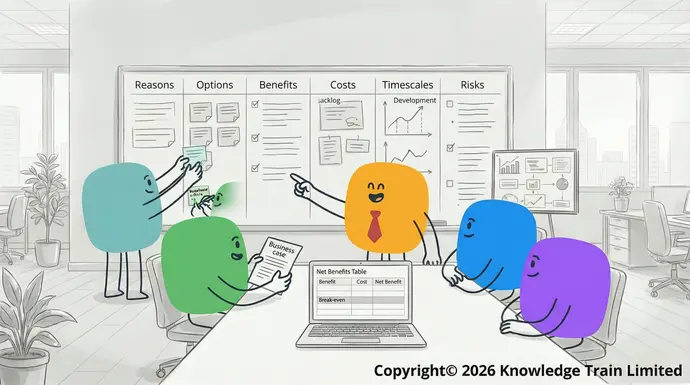
A business case is the justification for some activity (e.g. a project) undertaken by your organisation. It weighs up the timescales, costs and risks of doing the activity against the benefits to be gained. Think of it as weighing up the pros and cons and then taking a sensible decision.
A business case forms an essential component of the curriculum of the best project management coursesInstructor-led.Introduction to Project Management course
Personal business case
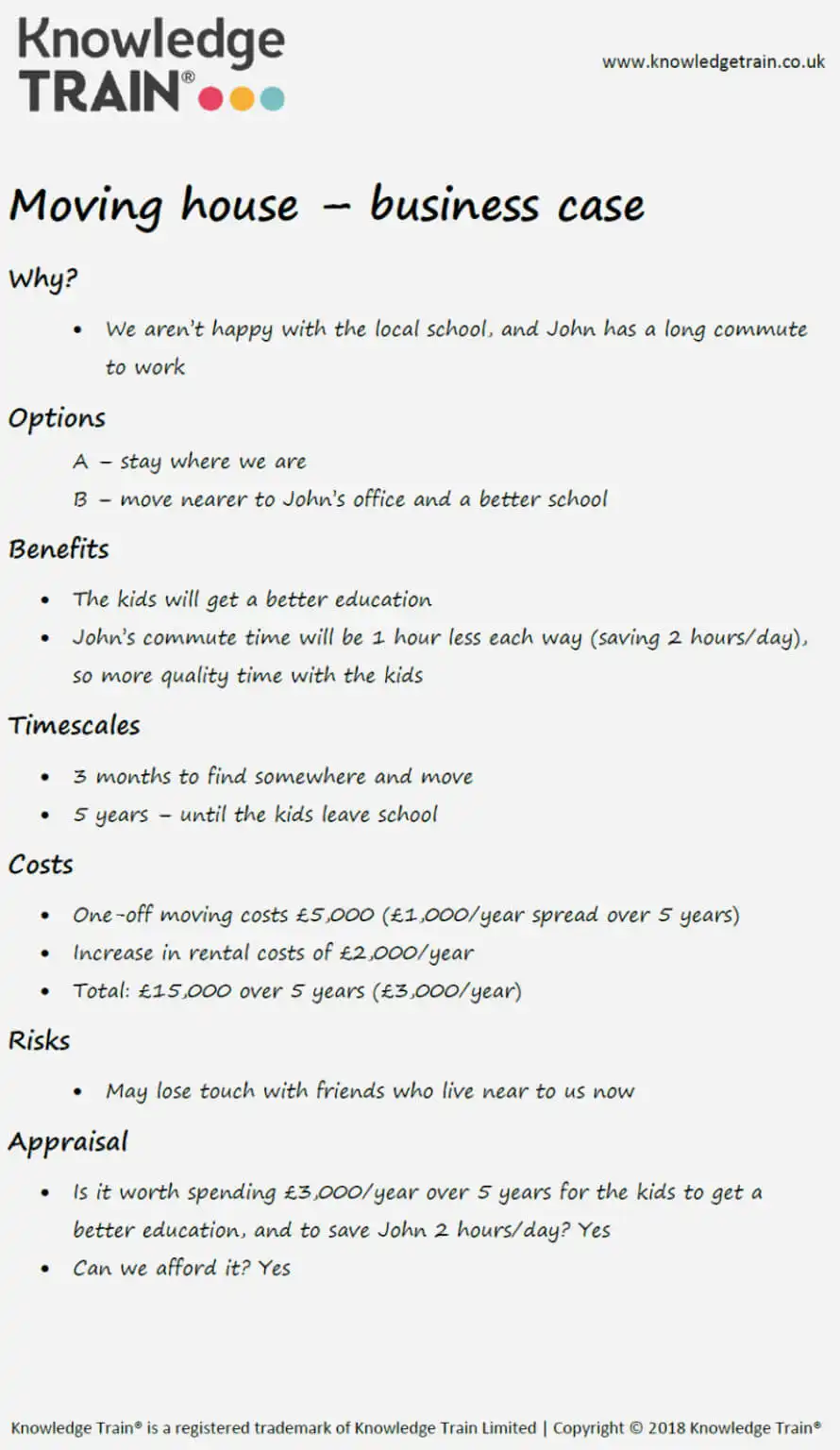
You may also use a business case to justify an investment you make in your personal life. For example, when you’re thinking of moving home to another area. You and your spouse will need to understand the costs of moving, the timescales and risks involved, and weigh these up against the benefits to be gained e.g. saving time traveling to your office, or your children able to go to a better school.£499 +vat
: Developing product roadmaps, making informed decisions, and prioritising features based on market demands and business goals.
Investment appraisalUser experience and customer focus
The next section is where the costs and timescales and risks are weighed up. For this project, it’s a simple decision for the couple to decide if it’s worth spending money over the next 5 years to give their kids better schooling and to save John 2 hours a day commuting.: Product managers need to have a strong understanding of their target audience and create products that resonate with them.
For an organisation to decide if an investment is worthwhile, however, there are several different ways in which it can decide about the investment.Technical understanding
Often in organisations there are rules defined to help business analysts or : While coding skills may not be essential, product managers should have a basic understanding of technology and development processes to communicate effectively with development teams and make informed product decisions.project managersOverlapping skills for both roles write what’s called an investment appraisal. In the next example, we’ll look at one example known as net benefits.In addition to the distinct skills mentioned above, there are also skills that are important for both project and product managers. These skills include:
Business case example 2: Handheld device projectProblem-solving
Imagine a heating repair services company that uses a paper-based set of forms filled in by an engineer during site visits. The spare parts required to fix the heater are recorded on a form which is given to staff to process back in the office. They then order the parts, and schedule a follow-up visit for the engineer to fix the heater.: Both roles often involve solving complex problems, whether during project execution or product development.
method or story mapping workshops can assist product managers in organising and prioritising features based on user needs and business value. These approaches ensure that product development focuses on delivering maximum value to customers.Reasons
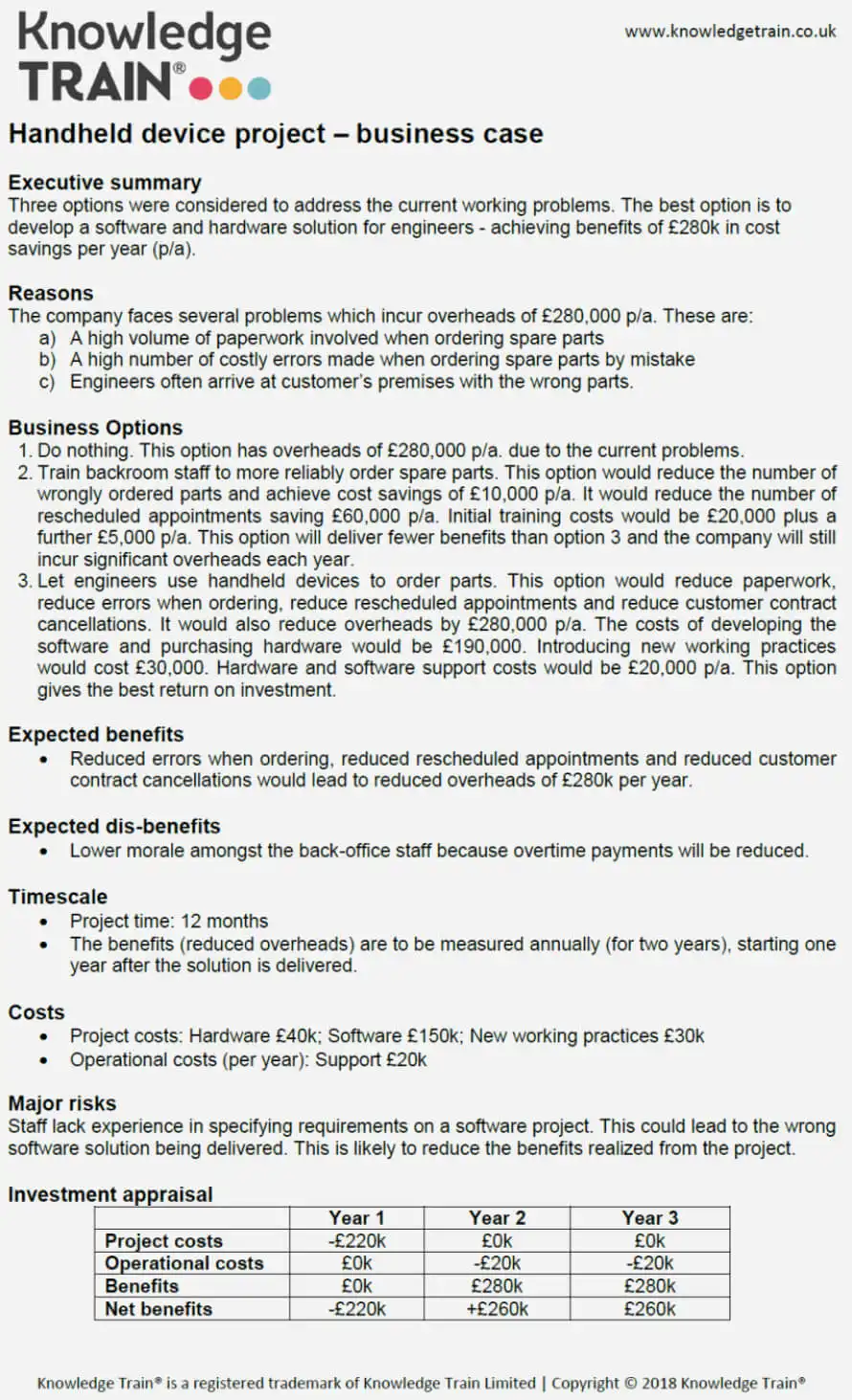
The reasons for the project are clearly spelled out when describing the 3 current problems which the company faces.Shared tools and methodologies
OptionsProject managers and product managers both rely on collaboration and communication platforms such as Slack, Microsoft Teams, or Zoom to facilitate real-time communication and information sharing among team members and stakeholders. These tools allow both types of managers to keep everyone aligned and informed, and to quickly address any issues that may arise.
In this example, there are 2 options (other than do nothing) which have been examined. Each option is summarized and the reason why option 3 is the preferred option has been stated.Data analysis and reporting tools such as Tableau or Power BI are also valuable for both project managers and product managers. These tools allow managers to analyse performance metrics, create visualisations, and generate reports for stakeholders. They help both types of managers to make data-driven decisions and to demonstrate the impact of their work.
BenefitsBy leveraging the appropriate tools and methodologies, both project and product managers can enhance their effectiveness, improve team collaboration, and drive successful outcomes in their respective domains.
The expected benefits of reduced overheads are clearly stated. Benefits should be measurable and quantifiable. That means that the benefits can be measured later. But what about the reduced errors, rescheduled appointments and customer contract cancellations? Aren’t they benefits?Enhance your skills with our expert-led courses
Well, these are in fact something else – they’re called outcomes. Outcomes are the results of the changes which come about by using the new handheld devices. The ways you measure the improvements resulting from these outcomes are known as benefits.
Dis-benefits
This example also contains a dis-benefit which is that the back-office staff morale will be lower due to reduced overtime payments. A dis-benefit, if you’re wondering, is a negative consequence of a project. It’s not the same as a risk which implies something uncertain. A dis-benefit is something which you know will happen because of the project and it has negative consequences for the organisation. It’s the opposite of a benefit!
TimescalesInstructor-led
Just as we saw in the previous example, the business case contains 2 timescales – the project timescales (i.e. the time it will take to complete the project) and the benefits realization timescales (i.e. the time over which benefits are expected to be realized).Introduction to Project Management course
Costs
Again, there are 2 costs – project costs and the ongoing operational costs over the benefits realization timescale. When the decision is taken whether to invest in this project, the total costs (i.e. project costs and ongoing operational costs) are weighed against the expected benefits over the same time period.£499 +vat
Risks
One major risk has been identified in this example, but on your project, there could be many risks.See all dates
Investment appraisal
The final section is the investment appraisal. The investment technique used in this example is called net benefits. As you can see from the table, the project and operational costs are recorded for each year of the investment.
The project lasts 1 year which is why the project costs are zero after year 1. Of course, the benefits won’t be realized until the solution is in place and the company starts to use the handheld devices.
The net benefits are simply the total benefits minus the total costs. This shows that the company will start to get a return on its investment sometime towards the end of year 2. This knowledge is vital if the decision-makers are to take a sensible decision about whether to invest in the project.Instructor-led
Business case templateProject Management Essentials
This simple business case template£999 +vat is free to download.
SummarySee all dates
A business case is the most important document on any project. That’s because it justifies the investment.Career paths and progression
It helps an organisation be clear about why a project is needed, and what the results of the investment will be. This is crucial because no organisation has unlimited funds to spend on an unlimited number of projects. Therefore, a business case gives confidence to senior managers when deciding to invest in one project rather than another.Project management career trajectory
However, as you have seen in this article, a business case is something which you can find useful when taking major decisions in your own personal life. Remember – a business case doesn’t need to be a lengthy document. It could easily be a few notes scribbled on the back of something or even sent in an email.Project management
Whatever form your business case takes, remember one thing – it will help you or your organisation take sensible decisions about committing time and resources to a project or activity. careers
Remember, if you want to learn more about developing a business case, and learn many of the techniques useful for assessing business problems, consider attending a classroom often start with entry-level positions like project coordinator or project assistant. In these roles, individuals could learn the basics of project execution and team coordination. As they gain experience, project managers can progress to managing more complex and high-stakes projects.business analyst courseSenior project managers are responsible for overseeing multiple projects or programs and may also take on mentoring roles for junior team members. Career advancement opportunities include roles such as portfolio manager or director of .project management
Business case FAQsSet up clear communication channels and regular meetings
Who approves a business case?Explicitly define roles and responsibilities to prevent overlap or gaps
Usually on a project, the project sponsor (the person or people who are committing the funds) will approve a business case. Before approving it, they need to have confidence that the problems have been addressed and the right solution has been selected, that the benefits are achievable and realistic, when the investment will pay off, and how big will the return on investment be.Create shared documentation for product requirements and
What makes a good business case?project plans
As you have seen in this article, there’s several important bits of information which goes into a business case. Don’t spend unnecessary time though adding information which isn’t required. Your project sponsor will have to read your business case before they approve it, and you don’t want to make their job any harder than it already is!Cultivate a culture of respect and appreciation for the value each role brings.
There are several things you can use to check whether your business case is adequate or not. Here’s a checklist of 13 questions to ask yourself before you submit your business case to your sponsor for approval:By following these guidelines, organisations can harness the strengths of both roles and work together toward successful product outcomes.
- Are the reasons for the project consistent with the corporate, Measuring success: Metrics and KPIsportfolioProject management success metrics or Project managersprogramme management often define success using a mix of quantitative and qualitative metrics: strategies?On-time delivery
- Is the : This is a critical measure, indicating whether a project meets its milestones and deadlines. It can often be linked to efficient planning and project planrisk management aligned with the business case? (e.g. are the costs and timescales in the project plan correctly reflected in the business case?).
- Are the benefits clearly identified and justified?Budget adherence
- Is it clear how the benefits will be realized?: Staying within the pre-planned budget is a common KPI for
- Is it clearly defined what will judged a successful outcome?project managers
- Is the preferred business option clearly stated, along with the reasons why?. It reflects efficient resource allocation and the ability to handle unforeseen expenses. Deviations from the budget should be minimal and justified.
- If the project requires external procurement, is the preferred sourcing option stated, and why?Stakeholder satisfaction
- Is it clearly stated how any necessary funding will be obtained?: This is a more qualitative metric but is just as important. It includes the satisfaction of team members, clients, and any other stakeholders. High levels of satisfaction can often be a sign of well-executed project management and communication.
- Does the business case include non-financial, as well as financial criteria?Product management success metrics
- Does the business case include operations and maintenance costs and risks?Product managers
- Does the business case include project costs and risks?, on the other hand, often use different metrics to measure success:
- Does the business case conform to organisational accounting standards (e.g. break-even analysis and cash-flow conventions)?User adoption and engagement
- Are the major risks faced by the project explicitly stated, together with any proposed responses?: These metrics help understand how well a product is meeting customer needs and how often it’s being used. They can include daily active users, feature usage, or time spent on the product.
How do you write a good business case?Revenue and market share
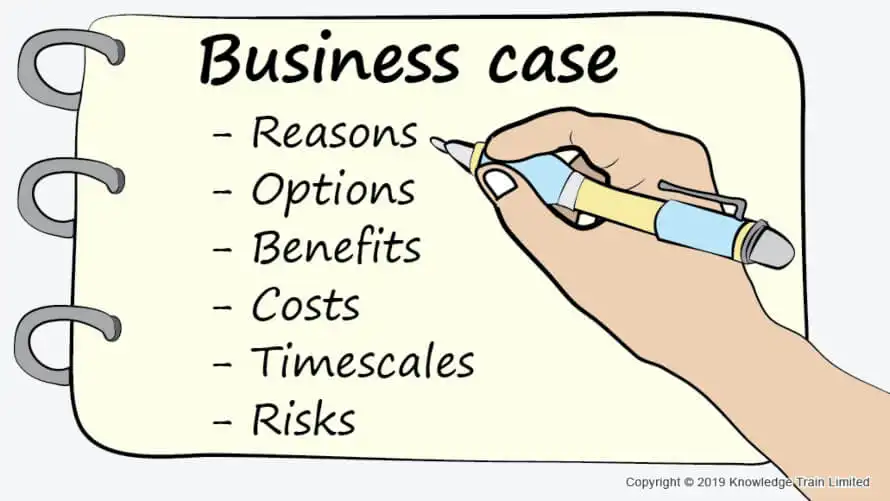
A good business case must contain certain key information including:: For a product manager, these are key indicators of a product’s commercial success. They show the product’s financial contribution and its position in the market relative to competitors. Growth in these areas can indicate a successful product strategy and a good market fit.
- The reasons for doing the project;Customer satisfaction and retention
- The business options which have been considered, including the base business options of do nothing, so something, or do something else;: These metrics offer insights into a product’s long-term viability. Measures like Net Promoter Score (NPS) or churn rate fall into this category. High satisfaction and retention rates suggest that the product continues to meet users’ needs over time.
- Project and operational costs;In conclusion, while there are some overlaps, project and product managers often focus on different success metrics that are specific to their roles and responsibilities.
- Project and operational timescales;Enhance your skills with our expert-led courses
- Benefits, expressed in measurable terms;
- Investment appraisal (or cost benefit analysis);
- Major risks and their mitigation plans;
How long is a business case?Instructor-led
A good business should be long enough that it contains all the information needed for the decision-makers to take an informed decision about whether to invest in the project. That means, remove any waffle, and only include information which helps decision-making.Introduction to Project Management course
What’s included in a business case?
The following are the most important items to put into a business case:£499 +vat
- Executive summary – summarizes the key points;
- The reasons for the project (answers the question ‘Why are we doing this?’);See all dates
- The options considered – e.g. do nothing, do something, or do something else – (answers the question ‘What’s the best option?’);
- The expected benefits – in measurable terms – (answers the question ‘What’s the return?’);
- Costs – both project and operational – (answers the question ‘How much will it cost?’);
- Timescales – for the project and for realizing benefits – (answers the question ‘How long will it take?’);Instructor-led
- Investment appraisal – weigh up costs, times, risks against benefits – (answers the question ‘Is it worth it?’);Project Management Essentials
- Major risks – (answers the question ‘What if?’).See all dates
What is a business case template?Future trends and evolving roles
A business case template serves as a starting point when writing a business case. It is reusable and can be used across all your projects. Depending upon its needs, your organisation may have different business case templates, each one used for different scales of projects.Impact of digital transformation on both roles
You can download an example Digital transformationbusiness case template here is redefining both project and product management roles. Project managers are increasingly adopting .Agile methodologies
What is the purpose of a business case? and remote collaboration tools to manage distributed teams and resources more effectively. On the other hand, product managers are prioritising data-driven decision-making and continuous product iteration based on real-time user feedback.
The purpose of a business case is simple – it’s used to justify an investment in an activity. Typically, in an organisation this activity is a project. It helps give confidence to management that their investment is worthwhile and will realize benefits for the organisation.Emerging technologies and their influence
Who owns a business case?Artificial intelligence
A business case is owned by the person who is funding the project. The name of this role is different across organisations, but commonly this role is known as a project sponsor, or project executive. and
By owning the business case, it means this person is accountable for ensuring that any investment decisions which are taken based upon the information within the business case are worthwhile.machine learning