How to write a business caseOur 6 core values are everything we do. They include:

Key takeaways
A business case helps decision-makers judge whether an investment is worth the time, money and risk.[email protected]
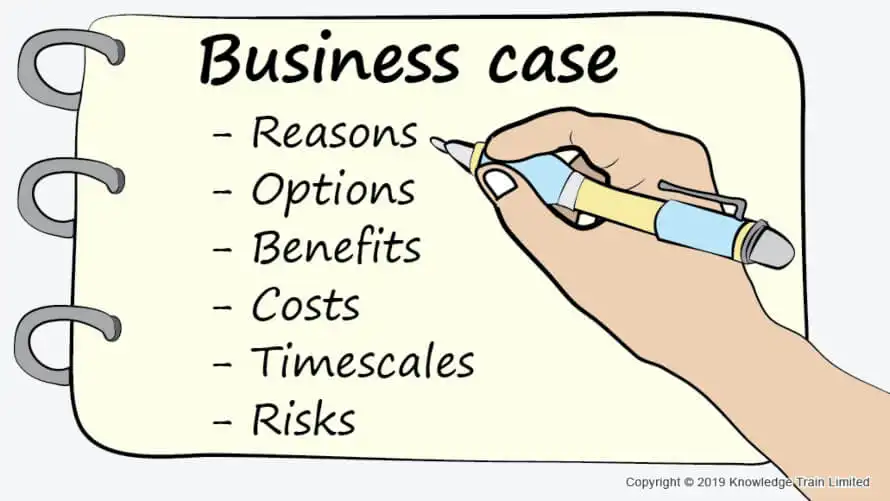
- State the reason for the activity and ensure it aligns with organisational strategy.
- Compare realistic options, including doing nothing, and clearly justify the preferred choice.
- Separate project costs and timescales from ongoing operational costs and benefit realisation timescales.
- Define benefits in measurable terms and distinguish outcomes from benefits so performance can be tracked.
- Include known dis-benefits and major risks, plus mitigations, to avoid one-sided decisions.
Key roles and concepts in Agile projects
For an organisation to decide if an investment is worthwhile, however, there are several different ways in which it can decide about the investment.
Often in organisations there are rules defined to help business analysts or Benefits of Agile project managementproject managers write what’s called an investment appraisal. In the next example, we’ll look at one example known as net benefits.Challenges and limitations
Business case example 2: Handheld device project
Imagine a heating repair services company that uses a paper-based set of forms filled in by an engineer during site visits. The spare parts required to fix the heater are recorded on a form which is given to staff to process back in the office. They then order the parts, and schedule a follow-up visit for the engineer to fix the heater.Real-world applications and use cases
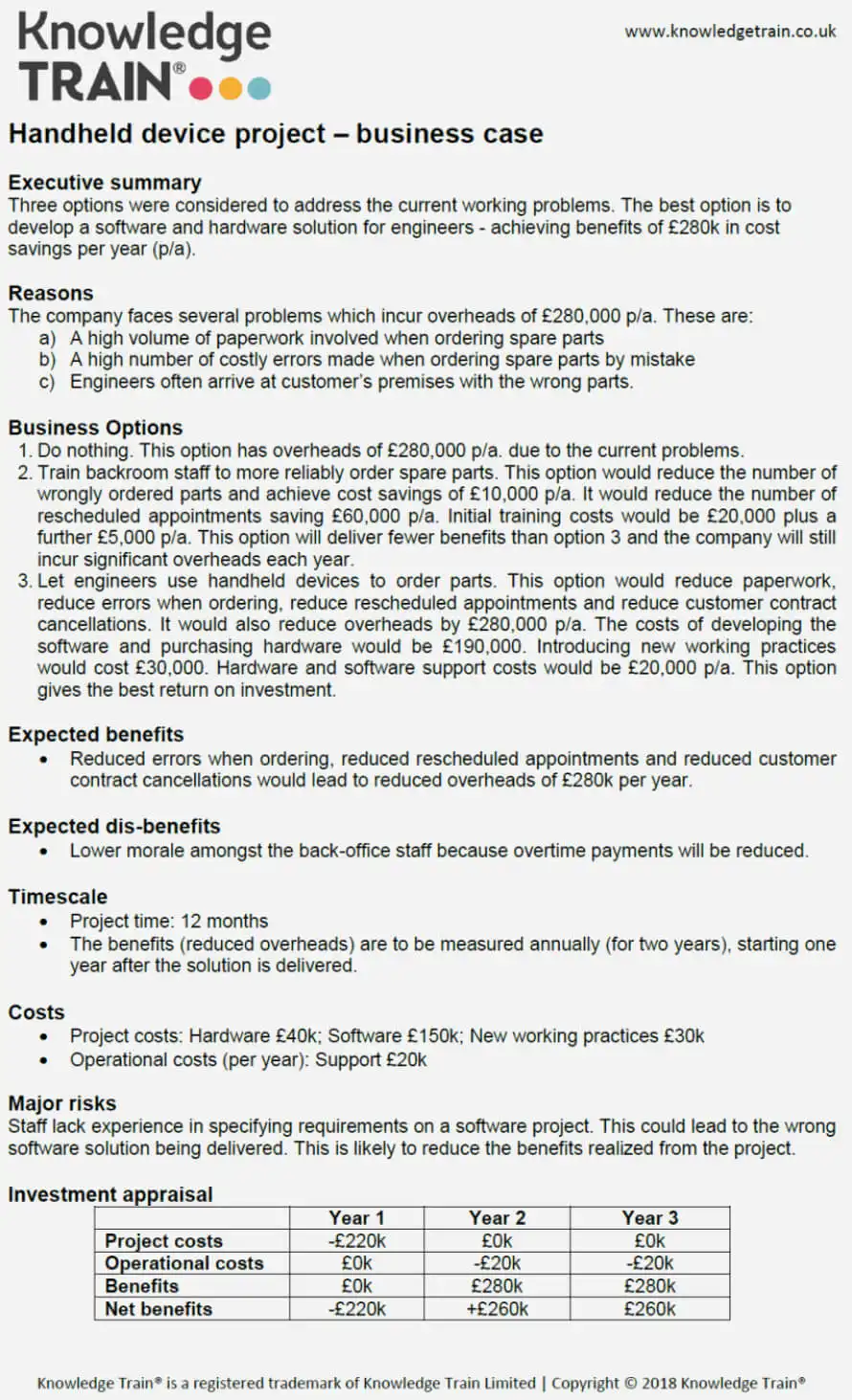
Let’s now look at this example business case.Welcome changing requirements, even late in development
Executive summaryDeliver working products frequently
This sample business case contains an executive summary. This section briefly describes the selected option and the key benefits it will bring.Close, daily cooperation between business people and developers
ReasonsBuild
The reasons for the project are clearly spelled out when describing the 3 current problems which the company faces.projects
Options around motivated individuals
In this example, there are 2 options (other than do nothing) which have been examined. Each option is summarized and the reason why option 3 is the preferred option has been stated.Face-to-face conversation as the best form of communication
BenefitsWorking product as the primary measure of progress
The expected benefits of reduced overheads are clearly stated. Benefits should be measurable and quantifiable. That means that the benefits can be measured later. But what about the reduced errors, rescheduled appointments and customer contract cancellations? Aren’t they benefits?Sustainable development pace
Well, these are in fact something else – they’re called outcomes. Outcomes are the results of the changes which come about by using the new handheld devices. The ways you measure the improvements resulting from these outcomes are known as benefits.Continuous attention to technical excellence and good design
Dis-benefitsSimplicity – the art of maximising the amount of work not done – is essential
This example also contains a dis-benefit which is that the back-office staff morale will be lower due to reduced overtime payments. A dis-benefit, if you’re wondering, is a negative consequence of a project. It’s not the same as a risk which implies something uncertain. A dis-benefit is something which you know will happen because of the project and it has negative consequences for the organisation. It’s the opposite of a benefit!Self-organising teams produce the best results
TimescalesRegular reflections for continuous improvement
Just as we saw in the previous example, the business case contains 2 timescales – the project timescales (i.e. the time it will take to complete the project) and the benefits realization timescales (i.e. the time over which benefits are expected to be realized).Key Agile frameworks and methodologies
CostsAgile
Again, there are 2 costs – project costs and the ongoing operational costs over the benefits realization timescale. When the decision is taken whether to invest in this project, the total costs (i.e. project costs and ongoing operational costs) are weighed against the expected benefits over the same time period. encompasses various frameworks, each with its own practices and terminology. The most widely used Agile frameworks were designed for more efficient product delivery, rather than
Risksproject management
One major risk has been identified in this example, but on your project, there could be many risks.. They include
Investment appraisalScrum
The final section is the investment appraisal. The investment technique used in this example is called net benefits. As you can see from the table, the project and operational costs are recorded for each year of the investment., Kanban, Lean, and Extreme Programming (XP):
The project lasts 1 year which is why the project costs are zero after year 1. Of course, the benefits won’t be realized until the solution is in place and the company starts to use the handheld devices.Scrum
The net benefits are simply the total benefits minus the total costs. This shows that the company will start to get a return on its investment sometime towards the end of year 2. This knowledge is vital if the decision-makers are to take a sensible decision about whether to invest in the project.Main focus:
Business case template Team roles, time-boxed sprints, and iterative delivery
This simple Core roles:business case template Product Owner, is free to download.Scrum Master
Summary, Team Members
A business case is the most important document on any project. That’s because it justifies the investment.Artefacts:
It helps an organisation be clear about why a project is needed, and what the results of the investment will be. This is crucial because no organisation has unlimited funds to spend on an unlimited number of projects. Therefore, a business case gives confidence to senior managers when deciding to invest in one project rather than another. Product backlog, sprint backlog
However, as you have seen in this article, a business case is something which you can find useful when taking major decisions in your own personal life. Remember – a business case doesn’t need to be a lengthy document. It could easily be a few notes scribbled on the back of something or even sent in an email.Key events:
Whatever form your business case takes, remember one thing – it will help you or your organisation take sensible decisions about committing time and resources to a project or activity. Sprint planning, daily scrum, sprint review, sprint retrospectives
Remember, if you want to learn more about developing a business case, and learn many of the techniques useful for assessing business problems, consider attending a classroom Advantages:business analyst course Well-defined structure, clear accountability, transparency.Kanban
Business case FAQsFramework
Who approves a business case?Main focus
Usually on a project, the project sponsor (the person or people who are committing the funds) will approve a business case. Before approving it, they need to have confidence that the problems have been addressed and the right solution has been selected, that the benefits are achievable and realistic, when the investment will pay off, and how big will the return on investment be.Key practice
What makes a good business case?Team structure
As you have seen in this article, there’s several important bits of information which goes into a business case. Don’t spend unnecessary time though adding information which isn’t required. Your project sponsor will have to read your business case before they approve it, and you don’t want to make their job any harder than it already is!Best use case
There are several things you can use to check whether your business case is adequate or not. Here’s a checklist of 13 questions to ask yourself before you submit your business case to your sponsor for approval:Scrum
- Are the reasons for the project consistent with the corporate, Time-boxed iterations (Sprints)portfolioPredefined roles and events or Cross-functionalprogramme managementComplex projects needing structure
- Customer InvolvementThe reasons for the project (answers the question ‘Why are we doing this?’);
- The options considered – e.g. do nothing, do something, or do something else – (answers the question ‘What’s the best option?’);Continuous collaboration
- The expected benefits – in measurable terms – (answers the question ‘What’s the return?’);Primarily at start/end
- Costs – both project and operational – (answers the question ‘How much will it cost?’);
utive.Scrum Master
By owning the business case, it means this person is accountable for ensuring that any investment decisions which are taken based upon the information within the business case are worthwhile.: