
Introduction
This article explains how to write a business case. It includes 2 business case examples and a free business case template for you to Lewin's model vs other theoriesdownload .Influence tactics and work outcomes
You’re probably reading this article because you want to know how to write a business case. Perhaps your organisation is embarking on a major project to develop a new product. Or, perhaps you’re thinking of moving house so your family can enjoy a better life. In either case, you write a business caseConclusion to ensure the investment is worthwhile.
In this article we’ll give you 2 business case examples, provide you with a simple business case template for you to use, and explain how to write a business case.FAQs
What is a business case?, and
A business case is the justification for some activity (e.g. a project) undertaken by your organisation. It weighs up the timescales, costs and risks of doing the activity against the benefits to be gained. Think of it as weighing up the pros and cons and then taking a sensible decision.refreezing
A business case forms an essential component of the curriculum of the . Each stage addresses specific aspects of change management, providing a comprehensive roadmap for organisations aiming to navigate transitions effectively.best project management coursesHistorically, Lewin developed this model in 1947, a period marked by an increased focus on scientific approaches to psychology. His model remains relevant today due to its simplicity and emphasis on the psychological aspects of change, such as reducing resistance and promoting acceptance. In an era where change is constant, Lewin’s model offers a structured yet flexible approach, allowing organisations to adapt and thrive..Unfreezing
Personal business caseThe
You may also use a business case to justify an investment you make in your personal life. For example, when you’re thinking of moving home to another area. You and your spouse will need to understand the costs of moving, the timescales and risks involved, and weigh these up against the benefits to be gained e.g. saving time traveling to your office, or your children able to go to a better school.unfreezing
Why have a business case? stage is critical in preparing an organisation for change. It involves creating awareness about the necessity for transformation and challenging existing norms and behaviours. The primary goal is to reduce resistance by showing the benefits of change and the drawbacks of maintaining the status quo. This stage often involves:
Projects should not just start on a whim or because of vanity – although a lot of money has been wasted over the years on such Communicationprojects: Open and transparent communication helps employees understand the reasons for change. It reduces uncertainty and anxiety, fostering a supportive environment where individuals are more willing to let go of old habits..Leadership engagement
For business organisations, justification for a project usually takes a commercial form i.e. evaluating how much money could be made from the investment. For example, investing money in developing a new software app to bring first to market, might be deemed to bring certain monetary benefits (in terms of sales) which exceeds the costs of investment.: Leaders play a crucial role in modelling desired behaviours and attitudes. Their involvement is essential in building trust and commitment to the change process.
For government organisations, justification is probably not a commercial one, but could be based upon giving value for money to achieve certain benefits. For example, a public health campaign extolling the benefits of flu-vaccinations for elderly people, might be judged as giving greater value for money than having no campaign, and instead relying on treating patients in hospital once they have contracted the virus.Stakeholder involvement
With so many competing claims being made on scarce funds, organisations need the assurance that the decision they are taking is the right one. After all, there will not be enough funds to pay for all the ideas for projects which are floating around the organisation.: Engaging key stakeholders early in the process ensures that their concerns are addressed, and their insights are incorporated into the change strategy. This involvement can lead to more innovative solutions and greater buy-in.
Who uses a business case?Psychologically, unfreezing helps individuals and groups prepare for change by breaking down existing mindsets and fostering a readiness to embrace new ideas. By addressing the emotional aspects of change, organisations can create a foundation for successful transformation.
Business cases can be used by many different levels of management within an organisation. Not only are they used to justify the investment in an individual project, but also they are typically used by a Changingportfolio managementThe office to help it decide which projects will contribute to the organisation’s strategic goals. That way, they can filter out the bad ideas for projects, and only fund projects which will contribute to strategic goals.changing
A business case is also often used by a project sponsor or project executive to help it decide if they should invest in a specific project. stage represents the transition from old behaviours to new practices. It is the phase where the actual change occurs, requiring careful planning and execution. This stage focuses on:
In all cases, the business case must be written and approved prior to any major commitment of resources.Implementation
What form does a business case take?: Introducing new processes, technologies, or structures requires clear guidance and support. Training programmes and resources should be made available to facilitate learning and adaptation.
Business cases can take many forms – digital or analogue. The tools you use to create one are also many and varied. Common business tools such as Microsoft Office might be used. Rather than being a document or slide deck however, it could equally be in the form of an email.Support systems
Equally, a business case could be written by hand on a whiteboard or flipchart, or on the back of a cigarette packet!: Providing support through mentoring or coaching can help employees navigate the challenges of change. It ensures that they have the necessary skills and confidence to adopt new ways of working.
What you should always remember is that a business case does not have to be a huge long document. In fact, it should be as short as possible, and only include the most important information. That way it cuts out the noise and provides decision-makers with just the right information to enable them to take sensible decisions.Feedback mechanisms
For those of you interested in : Regular feedback allows for continuous improvement and adjustment. It helps identify areas of resistance or difficulty, enabling timely interventions to keep the change process on track.project managementDuring the changing stage, the emphasis is on enabling individuals to adopt new behaviours and integrate them into their daily routines. By focusing on both structural and human elements, organisations can ensure that change is effective and sustainable., the project management methodology known as RefreezingPRINCE2The focuses its decision-making on a project on having a viable business case.refreezing
Business case examples stage is the final step, where new changes are solidified and integrated into the organisational culture. It ensures that the changes become permanent and prevents regression to old practices. Key aspects of refreezing include:
We will now give you 2 business case examples. The first example is one which you might find useful for taking decisions in your personal life. The 2nd business case example is more business focused project.Reinforcement
Business case example 1: Moving home: Recognising and rewarding employees who successfully adapt to change reinforces desired behaviours. It encourages others to follow suit and helps embed new norms.
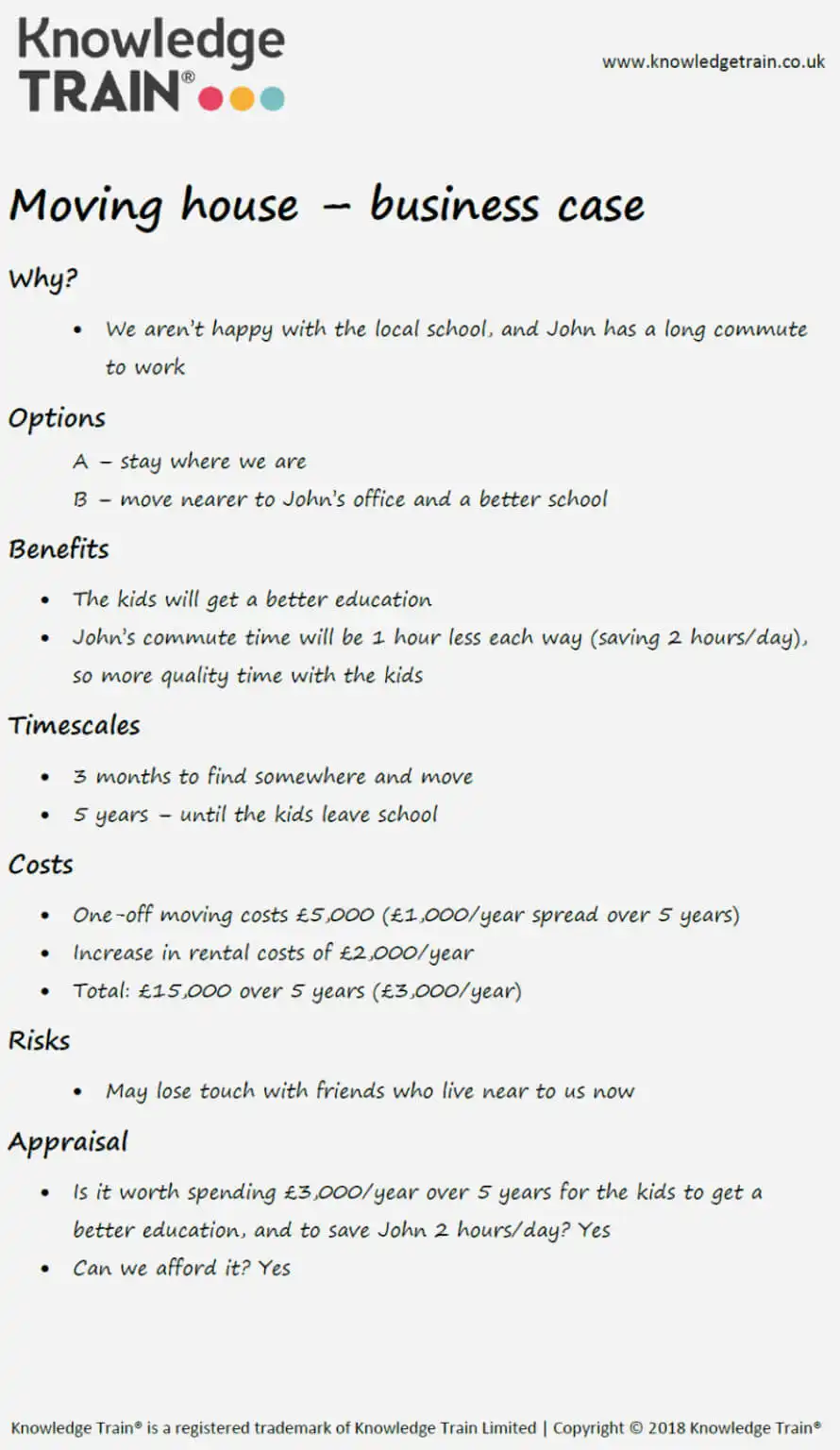
Suppose you and your spouse are considering moving to a new home. You will need to weigh up the pros and cons of moving. This is done using a business case. You might not call it that, but that’s what it is. Let’s look at an example.Policy and procedure alignment
Reason: Updating policies and procedures to reflect new practices ensures consistency and clarity. It provides a framework for maintaining changes over time.
As you can see from the example, the first thing to be clear about in a business case is the reason for doing the project or activity. In this example, the couple has answered the question Cultural integrationWhy?: Embedding changes into the organisational culture requires ongoing effort and commitment. It involves aligning values, beliefs, and behaviours with the new direction. In fact, there are two problems here – the local school and John’s long commute.Refreezing is crucial for sustaining change, as it creates stability and reduces the likelihood of reverting to previous habits. By reinforcing new behaviours and aligning them with organisational goals, change becomes an integral part of the organisation’s identity.
Options consideredIn conclusion, Lewin’s change model offers a structured approach to managing organisational change, addressing both the psychological and practical aspects of transformation. Its enduring relevance lies in its ability to guide organisations through the complexities of change, ensuring successful and lasting outcomes.
A business case should weigh up the competing options which have been considered. After all, there is usually more than one option. Perhaps an alternative option would have been for John to change his job to one nearer their current house. However, this wouldn’t solve the issue with the school.Enhance your skills with our expert-led courses
Benefits
The benefits of a project or activity are the positive things you’re going to get back in return for your investment of time and money. In this case, the kids will get a better education, and John will save time each day.
Timescales
It’s also important to understand how long the investment of resources will take. This is so that the organisation (or family in this case) knows when the resources will be freed up to work on other Instructor-ledprojectsChange Management Practitioner (with Foundation) course or activities.
There are usually 2 timescales to consider. First, the timescale of the project or activity – in this case 3 months to find a new house and move there. Second, the time over which the benefits shall be realized. In this case it’s 5 years until the kids leave school.£1,699 +vat
Costs
The costs of doing the project or activity is the next important bit of information. On this project, the costs of moving to a new house will be £5,000. These are the project costs.See all dates
Let’s now look at this example business case. phase,
Executive summaryagile methodologies
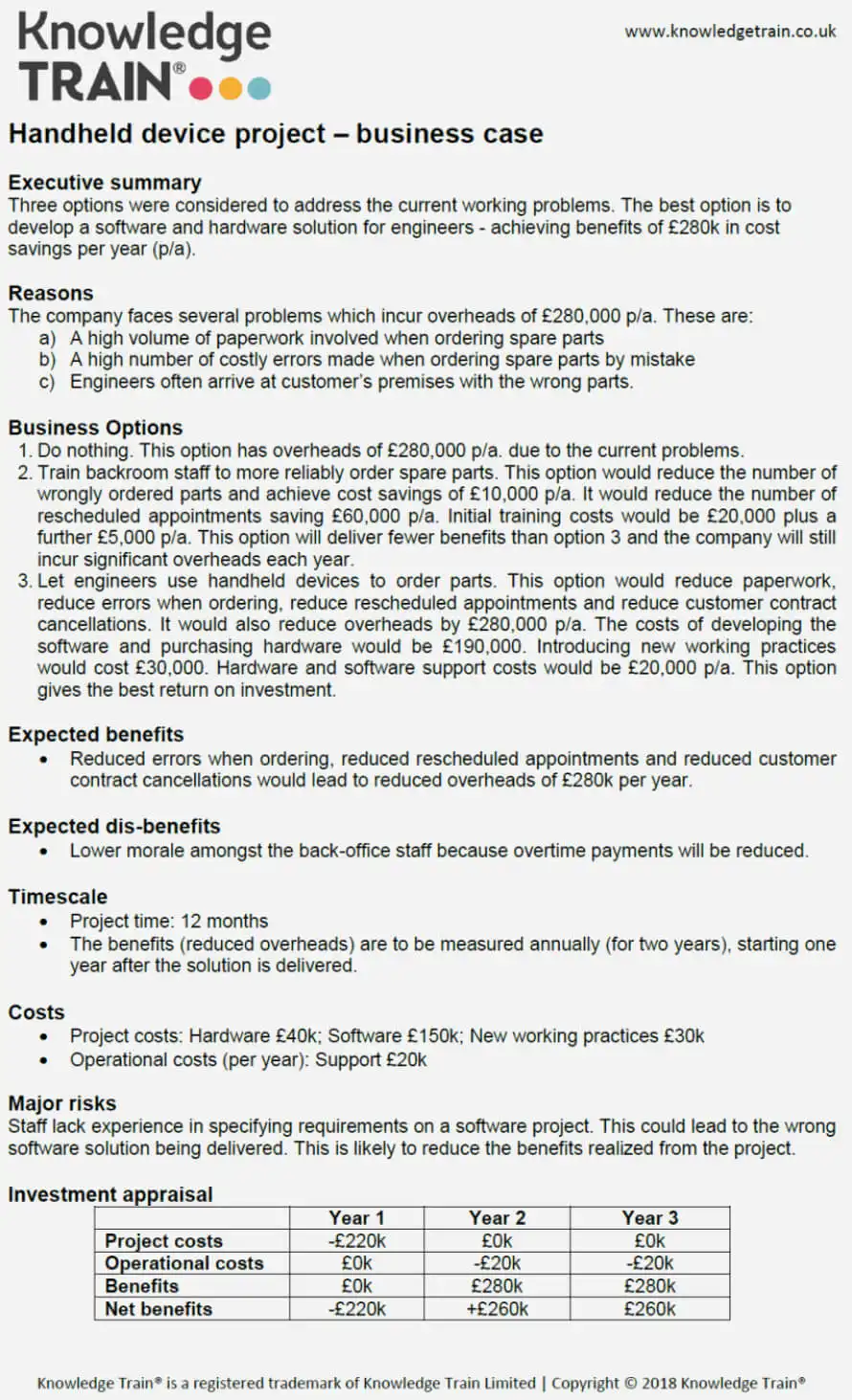
This sample business case contains an executive summary. This section briefly describes the selected option and the key benefits it will bring. were introduced through training programmes, supported by mentors to ease the transition. The
Reasonsrefreezing
The reasons for the project are clearly spelled out when describing the 3 current problems which the company faces. stage involved integrating these practices into the company culture, reinforced by regular feedback sessions.
OptionsOutcome
In this example, there are 2 options (other than do nothing) which have been examined. Each option is summarized and the reason why option 3 is the preferred option has been stated.: The move resulted in improved project delivery times and enhanced team collaboration.
Benefits
The expected benefits of reduced overheads are clearly stated. Benefits should be measurable and quantifiable. That means that the benefits can be measured later. But what about the reduced errors, rescheduled appointments and customer contract cancellations? Aren’t they benefits?
Well, these are in fact something else – they’re called outcomes. Outcomes are the results of the changes which come about by using the new handheld devices. The ways you measure the improvements resulting from these outcomes are known as benefits.Lesson
Dis-benefits: Clear communication and support systems are crucial for overcoming resistance.
This example also contains a dis-benefit which is that the back-office staff morale will be lower due to reduced overtime payments. A dis-benefit, if you’re wondering, is a negative consequence of a project. It’s not the same as a risk which implies something uncertain. A dis-benefit is something which you know will happen because of the project and it has negative consequences for the organisation. It’s the opposite of a benefit!Example 2: Implementation in healthcare
TimescalesA hospital implemented Lewin’s model to transition from paper-based to electronic medical records. The
Just as we saw in the previous example, the business case contains 2 timescales – the project timescales (i.e. the time it will take to complete the project) and the benefits realization timescales (i.e. the time over which benefits are expected to be realized).unfreezing
Costs phase involved addressing staff concerns through information sessions. During the
Again, there are 2 costs – project costs and the ongoing operational costs over the benefits realization timescale. When the decision is taken whether to invest in this project, the total costs (i.e. project costs and ongoing operational costs) are weighed against the expected benefits over the same time period.changing
Risks
One major risk has been identified in this example, but on your project, there could be many risks. stage, training sessions were conducted to familiarise staff with the new system. The
Investment appraisalrefreezing
The final section is the investment appraisal. The investment technique used in this example is called net benefits. As you can see from the table, the project and operational costs are recorded for each year of the investment. stage ensured the new process was standard practice, with ongoing technical support provided.
The project lasts 1 year which is why the project costs are zero after year 1. Of course, the benefits won’t be realized until the solution is in place and the company starts to use the handheld devices.Outcome
The net benefits are simply the total benefits minus the total costs. This shows that the company will start to get a return on its investment sometime towards the end of year 2. This knowledge is vital if the decision-makers are to take a sensible decision about whether to invest in the project.: This change increased efficiency and accuracy in patient record management.
Business case FAQs, and
Who approves a business case?Reinforcement
Usually on a project, the project sponsor (the person or people who are committing the funds) will approve a business case. Before approving it, they need to have confidence that the problems have been addressed and the right solution has been selected, that the benefits are achievable and realistic, when the investment will pay off, and how big will the return on investment be.. It is beneficial for understanding and managing personal impacts during organisational changes.
What makes a good business case?Lewin’s model is preferred when a concise and psychologically grounded approach is needed. It is particularly effective in scenarios where resistance to change is prominent, and fostering a supportive environment is crucial. However, in complex or large-scale organisational transformations, Kotter’s detailed steps or ADKAR’s individual focus might offer additional advantages.
As you have seen in this article, there’s several important bits of information which goes into a business case. Don’t spend unnecessary time though adding information which isn’t required. Your project sponsor will have to read your business case before they approve it, and you don’t want to make their job any harder than it already is!Ultimately, the choice of model depends on the organisational context and the specific challenges faced. Integrating elements from different frameworks can often provide a more comprehensive strategy, catering to both structural and human elements of change.
There are several things you can use to check whether your business case is adequate or not. Here’s a checklist of 13 questions to ask yourself before you submit your business case to your sponsor for approval:Enhance your skills with our expert-led courses
- Are the reasons for the project consistent with the corporate, portfolio or programme managementInstructor-led strategies?Change Management Practitioner (with Foundation) course
- Is the project plan£1,699 +vat aligned with the business case? (e.g. are the costs and timescales in the project plan correctly reflected in the business case?)
- Are the benefits clearly identified and justified?See all dates
- Is it clear how the benefits will be realized?
- Is it clearly defined what will judged a successful outcome?
- Is the preferred business option clearly stated, along with the reasons why?
- If the project requires external procurement, is the preferred sourcing option stated, and why?Self-paced
- Is it clearly stated how any necessary funding will be obtained?Change Management Practitioner (with Foundation) self-paced online
- Does the business case include non-financial, as well as financial criteria?
- Does the business case include operations and maintenance costs and risks?£1,299 +vat
- Does the business case include project costs and risks?
- Does the business case conform to organisational accounting standards (e.g. break-even analysis and cash-flow conventions)?
- Are the major risks faced by the project explicitly stated, together with any proposed responses?
How do you write a good business case?Self-paced
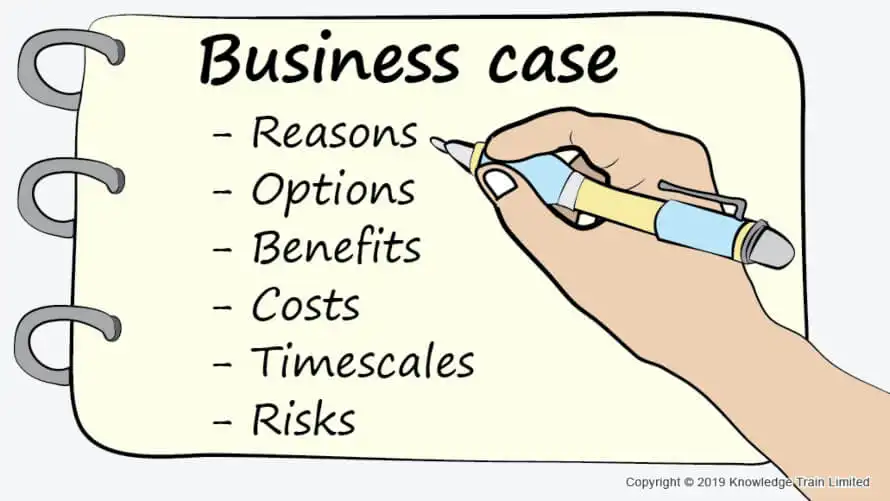
A good business case must contain certain key information including:Change Management Foundation self-paced online
- The reasons for doing the project;
- The business options which have been considered, including the base business options of do nothing, so something, or do something else;£799 +vat
- Project and operational costs;Influence tactics and work outcomes in change management
- Project and operational timescales;The success of
- Benefits, expressed in measurable terms;change management
- Investment appraisal (or cost benefit analysis); efforts is significantly influenced by the tactics employed to guide and motivate individuals within an organisation. Effective
- Major risks and their mitigation plans;influence tactics
How long is a business case? are essential for ensuring that changes are not only implemented but also sustained over time. These tactics include clear communication, employee involvement, and positive reinforcement, all of which contribute to a supportive environment for change.
A good business should be long enough that it contains all the information needed for the decision-makers to take an informed decision about whether to invest in the project. That means, remove any waffle, and only include information which helps decision-making.Research on work outcomes in relation to change efforts highlights the importance of these tactics. The analysis reveals that successful change initiatives often involve:
What’s included in a business case?Effective communication
The following are the most important items to put into a business case:: Keeping communication channels open and transparent helps align employees with the change objectives. It reduces uncertainty and stress, fostering an environment where employees feel informed and valued.
- Executive summary – summarizes the key points;Employee involvement
- The reasons for the project (answers the question ‘Why are we doing this?’);: Actively involving employees in the change process enhances their commitment and ownership. It empowers them to contribute ideas and feedback, which can lead to more innovative solutions and smoother transitions.
- The options considered – e.g. do nothing, do something, or do something else – (answers the question ‘What’s the best option?’);Positive reinforcement
- The expected benefits – in measurable terms – (answers the question ‘What’s the return?’);: Recognising and rewarding employees who adapt well to change encourages continued compliance and motivation. This reinforcement helps embed new behaviours and norms into the organisational culture.
- Costs – both project and operational – (answers the question ‘How much will it cost?’);Furthermore, the psychological benefits of these tactics, such as stress reduction and enhanced acceptance, cannot be overstated. By addressing the human aspect of change, organisations can mitigate resistance and build resilience among their workforce.
- Timescales – for the project and for realizing benefits – (answers the question ‘How long will it take?’);Ultimately, the strategic use of influence tactics in
- Investment appraisal – weigh up costs, times, risks against benefits – (answers the question ‘Is it worth it?’);change management
- Major risks – (answers the question ‘What if?’). not only improves individual work outcomes but also contributes to the overall success of the organisation. By fostering an inclusive and supportive atmosphere, businesses can ensure that change is not just a temporary adjustment but a lasting transformation.
What is a business case template?Conclusion
A business case template serves as a starting point when writing a business case. It is reusable and can be used across all your projects. Depending upon its needs, your organisation may have different business case templates, each one used for different scales of projects.In this article, we explored
You can download an example Lewin’s change modelbusiness case template here, a foundational framework for implementing .organisational change
What is the purpose of a business case?. The model’s three stages – unfreezing, changing, and refreezing – provide a structured approach that emphasises the psychological aspects of change, such as stress reduction and enhanced acceptance. We discussed its real-world applications across corporate settings, healthcare, and educational institutions, highlighting its adaptability and effectiveness. While Lewin’s model offers simplicity and clarity, it is essential to acknowledge its limitations, especially in dynamic environments requiring more iterative approaches. Comparing it with other frameworks like Kotter’s 8-Step Process and
The purpose of a business case is simple – it’s used to justify an investment in an activity. Typically, in an organisation this activity is a project. It helps give confidence to management that their investment is worthwhile and will realize benefits for the organisation.ADKAR