What is the Association for Project Management (APM)?19 Feb 2026

Gantt charts
The Association for Project Management (APM) is the chartered professional body for project management in the United Kingdom. In practice, it works to improve how projects, programmes, and portfolios are delivered by providing a recognised are one of the most widely used and recognised project management techniques. They provide a visual timeline for the project and can display the relationships and dependencies between different tasks or activities. Gantt charts have a long history, with their use dating back to the early 1900s when they were popularised by Henry Gantt, a mechanical engineer and management consultant. In recent years, Gantt charts have transitioned from physical, hand-drawn charts to digital project management tools.qualifications frameworkA Gantt chart typically consists of a horizontal bar chart with the project tasks listed on the vertical axis on the left side and the time periods spread across the top. The project tasks are then represented by horizontal bars spanning the time periods in which they are scheduled to be performed. The length of the bar indicates the duration of each task. This format allows , professional standards, and membership pathways for aproject managers
and team members to:project managerClearly visualise the project timeline and the duration of each task and wider delivery roles.Identify dependencies and relationships between tasks
APM’s activities commonly relate to:Track progress against the planned schedule
- Professional membershipAllocate resources to tasks and recognition, including progression through membership grades.Communicate the project timelines to stakeholders.
- Qualifications and certificationSome modern Gantt chart software provides additional features such as colour-coding of tasks, milestone markers, and linking of dependent tasks. Some tools also allow for resource allocation and workload management directly from the Gantt view. that assess knowledge and professional competence.Gantt charts are most useful when you want to provide an overview of the entire project. However, for large and complex projects, they may become cluttered and difficult to read. Despite this, Gantt charts remain a popular tool for project managers because of their intuitive design and ability to communicate complex scheduling information quickly and clearly.
- CPDProject network diagrams expectations and learning resources to support ongoing capability.Project Network Diagrams
- Guidance on , as the name implies, are graphical representations of a project’s tasks and their relationships, showing how the project activities are sequenced and interrelated. These diagrams provide a visual depiction of the project flow and are commonly used in project management methodologies that include Critical Path Method (CPM) and Program Evaluation and Review Technique (PERT).project governanceNetwork diagrams typically use nodes to represent tasks or activities and arrows to indicate dependencies between these tasks. They allow for a clear visualisation of task sequences and can help project managers identify potential bottlenecks or critical paths in the , ethics, and good practice.project schedule
- Community building through events, interest networks, and publications..
APM qualifications and certificationsKey takeaways
APM qualifications are designed to support learning and professional development across different career stages, from introductory project management to more advanced competence assessment. The best starting point depends on your experience, theVisual representation of task dependencies
Identify critical path and potential schedule risksproject management methodologyFacilitate resource allocation and schedule optimisation. used in your organisation (for example PRINCE2 environments), and whether you need knowledge validation or professional recognition.Quick tips
APM Project Fundamentals Qualification (PFQ)Begin with a clear list of all project tasks and their dependencies.
- PurposeUse software tools for easy creation and updating of network diagrams.: Introductory certification covering key concepts, language, and foundational knowledge in project management.Regularly review and update the diagram as the project progresses.
- Who it is forUtilise color-coding to highlight critical paths or high-risk activities.: Beginners, new starters, and people who work with projects (including stakeholders) but are not yet project managers.Common pitfalls
- PrerequisitesOverlooking important task dependencies.: None.Creating overly complex diagrams that are difficult to understand.
- FormatFailing to update the diagram as project scope or timelines change.: Typically a short course plus a multiple choice exam.Neglecting to consider resource constraints when analysing the network.
- OutcomesBy learning project network diagrams, managers can enhance their ability to plan, schedule, and control complex projects effectively.: Enhance your skills with our expert-led coursesAPM PFQ provides a baseline understanding of planning, roles, risk, and communication, supporting progression to more advanced study.
APM Project Management Qualification (PMQ)
- PurposeSelf-paced: Knowledge based certification aligned to the APM Body of Knowledge and common delivery practices.APM PFQ blended online
- Who it is for : Practitioners who contribute to projects, including aspiring or current project managers.£749 +vat
- Prerequisites : No formal prerequisite, but some experience or prior study helps.
- Format : Assessed by a written exam.
Provides a visual overview of project schedules is a reference framework that describes key concepts, functions, and areas of knowledge used in project based work. It is used by learners, practitioners, trainers, and employers to build a shared language and improve capability across delivery roles.
It supports the profession by helping to:Highlights tasks that have the most significant impact on project duration
- Standardise terminology across teams and organisations.Helps optimise resource allocation
- Inform learning pathways and a qualifications framework.Enables “what-if” scenario analysis.
- Provide a common basis for improving governance and decision making.To effectively apply CPM, project managers often use specialised software that can handle complex calculations and visualise schedules. These tools can also integrate with other techniques like Gantt charts and resource levelling.
High level knowledge areas commonly associated with the APM Body of Knowledge include:While CPM is well-suited for projects with well-defined tasks and dependencies, it may be less effective for projects with high levels of uncertainty or frequent changes. In such cases, it’s often used in conjunction with other techniques, such as PERT or
- Governance and organisational context, including Agile methodologiesproject governance, for a more adaptive approach.
- Planning and schedulingPERT (Program Evaluation and Review Technique)
- Risk, issues, and change controlPERT
- Quality management is a project management technique that can be used for
- People, leadership, and teamworkprojects
- Communication and with uncertain or variable task durations. Developed in the 1950s for the U.S. Navy’s Polaris missile program, PERT allows project managers to incorporate probabilistic time estimates into their project schedules.stakeholder managementPERT requires the creation of a network diagram of all project tasks, along with three time estimates for each task:
- Commercial and procurement considerationsOptimistic time (O): The shortest time the task could possibly take.
- Integration across Most likely time (M): The best estimate of how long the task will take, based on available information.programme managementPessimistic time (P): The longest time the task could possibly take, considering all potential issues. and The expected time (E) for each task is then calculated as E = (O + 4M + P) / 6.portfolio managementKey takeaways
MembershipProvides more realistic project timelines by accounting for uncertainties
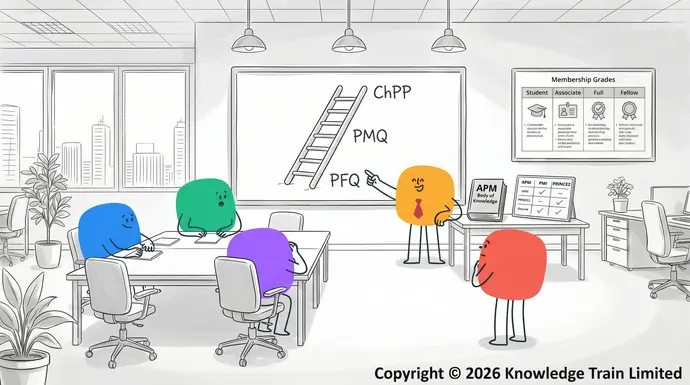
APM membership (professional membership) provides a way to demonstrate commitment to the profession and access support for career development. Membership criteria and naming can change over time, but grades typically align to experience and contribution.Identifies critical paths and potential schedule risks
Typical APM membership gradesHelps in better resource allocation and
- Studentrisk management: For people in education who are building foundational knowledge.Allows probabilistic analysis of project completion times.
- AssociateQuick tips: For early career professionals and those developing competence.Involve experts in estimating task durations to get accurate timeframes
- FullUpdate estimates regularly as new information becomes available: For experienced practitioners who meet defined experience and professionalism requirements.Use PERT in conjunction with CPM for a comprehensive schedule analysis
- FellowLeverage software tools for PERT calculations and visualisations.: Senior recognition for significant contribution and leadership in the profession.Common pitfalls
Common member benefitsOverreliance on extreme (optimistic or pessimistic) estimates
- Access to learning resources that support Neglecting task dependenciesContinuing Professional Development (CPD)Failing to update analysis as the project progresses.Misinterpreting results as definitive rather than probabilistic.
- Professional recognition and use of post nominal designations where applicable.PERT can be time-consuming to apply to large projects, and it may not be necessary for every project. It is most useful when used judiciously, in combination with other techniques, and applied to the most critical or highly uncertain aspects of a project.
- Networking through events, branches, and special interest groups.Kanban boards
is a visual technique to analyse and prioritise stakeholders for your project based on their interest, influence, and impact on the project.
For verifiable organisational facts such as dates, governance updates, and current policies, consult APM’s official publications and register entries where applicable.Key takeaways
SourcesRecognise all potential stakeholders, those who may affect or be affected by the project.
- APM official website: membership, qualifications, chartered information, and publications.Help prioritise stakeholders based on their influence and interest in the project.
- General reference entry for Association for Project Management for high level organisational facts.Facilitate communication planning with stakeholders.
- UK professional standards and governance references where relevant to chartered bodies.Aid in
FAQsrisk management
What does APM stand for in project management? and informed decision making.
In project management, APM most commonly stands for the Association for Project Management, the United Kingdom based professional association for the project profession. Because APM is also used in other industries, it is worth confirming the context, especially in IT where APM can refer to Applications Performance Monitoring.Quick tips
What is the Association for Project Management (APM)?Use a power/interest grid to plot stakeholders.
The Association for Project Management (APM) is the chartered professional body for project management in the United Kingdom. It supports the profession through membership (professional membership), CPD, standards and guidance such as the APM Body of Knowledge, and a qualifications framework that includes certifications like PFQ, PMQ, and Chartered Project Professional.Update the stakeholder map regularly as the project evolves.
What does APM do?Identify both positive and negative stakeholders.
APM advances project management by setting professional expectations, providing training aligned qualifications and certification, supporting CPD, and publishing guidance on topics such as project governance and stakeholder management. It also connects members through events, communities, and resources that help individuals and organisations improve project, programme, and portfolio delivery.Customise communication plans for different stakeholder groups.
Is APM a chartered body?Engage team members in the mapping process for a broader view.
Yes. APM holds chartered status as the professional body for project management in the UK. Chartered status indicates formal recognition of a professional body’s role in promoting standards and competence. For individuals, APM also provides chartered style professional recognition through routes such as Chartered Project Professional (ChPP).Common pitfalls
What qualifications does APM offer?Missing less apparent stakeholders.
APM offers a range of project management qualifications and certifications including the Project Fundamentals Qualification (PFQ) for beginners, the Project Management Qualification (PMQ) for broader knowledge assessment, and Chartered Project Professional (ChPP) for experienced practitioners. These routes align with APM guidance and support development across project, programme, and portfolio roles.Not reassessing stakeholder positions over time.
How do I join APM membership?Ignoring low-power stakeholders.
You typically join by choosing a membership grade that matches your career stage, such as Student, Associate, Full, or Fellow, then applying through the APM website. Requirements can include experience evidence and commitment to CPD for higher grades. Check current criteria directly with APM, as grades and requirements may change.Overlooking the need for individual engagement strategies.
Is APM equivalent to PMI or PMP?Assuming stakeholders’ interests do not change.
APM and the Project Management Institute (PMI) are different professional bodies. PMP (Project Management Professional) is a PMI certification, not an APM qualification. They are not direct equivalents, but both can be valuable depending on your location, employer expectations, and whether you need UK aligned chartered recognition or a widely used global certification route.Project success can be achieved by carefully identifying and communicating with key project stakeholders. The concept of a stakeholder map can be explained as the graphical representation of project stakeholders. The process to be performed for conducting a stakeholder mapping analysis is very crucial for the project success. When starting with a new project, the first phase in stakeholder mapping analysis is to conduct a stakeholder identification process. The stakeholder identification process in a project involves categorising the identified stakeholders based on their impact on the project and their level of influence in the project.
Is APM better than PRINCE2?Enhance your skills with our expert-led courses
APM and PRINCE2 are not like for like. APM is a professional association offering membership, standards, and qualifications, while PRINCE2 is a project management methodology. Many professionals use both: PRINCE2 for method and controls, and APM learning for broader professional knowledge including governance, stakeholder management, and development pathways.
What is the APM Body of Knowledge used for?
The APM Body of Knowledge is used as a reference for learning and consistent practice across the profession. It supports a shared understanding of key topics such as governance, planning, risk, quality, people, and stakeholder management. It is often used by trainers, learners, and employers to structure development and align capability.
Yes. While APM is often associated with project management, its guidance and professional development coverage extends to programme management and portfolio management. This reflects how organisations govern and deliver change at different levels, linking individual projects to strategic objectives through structured governance, benefits focus, and stakeholder engagement.£749 +vat