
Key takeawaysAPM PMQ training
APM is the UK chartered professional body that sets expectations for project delivery and professional development. which takes 5 days, or 35 hours if studying online.
- APM supports better project, programme, and portfolio outcomes through standards, guidance, and a shared professional language.PRINCE2 Practitioner
- PFQ builds fundamentals, PMQ validates broader knowledge, and ChPP recognises assessed competence and judgement in practice.A
- The APM Body of Knowledge helps standardise terminology and strengthens governance, decision making, and capability building.PRINCE2 Practitioner
- Membership grades signal career progression and provide CPD resources, networking, and professional recognition. certification requires that you first hold the PRINCE2 Foundation certificate. The Practitioner certification tests you on your ability to apply PRINCE2 to life-like project scenarios. More particularly, it tests whether you can apply the PRINCE2 principles, practices, and processes to a fictional project scenario.
- APM is different from PRINCE2 and PMI, and many professionals combine routes based on role scope and employer needs.After PRINCE2 Foundation, the PRINCE2 Practitioner certification is probably the top project management certification in the UK.
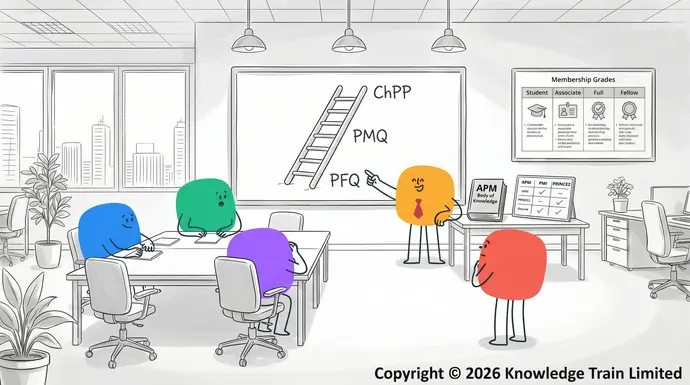
The Association for Project Management (APM) is a United Kingdom based professional association for project management. It supports the profession through membership, qualifications, standards, and guidance such as the APM Body of Knowledge.To gain your PRINCE2 Agile Practitioner certification, the typical learning path is
Not to be confused withPRINCE2 Agile Practitioner training: APM can also mean Applications Performance Monitoring or other industry acronyms. This page is about the which takes 2 days, or 21 hours if studying online. Training can also be combined with the PRINCE2 Agile Foundation. In this case, training takes 4 days, or 33 hours if studying online.Association for Project ManagementAgilePM Practitioner in the UK.AgilePM Practitioner certification requires that you hold an AgilePM Foundation certificate. It is suitable if you want to apply the agile project framework on projects. AgilePM Practitioner is a popular choice for project managers working in an agile context.
| Full nameTo gain your AgilePM Practitioner certification, the typical learning path is | Association for Project ManagementAgilePM Practitioner training |
|---|---|
| Acronym which takes 1 day, or 15 hours if studying online. Training can also be combined with the AgilePM Foundation in which case, it takes 4 days, or 35 hours if studying online. | APM (acronym)CompTIA Project+ |
| Organisation typeCompTIA offers some of the leading IT qualifications in the world. CompTIA Project+ | Professional association (professional body for project management)® |
| Country focuses on managing smaller, less complex projects within the IT industry. This certification tests student’s knowledge of the specific industry tools used for documentation and requirements analysis. | United KingdomThis certification has no prerequisites, but without the recommended 135 hours of IT project development experience, you might find yourself a bit lost. |
| HeadquartersPMI PMP | Buckinghamshire, England (UK)PMI’s |
| MissionProject Management Professional | To advance the discipline of project management and support project professionals and organisations. (PMP) |
| Core services® | Professional membership, qualifications and certification, events and community, publications and guidance, Continuing Professional Development (CPD) certification is the most challenging one on this list. To be eligible for this certification you must have 3 years of project management experience and a 4-year college/university degree. Without a degree you require 5 years of project management experience. In both cases you also need at least 35 hours of project management education completed before the exam. |
| Flagship qualificationsThe PMI PMP | APM Project Fundamentals Qualification (PFQ), APM Project Management Qualification (PMQ), Chartered Project Professional (ChPP)® |
| Membership types exam covers every aspect of project management from your ability to plan projects to monitoring and controlling project tasks. | Student, Associate, Full, Fellow (grade availability and criteria vary)Maintaining your PMI PMP |
| Official website® | https://www.apm.org.uk/ qualification requires you continuously accumulate Professional Development Units (PDUs), which are one-hour blocks of time that you spend learning, teaching others, or volunteering. |
What APM does for project management in the UKIf you want to gain your PMP certificate, a typical learning path is to take
The Association for Project Management (APM) is the chartered professional body for project management in the United Kingdom. In practice, it works to improve how projects, programmes, and portfolios are delivered by providing a recognised PMP trainingqualifications framework which takes 35 hours of online study., professional standards, and membership pathways for aChoose from these project management certifications
project manager and wider delivery roles.
APM’s activities commonly relate to:Self-paced
- Professional membershipAPM PFQ blended online and recognition, including progression through membership grades.
- Qualifications and certification£749 +vat that assess knowledge and professional competence.
- CPD
- Outcomes: Professional recognition that you can apply good practice, leadership, and governance in real delivery contexts.
How APM qualifications relate to PRINCE2 and other methodologies
APM qualifications are generally methodology agnostic and focus on transferable principles and knowledge. PRINCE2 is a project management methodology used widely in the UK and beyond; many organisations use PRINCE2 alongside APM aligned learning. In practice, PRINCE2 may provide a structured method for managing stages and controls, while APM learning may broaden understanding across domains such as governance, stakeholder engagement, risk, and professionalism.
APM Body of Knowledge
The
- Integration across programme managementKnowledge Train and 19 Feb 2026
What does APM do?Find out about the most efficient project management tools for 2025. This comprehensive guide compares the best software solutions and enables you to select the right one to manage your workflow and complete the project on time.
APM advances project management by setting professional expectations, providing training aligned qualifications and certification, supporting CPD, and publishing guidance on topics such as project governance and stakeholder management. It also connects members through events, communities, and resources that help individuals and organisations improve project, programme, and portfolio delivery.
Is APM a chartered body?
Yes. APM holds chartered status as the professional body for project management in the UK. Chartered status indicates formal recognition of a professional body’s role in promoting standards and competence. For individuals, APM also provides chartered style professional recognition through routes such as Chartered Project Professional (ChPP).