What is the Association for Project Management (APM)?Knowledge TrainLean principles

Key takeawaysCapture risks, assumptions, issues, and dependencies in a single RAID log that is reviewed and updated regularly.Key takeaways
APM is the UK chartered professional body that sets expectations for project delivery and professional development.Prioritise items by likelihood and impact so time and budget go to the highest exposure areas.Lean improves outcomes by defining value, removing waste, and building continuous improvement into everyday work.
- APM supports better project, programme, and portfolio outcomes through standards, guidance, and a shared professional language.Turn high-priority RAID items into clear SMART actions with named owners and deadlines.Start by defining value from the customer’s perspective, using research when needs are unclear.
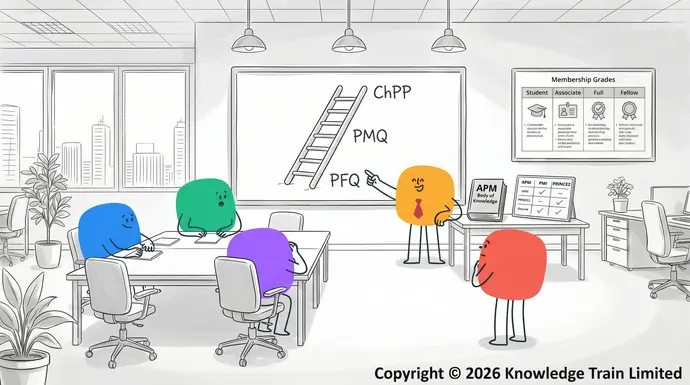
- PFQ builds fundamentals, PMQ validates broader knowledge, and ChPP recognises assessed competence and judgement in practice.Use RAID updates to improve stakeholder confidence through transparent, routine communication.Map the value stream end to end, then remove steps that do not contribute to customer value.
- The APM Body of Knowledge helps standardise terminology and strengthens governance, decision making, and capability building.Keep RAID lightweight for smaller projects to avoid overhead and paralysis by analysis.Improve flow by breaking work into smaller activities and reducing bottlenecks across teams.
- Membership grades signal career progression and provide CPD resources, networking, and professional recognition. Use pull systems to limit work in progress so work starts only when it is needed.
- APM is different from PRINCE2 and PMI, and many professionals combine routes based on role scope and employer needs. Make continuous improvement part of culture through learning, communication, and training.
Key factsIntroduction
The Association for Project Management (APM) is a United Kingdom based professional association for project management. It supports the profession through membership, qualifications, standards, and guidance such as the APM Body of Knowledge.Project management is a complex field that requires careful planning and execution. One of the essential aspects of project management is
Not to be confused withRAID : APM can also mean Applications Performance Monitoring or other industry acronyms. This page is about the , which stands for Self-pacedAssociation for Project ManagementRisksLean Six Sigma Yellow Belt self-paced online in the UK.,
| Full nameAssumptions£499 +vat | Association for Project Management, The 5 Lean Principles |
|---|---|
| AcronymIssuesThe 5 Lean principles we use today have deviated only slightly from their first incarnation used in Lean Manufacturing. Like many | APM (acronym), and agile methods |
| Organisation typeDependencies, the rules that guide Lean are rational, logical, and based on the needs of the people who use them. They are not complex, and this simplicity has given them such longevity so that organisations can still apply them to their work today. | Professional association (professional body for project management). Understanding and implementing When comparing Lean principles with those from the |
| CountryRAIDAgile Manifesto | United Kingdom in your projects can help you anticipate potential risks and challenges, clarify project foundations, and address problems and interdependencies with greater clarity., it’s clear that both emphasise learning and a people-first approach while enabling |
| HeadquartersThe importance of RAID in project management cannot be overstated. By incorporating RAID into your sustainable projects | Buckinghamshire, England (UK)project management practices. The |
| Mission, you can improve your decision-making process, allocate resources more efficiently, and increase transparency within your projects. This approach provides project teams with the tools and techniques necessary to tackle complex projects with more confidence and precision.Agile | To advance the discipline of project management and support project professionals and organisations.In this article, we will explore the components of RAID, discuss how to implement it in your projects, and analyse the benefits and challenges associated with it. We will also examine real-world case studies and consider future trends in the field. Whether you are a seasoned focus on continuous improvement also works well within Lean. |
| Core servicesproject managerThe 5 principles of Lean are: | Professional membership, qualifications and certification, events and community, publications and guidance, Continuing Professional Development (CPD) or new to the industry, this comprehensive guide will equip you with the insights and knowledge you need to apply RAID in your projects for greater success.Define Value |
| Flagship qualifications To generate value, we must first define what | APM Project Fundamentals Qualification (PFQ), APM Project Management Qualification (PMQ), Chartered Project Professional (ChPP)Understanding the RAID framework‘value’ |
| Membership typesThe RAID framework is an essential is. The finer details may differ from project to project, but value is essentially anything a customer is willing to pay for. To maximize the value of a single product, we must take the time to discover our client’s needs. | Student, Associate, Full, Fellow (grade availability and criteria vary)project managementOften, customers will not be able to articulate what they want, or in some cases, they might not know what they want. This is especially common when it comes to software and newer technology. By gathering data through interviews, surveys, and other methods, organisations can help customers find the optimal solution to a problem they are trying to solve. |
| Official website tool that consists of four components: Risks, Assumptions, Issues, and Dependencies. Each component serves a distinct purpose in helping project teams anticipate and mitigate potential challenges that may arise during the project lifecycle. In this section, we will break down each component, discussing their roles, sub-components, and practical tips for effectively managing them in your projects.Only after we have uncovered what value means to our customers can we proceed. | https://www.apm.org.uk/RisksMap the Value Stream |
What APM does for project management in the UKA risk in project management refers to an uncertain event or condition that, if it occurs, has a potential impact on the project’s objectives. It’s important for The second Lean principle is to map the
The Association for Project Management (APM) is the chartered professional body for project management in the United Kingdom. In practice, it works to improve how projects, programmes, and portfolios are delivered by providing a recognised project managers‘value stream’qualifications framework to identify, assess, and prioritise risks to minimise their potential impact on the project’s success. Here are some examples of . This means using the customers’ idea of ‘value’ as an end-goal, then mapping all the processes contributing toward this goal. Anything that does not add value is waste and must be eliminated., professional standards, and membership pathways for aproject risksWaste comes in two forms: Unnecessary and nonvaluable, and nonvaluable but necessary. The former should be limited in its entirety, while the latter should be reduced as much as possible not to draw resources from value-adding activities.
:Accurate mapping of the value stream helps reduce cost, improve the speed of development, and ultimately provide a cost-effective and timely solution to a problem.project managerBudget overrunsThis is doubly important in industries that rely heavily on emergent technologies and software. Slow development due to wasteful processes might render a final product obsolete before being delivered to customers. and wider delivery roles.Scope creepMap the flow
APM’s activities commonly relate to:Resource shortages.Once the value stream has been mapped, we must plan out each step in the development process and ensure that staff can complete each without delays or interruptions.
- Professional membershipAssessing and prioritising risks involve determining the likelihood and impact of each risk on the project’s goals. To achieve this, we can break down large, complex steps into its’ component activities. Production steps can be reconfigured and reordered to prevent bottlenecks. Workloads can be monitored across departments. If necessary, cross-functional teams can be created to share work and duties. and recognition, including progression through membership grades.Project managersStaff can be trained in multiple skills and disciplines to help share work among the entire development team.
- Qualifications and certification can use various prioritisation techniques such as risk matrices, expected monetary value (EMV) analysis, or decision trees to identify which risks require immediate attention and resources.Establish Pull that assess knowledge and professional competence.AssumptionsUnused inventory is one of the biggest wastes in any production system. A pull-based system limits
- CPDAssumptions are statements or beliefs that a project team accepts as true without concrete evidence to support them at the time of making the decision. They play a critical role in work in process expectations and learning resources to support ongoing capability.project planning (WIP), ensuring that products are created only when needed and in the exact quantities required. Pull-based systems are made by following the value stream and working backward through the development cycle.
- Guidance on , as they provide a basis for decision-making and help to highlight areas of uncertainty within a project. Some examples of project assumptions include:In a pull system, the tasks that must be completed are stored in a queue. Developers who are not currently occupied will go to the queue and take the item with the highest priority that they are able to complete.project governanceAvailability of specific resourcesPursue Perfection, ethics, and good practice.Stakeholder supportFollowing the first four principles helps eliminate almost all waste in development. But this 5th step is considered the most important of all.
- Community building through events, interest networks, and publications.Stable market conditions.A large part of Lean is about making the Lean mindset and continuous process improvement a part of organisational culture. For Lean to work as intended, staff must always strive to improve the way they work. Organisations must create an environment of learning, communication, and collaboration that facilitates continuous improvement and the pursuit of perfection.
APM qualifications and certificationsValidating assumptions is an ongoing process that should take place throughout the project lifecycle. Project managers should ensure assumptions are well-documented and reviewed regularly to verify their continued validity.Applying the Lean principles
APM qualifications are designed to support learning and professional development across different career stages, from introductory project management to more advanced competence assessment. The best starting point depends on your experience, theIssuesThe principles detailed above help create a framework that guides the
Issues in project management refer to problems or obstacles that have already occurred and are currently affecting the project’s progress. Identifying and categorising issues early on is crucial for effective issue management and helps in minimising their impact on the project. Some ways to identify and categorise issues include:project management practicesproject management methodologyRegular team meetings and development practices used to create a product or service. used in your organisation (for example PRINCE2 environments), and whether you need knowledge validation or professional recognition.Progress reportsUnderstanding these principles is the first step to the successful implementation of Lean in your organisation. These principles cannot be changed or overlooked. Failure to follow them
APM Project Fundamentals Qualification (PFQ)Stakeholder feedback.will
- PurposeOnce identified, project managers should establish a structured approach for issue resolution, which may include: lead to a failed adoption of Lean!: Introductory certification covering key concepts, language, and foundational knowledge in project management.Clear ownership assignmentLike many other prescriptive frameworks, adequate training is essential if you wish to implement Lean in your organisation. If you’d like to learn more bout how
- Who it is forRoot cause analysisLean Six Sigma: Beginners, new starters, and people who work with projects (including stakeholders) but are not yet project managers.Action plan development. (a closely related variation of Lean) can help you improve productivity and profits, see our
- PrerequisitesLean Six Sigma online courses.
- As always, the finer details may change from industry to industry. For example, the tools you might use to determine customer value will differ depending on the context, the product, and target demographics. Likewise, those necessary but nonvaluable processes that must be completed will vary in size and complexity depending on the project and what must be delivered.The correct approach is to adapt the tools to the process available after due consideration of the situation at hand. Investing in Lean training or training key members of staff in
- change management can help reduce the risk of failure.Enhance your skills with our expert-led courses
- Self-paced
- Lean Six Sigma Yellow Belt self-paced online
- £499 +vatSubscribe to our exclusive offers and promotions
- Subscribe now
- , or portfolio managementInstructor-led .Project Management Essentials
- Prerequisites : Demonstrable experience and evidence of professional practice, typically supported by membership and CPD.£999 +vat
- Format Agile digital marketing: Application with evidence and assessment (process can evolve over time).See all dates
- OutcomesImplementing RAID analysis in projectsSimon Buehring: Professional recognition that you can apply good practice, leadership, and governance in real delivery contexts.RAID analysis is a project management technique used to identify and manage potential risks, assumptions, issues, and dependencies in a project. Effective implementation of RAID analysis can help project teams make informed decisions, mitigate risks, and enhance project success. In this blog, we will explore how to implement RAID analysis in your projects successfully.14 Feb 2025
How APM qualifications relate to PRINCE2 and other methodologiesFive steps guide to conducting a RAID analysis
APM qualifications are generally methodology agnostic and focus on transferable principles and knowledge. 1. Defining project scope and objectivesMarketers can apply Agile techniques to digital campaigns. Learn how these methods streamline workflows and improve results. Read on.PRINCE2Start by defining the project scope and objectives. This will help you focus your RAID analysis on the most relevant elements. is a project management methodology used widely in the UK and beyond; many organisations use PRINCE2 alongside APM aligned learning. In practice, PRINCE2 may provide a structured method for managing stages and controls, while APM learning may broaden understanding across domains such as governance, stakeholder engagement, risk, and professionalism.2. Organising brainstorming sessions
APM Body of KnowledgeBring together your project team to brainstorm potential risks, assumptions, issues, and dependencies.
The Encourage open communication and diverse perspectives to ensure all relevant elements are captured. APM Body of Knowledge3. Categorising and documenting findings is a reference framework that describes key concepts, functions, and areas of knowledge used in project based work. It is used by learners, practitioners, trainers, and employers to build a shared language and improve capability across delivery roles.Use a
It supports the profession by helping to:RAID log
- Standardise terminology across teams and organisations. to record and categorise the elements identified during the brainstorming session. Ensure that each item is properly categorised and described in sufficient detail.The challenges with Agile
- Inform learning pathways and a qualifications framework.4. Prioritising RAID elements
- Provide a common basis for improving governance and decision making.Evaluate the impact and likelihood of each item to determine its priority. Consider using a prioritisation matrix to visualise and rank RAID elements.Simon Buehring
High level knowledge areas commonly associated with the APM Body of Knowledge include:5. Developing action plans19 Feb 2026
- Governance and organisational context, including For high-priority items, develop strategies to address them and assign responsibilities. Ensure that each action plan is specific, measurable, achievable, relevant, and time-bound (SMART). project governanceTools and techniques for RAID analysisLearn about the hurdles of shifting to Agile with insights from a top training provider. Read on for common organizational challenges.
- Planning and schedulingRAID logs and templates
- Risk, issues, and change controlRAID logs are simple tools that can be created using spreadsheets or specialised templates. They provide a structured format for recording and updating RAID elements throughout the project lifecycle.
- Quality managementSoftware solutions for RAID management
- People, leadership, and teamworkMany
- Communication and project management tools stakeholder management offer integrated RAID functionality, which can help streamline the analysis process and facilitate real-time collaboration among team members.
- Commercial and procurement considerationsBest practices for ongoing RAID monitoring
- Integration across Regular review and updatesLean managementprogramme managementSchedule periodic RAID reviews to ensure their continued relevance and accuracy. and Encourage team members to report new RAID items as they are identified to maintain an up-to-date risk profile.Simon Buehringportfolio managementStakeholder communication strategies19 Feb 2026
MembershipShare RAID updates in project status reports and address significant items in stakeholder meetings to ensure alignment and transparency.
APM membership (professional membership) provides a way to demonstrate commitment to the profession and access support for career development. Membership criteria and naming can change over time, but grades typically align to experience and contribution.By following these steps and utilising the appropriate tools and techniques, you can successfully implement RAID analysis in your projects. This will help you make better-informed decisions, mitigate Delve into Lean management, a philosophy of continuous improvement and learning. Read more on how it transforms businesses.
Typical APM membership gradesrisks
- Student, and improve your project success rates. : For people in education who are building foundational knowledge.Benefits of RAID in project management
- AssociateConducting RAID analysis can provide several benefits for : For early career professionals and those developing competence.project managers
- Full and their teams. Here are some of the main advantages of RAID analysis. : For experienced practitioners who meet defined experience and professionalism requirements.Enhanced risk management and mitigation
- FellowRAID analysis helps in anticipating and reducing risks associated with a project. When done regularly and with the participation of the relevant stakeholders, it can:Using Scrum with Agile: Senior recognition for significant contribution and leadership in the profession.Identify potential problems in advance, before they turn into actual risks
Common member benefitsFacilitate the development of effective mitigation plansSimon Buehring
- Access to learning resources that support Reduce the probability and impact of negative events.19 Feb 2026Continuing Professional Development (CPD)Improved decision-making and resource allocation .RAID analysis allows for making data-driven decisions and allocating resources to the most critical areas by:Debate the use of Scrum within traditional Agile frameworks. Discover more about their compatibility by reading on.
- Professional recognition and use of post nominal designations where applicable.Capturing and documenting risks, assumptions, issues, and dependencies in a systematic and accessible way
- Networking through events, branches, and special interest groups.Providing a complete and up-to-date picture of the project status and challenges
- Publications and guidance supporting better project delivery and governance.Enabling timely and informed adjustments to the
- Career support, including frameworks and pathways for project roles.project plans
Chartered status and what it means and strategies.
APM holds Increased project transparency and st chartered status (chartered body) Benefits of Agile methodologies
Simon Buehring
| DSDM principles: A visual guide | ||
| Simon Buehring | 19 Feb 2026 | |
| Learn about DSDM principles through our visual guide and see their response to traditional process flaws. Scroll for more insights. | ||
19 Feb 2026
Becoming a certified Scrum Master is straightforward. Learn about the role and its requirements by reading further.