
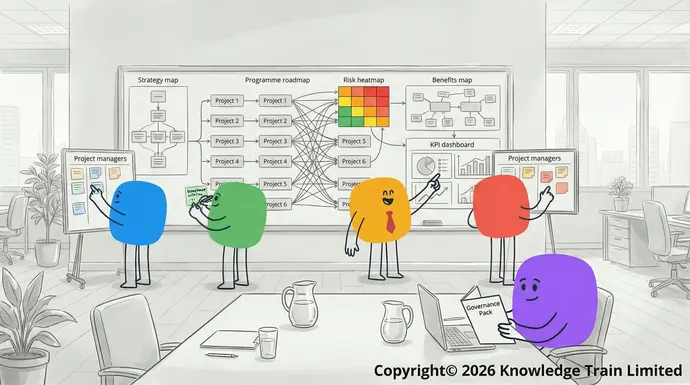
What is programme management?Most
Programme managementIT courses is the coordinated organisation, direction, and oversight of multiple related incorporate a combination of theoretical foundations and hands-on practical skills. Core areas typically covered include:projectsProgramming: and initiatives to achieve strategic goals and realise significant benefits. Leading authorities define it as the application of knowledge, skills, and techniques to meet a programme’s objectives and deliver lasting value aligned with organisational strategy. By linking project outcomes to broader business aims, programme management ensures effective governance, resource allocation, and benefits realisation. Learn to write software using programming languages such as Python, Java or C++.
Programme vs project managementNetworking:
Programme management and Understand how devices connect, communicate and operate within a network environment.project managementDatabases: are closely related but have distinct purposes and approaches: Study data storage, management and retrieval using systems like SQL.
| AspectCybersecurity | Programme management: | Project management Develop skills to protect systems from threats, covering |
|---|---|---|
| Focusrisk management | Strategic objectives; benefits realisation and ethical hacking. | Specific deliverables; outputsSoftware development: |
| Scope Apply methods for designing, coding and maintaining applications. | Coordinating multiple, related Cloud computing:projects Explore hosting and resources delivered over the internet. | One project at a timeData science & artificial intelligence: |
| Time frame Learn techniques for analysing data and developing smart algorithms. | Long-term, ongoingIT project management: | Defined start and end Gain experience in managing technical |
| Manager roleprojects | Programme manager and teams using frameworks like | Project managerAgile |
| Success criteria and | Strategic alignment and realised benefitsScrum | Project scope, time, cost, and quality. |
| MethodologiesTypes of IT courses | MSPIT courses, are available in a wide range of formats to suit different goals and learning preferences. Common types include:PMICertification courses: | PRINCE2 Short-term courses leading to industry , PMI PMBOKcertifications |
- edX Globally recognised, the PMI standard focuses on aligning programme outcomes with organisational strategy, stakeholder engagement, and progressive elaboration of programme benefits.Online (degree, micro-courses)
- PRINCE2University-backed, academic credit options:Universities While primarily for Offline/online (degree, diploma)projectsAccredited qualifications, student support, campus facilities, PRINCE2 techniques are often tailored within a programme context to ensure consistency and effective control across projects.CompTIA/Cisco
- Agile Programme Management:Certification (online/offline) Industry-recognised certificates for networking, support, securityAgile methodsCareer outcomes and IT jobs enable adaptive planning, incremental delivery, and continuous improvement. Agile frameworks are often applied to outcomes-focused, rapidly changing environments.Completing an IT course opens up diverse career paths in the technology sector. Typical job roles include:
Certification is available for each methodology, supporting best practices and professional development for programme managers.IT support specialist:
Programme life cycle Diagnose and resolve users’ technical issues.
The Network administrator:programme life cycle Plan, deploy and maintain computer networks. describes the distinct phases of effective programme management. These typically include:Software developer:
- Programme identification: Create and maintain applications and systems. Assess organisational needs, define objectives, and evaluate strategic alignment.Cybersecurity analyst:
- Programme definition: Protect data and systems from cyber threats. Develop the Cloud solutions architect:business case Design modern cloud-based IT infrastructures., programme charter, and key performance indicators. Identify stakeholders and establish governance structures.Data scientist:
- Programme planning: Extract insights from data using advanced analytical tools. Outline benefits realisation plans, Industry risk managementcertifications strategies, and communication protocols. Define deliverables and allocate resources. such as CompTIA A+, CCNA and cloud credentials are highly valued and often linked to improved salary prospects. Technical skills learned in
- Delivery and execution:IT courses Manage related projects, monitor progress, manage risks and changes, and ensure ongoing stakeholder engagement. are increasingly required in fields like finance, healthcare, education and more. For further details see UK government digital skills guidance and university career services.
- Closure and benefits realisation:Certifications and further development Finalise all activities, conduct post-programme reviews, ensure benefits are realised and sustained, and formally close the programme.Certifications demonstrate expertise in key IT disciplines. Leading certificates include:
Roles and responsibilitiesCompTIA A+, Network+, Security+;
Key responsibilities of a programme managerCisco CCNA, CCNP;
The Microsoft Certified Fundamentals, Solutions Associate;programme managerAWS Certified Cloud Practitioner; is the primary leader, accountable for:Certified Information Systems Security Professional (CISSP).
- Translating organisational strategy into actionable programme objectivesMany learners progress to degree
- Overseeing programmesproject managers after initial certificates, undertaking a Bachelor of Information Technology or a Masters in Information Technology to further their careers. and ensuring FAQsprojectsWhat qualifications do you need for an IT course? remain aligned with programme goalsEntry requirements vary by course level. Introductory courses usually require basic computer skills, while degrees may require A-levels or equivalent. Certification courses generally have no prerequisites.
- Facilitating effective governanceWhat subjects are studied in Information Technology?
- Managing stakeholders and ensuring clear communicationCommon subjects include programming, networking, databases,
- Benefits realisation and ensuring outcomes deliver valuecybersecurity
- Overseeing risk management and change management processes, cloud computing, software development, and data science.
Other key rolesWhich IT course is best for beginners?
- Project managers:Courses in basic computer literacy, CompTIA IT Fundamentals, or introductory programming are suitable for beginners. Online platforms and colleges provide flexible entry-level options. Lead individual projects within the programme, focusing on delivery of specific outputsAre online IT courses recognised by employers?
- Programme board or steering committee:Many online Provides oversight, ensures strategic alignment, and supports decision-makingIT courses
- Stakeholders:, especially those offering certificates from recognised providers (Coursera, edX, CompTIA, Cisco), are valued by employers. Accredited courses and Influence or are affected by programme outcomes, including sponsors, users, and support teamscertifications
Programme management processes are particularly well-regarded.
Programme management encompasses a range of core processes:What careers can I pursue after completing an IT course?
- Establishing a robust Typical roles include IT support, network administration, cybersecurity analyst, software developer, and data scientist. Advanced positions may require additional experience or qualifications.governanceSubscribe to our exclusive offers and promotions framework
- Defining and communicating the Subscribe nowprogramme charter
- Integrating risk management{"@context":"http://schema.org","@type":"WebPage","headline":"What is an IT Course? Core Modules & Benefits","url":"https://www.knowledgetrain.co.uk/it/it-course","significantLink":"https://nationalcareers.service.gov.uk/careers-advice/accessing-free-training-and-courses","about":[{"@type":"Thing","name":"training","sameAs":["http://en.wikipedia.org/wiki/Training","https://www.google.com/search?&kgmid=/m/014jg3","https://www.wikidata.org/wiki/Q918385"]},{"@type":"Thing","name":"IT","sameAs":["http://en.wikipedia.org/wiki/Information_technology","https://www.google.com/search?&kgmid=/m/03ytc","https://www.wikidata.org/wiki/Q11661"]}],"mentions":[{"@type":"Thing","name":"Cisco certifications","sameAs":["https://en.wikipedia.org/wiki/Cisco_certifications","https://www.google.com/search?&kgmid=/m/09vy4j"]},{"@type":"Thing","name":"Cloud computing","sameAs":["https://en.wikipedia.org/wiki/Cloud_computing","https://www.google.com/search?&kgmid=/m/02y_9m3"]},{"@type":"Thing","name":"Agile software development","sameAs":["https://en.wikipedia.org/wiki/Agile_software_development","https://www.google.com/search?&kgmid=/m/02zhbn"]},{"@type":"Thing","name":"Educational technology","sameAs":["https://en.wikipedia.org/wiki/Educational_technology","https://www.google.com/search?&kgmid=/m/067_f8"]},{"@type":"Thing","name":"Database","sameAs":["https://en.wikipedia.org/wiki/Database","https://www.google.com/search?&kgmid=/m/02bc6"]},{"@type":"Thing","name":"Project management","sameAs":["https://en.wikipedia.org/wiki/Project_management","https://www.google.com/search?&kgmid=/m/05_p2"]},{"@type":"Thing","name":"General Data Protection Regulation","sameAs":["https://en.wikipedia.org/wiki/General_Data_Protection_Regulation","https://www.google.com/search?&kgmid=/m/0pk_7xs"]},{"@type":"Thing","name":"Education","sameAs":["https://en.wikipedia.org/wiki/Education","https://www.google.com/search?&kgmid=/m/02jfc"]},{"@type":"Thing","name":"Risk management","sameAs":["https://en.wikipedia.org/wiki/Risk_management","https://www.google.com/search?&kgmid=/m/06k_y"]},{"@type":"Thing","name":"Cisco","sameAs":["https://en.wikipedia.org/wiki/Cisco","https://www.google.com/search?&kgmid=/m/0dmtp"]},{"@type":"Thing","name":"Institute of technology","sameAs":["https://en.wikipedia.org/wiki/Institute_of_technology","https://www.google.com/search?&kgmid=/m/047vtw"]},{"@type":"Thing","name":"Software","sameAs":["https://en.wikipedia.org/wiki/Software","https://www.google.com/search?&kgmid=/m/01mf0"]},{"@type":"Thing","name":"Computer network","sameAs":["https://en.wikipedia.org/wiki/Computer_network","https://www.google.com/search?&kgmid=/m/025szts"]},{"@type":"Thing","name":"Software development","sameAs":["https://en.wikipedia.org/wiki/Software_development","https://www.google.com/search?&kgmid=/m/025sbhf"]},{"@type":"Thing","name":"Security hacker","sameAs":["https://en.wikipedia.org/wiki/Security_hacker","https://www.google.com/search?&kgmid=/m/07gcbt"]},{"@type":"Thing","name":"CompTIA","sameAs":["https://en.wikipedia.org/wiki/CompTIA","https://www.google.com/search?&kgmid=/m/040shq"]},{"@type":"Thing","name":"Scrum (software development)","sameAs":["https://en.wikipedia.org/wiki/Scrum_(software_development)","https://www.google.com/search?&kgmid=/m/0ck_p8"]},{"@type":"Thing","name":"Certified Information Systems Security Professional","sameAs":["https://en.wikipedia.org/wiki/Certified_Information_Systems_Security_Professional","https://www.google.com/search?&kgmid=/m/02kzwy"]},{"@type":"Thing","name":"Java (programming language)","sameAs":["https://en.wikipedia.org/wiki/Java_(programming_language)","https://www.google.com/search?&kgmid=/m/07sbkfb"]},{"@type":"Thing","name":"Credential","sameAs":["https://en.wikipedia.org/wiki/Credential","https://www.google.com/search?&kgmid=/m/06r3t3"]},{"@type":"Thing","name":"Computer data storage","sameAs":["https://en.wikipedia.org/wiki/Computer_data_storage","https://www.google.com/search?&kgmid=/m/01m9s"]},{"@type":"Thing","name":"Certification","sameAs":["https://en.wikipedia.org/wiki/Certification","https://www.google.com/search?&kgmid=/m/011b7yqg"]},{"@type":"Thing","name":"DevOps","sameAs":["https://en.wikipedia.org/wiki/DevOps","https://www.google.com/search?&kgmid=/m/0c3tq11"]},{"@type":"Thing","name":"Security awareness","sameAs":["https://en.wikipedia.org/wiki/Security_awareness","https://www.google.com/search?&kgmid=/m/09bl16"]},{"@type":"Thing","name":"IT service management","sameAs":["https://en.wikipedia.org/wiki/IT_service_management","https://www.google.com/search?&kgmid=/m/049164"]},{"@type":"Thing","name":"CCNA","sameAs":["https://en.wikipedia.org/wiki/CCNA","https://www.google.com/search?&kgmid=/m/04n7mbz"]}]} and change managementRelated articles
- Planning and tracking benefits realisation
- Ensuring strategic alignment throughout the programme
- Managing stakeholder expectations and engagement
- Coordinating project interdependencies and deliverables
Best practices recommend regular reviews, transparent communication, consistent documentation, and adaptive planning.
Programme management benefits
- Improves strategic alignment with organisational goals
- Optimises resource allocationWhat is cyber security? across projects
- Enhanced Simon Buehringgovernance19 Feb 2026 and decision-making
- Streamlined Explore the essentials of cyber security, its importance, and the tools you need for a career in this field. Scroll down to learn more.risk management , ensuring proactive issue resolution
- Maximises benefits realisation and return on investment
- Promotes consistent delivery and outcome measurement
Programme management challenges
- Maintaining clear communication among diverse stakeholdersWhat is ITIL?
- Managing change resistance and ensuring engagementSimon Buehring
- Balancing priorities among competing projects27 Mar 2026
- Integrating risk management across projects and the programme
- Adapting methodologies to organisational culture and needsNew to ITIL? This article explains the framework and certification levels, with a free ebook to get you started. Read on for your complete guide.
These can be overcome by embedding adaptive governance structures, ensuring stakeholder buy-in, and applying risk-informed decision-making.
Best Practices
- Align programme vision with organisational objectives from the outset
- Use established frameworks, such as MSP , PMIWhat is DevOps: Free ebook, and PRINCE2Simon Buehring, as appropriate6 Mar 2026
- Ensure flexible processes to manage change and address complexity
- Continuously monitor and evaluate benefits realisationDiscover the rise of DevOps in 2018 and its increasing demand in the job market. Download the free ebook for a comprehensive guide.
- Invest in professional development, such as certifications for programme managers
Programme management example
An example of programme management in the public sector is the delivery of a national digital health initiative. Here, multiple IT , training, and policy projects are coordinated to improve patient care, achieve compliance, and realise lasting healthcare benefits, with programme managers ensuring strategic alignment, stakeholder collaboration, and robust governance throughout the life cycle.
FAQs5 reasons to study ITIL Foundation online
What is the main purpose of programme management?
The main purpose of programme management is to align multiple related projects with organisational strategy, deliver integrated benefits, and achieve strategic objectives through coordinated planning, governance, and oversight.Simon Buehring
How does a programme manager’s role differ from a project manager’s?27 Mar 2026
Programme managers focus on strategic alignment, benefits realisation, and oversight of several related projects. Project managersDiscover why studying ITIL Foundation online is efficient and effective. Read this article for insights on online learning advantages. are responsible for the delivery of specific project outputs within set constraints.
Which methodologies are used in programme management?
Common methodologies include Managing Successful Programmes (MSP), the PMI Standard for Program Management, PRINCE2 , and Agile-based approaches, each offering guidance on governance, process, and benefit realisation.
What are the main benefits of effective programme management?Cyber Security Awareness in Organisations
The main benefits include improved strategic alignment, optimised resource usage, enhanced risk and change managementSimon Buehring, clearer accountability, and successful delivery of expected benefits.19 Feb 2026
How does portfolio management relate to programme management?
Portfolio managementCyber security awareness encompasses not only knowledge but also the crucial attitudes and behaviours needed to safeguard information assets. Read on to enhance your strategies and secure your data effectively. is the practice of selecting and prioritising programmes and projects based on organisational goals. Programme management is focused on the coordinated delivery and realisation of benefits for selected programmes within the wider portfolio.