
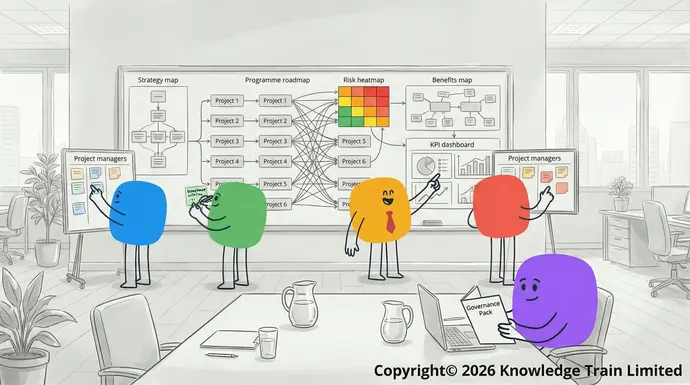
What is programme management?
Programme managementHow to get CAPM certified is the coordinated organisation, direction, and oversight of multiple related projects and initiatives to achieve strategic goals and realise significant benefits. Leading authorities define it as the application of knowledge, skills, and techniques to meet a programme’s objectives and deliver lasting value aligned with organisational strategy. By linking project outcomes to broader business aims, programme management ensures effective governance, resource allocation, and benefits realisation.Exam format and domains
Programme vs project management
Programme management and CAPM cost breakdownproject management are closely related but have distinct purposes and approaches:Study plan
| Aspect | Programme managementCAPM vs PMP vs PRINCE2 | Project management |
|---|---|---|
| FocusOfficial links | Strategic objectives; benefits realisation | Specific deliverables; outputsFAQs |
| ScopeQuick facts | Coordinating multiple, related ItemprojectsCAPM quick answer | One project at a timeIssuer |
| Time frameProject Management Institute (PMI) | Long-term, ongoingFull name | Defined start and endCertified Associate in Project Management (CAPM) |
| Manager roleWho it is for | Programme managerEntry level and early career project management roles (for example, project coordinator, PMO analyst, associate project manager) | Project managerExam length |
| Success criteria3 hours (per PMI) | Strategic alignment and realised benefitsNumber of questions | Project scope, time, cost, and quality150 (per PMI) |
| MethodologiesKey domains | MSPDomains are defined in the |
- Project coordinator Manage related projects, monitor progress, manage risks and changes, and ensure ongoing stakeholder engagement.Junior project manager
- Closure and benefits realisation:PMO analyst or PMO administrator Finalise all activities, conduct post-programme reviews, ensure benefits are realised and sustained, and formally close the programme.Associate project manager
Roles and responsibilitiesProject assistant or delivery support
Key responsibilities of a programme managerTypical outcomes
The include improved shared language, more confidence with project artefacts, and credibility when applying for entry level roles that request exposure to PMI aligned practices.programme managerCAPM eligibility requirements is the primary leader, accountable for:PMI publishes the definitive CAPM eligibility criteria. Use PMI’s
- Translating organisational strategy into actionable programme objectivesCAPM page
- Overseeing as your primary source and apply exactly as stated there.project managersEligibility checklist and ensuring Education prerequisite:projects Meet PMI’s stated minimum education requirement for CAPM (confirm the exact wording on PMI’s CAPM page). remain aligned with programme goalsProject management training hours:
- Facilitating effective governance Complete the required number of hours of project management education/training as specified by PMI.
- Managing stakeholders and ensuring clear communicationAgreement to policies:
- Benefits realisation and ensuring outcomes deliver value Accept PMI’s certification and exam policies during the PMI application (certification application).
- Overseeing risk management and change management processesDocumentation readiness:
Other key roles Be prepared to provide training details and to comply with any audit requests.
- Project managers:Note: Lead individual projects within the programme, focusing on delivery of specific outputs Eligibility rules can change. Always rely on PMI’s current published requirements before you pay or book.
- Programme board or steering committee:How to get CAPM certified Provides oversight, ensures strategic alignment, and supports decision-makingConfirm eligibility
- Stakeholders:: Read PMI’s current CAPM requirements and confirm your education and training hours meet the criteria. Influence or are affected by programme outcomes, including sponsors, users, and support teamsCreate a PMI account
Programme management processes: Set up or sign in to your account on the PMI website.
Programme management encompasses a range of core processes:Submit your PMI application (certification application)
- Establishing a robust : Enter your personal details, education, and project management training.governancePay the fee framework: Pay the CAPM exam fee (PMI membership is optional but can change pricing).
- Defining and communicating the Schedule the examprogramme charter: Book via PMI’s instructions and take the exam through
- Integrating Pearson VUE (exam delivery/testing)risk management at a test centre or as an and online proctored examchange management where available.
- Planning and tracking Preparebenefits realisation: Study the CAPM ECO domains and revise PMBOK Guide aligned concepts, then practise with timed questions.
- Ensuring Take the examstrategic alignment: Follow test day rules for ID and online proctoring setup if relevant. throughout the programmeReceive results and digital credential
- Managing stakeholder expectations and engagement: View your result per PMI’s process and access your digital badge if issued.
- Coordinating project interdependencies and deliverablesExam format and domains
Best practicesThe CAPM exam blueprint is governed by the recommend regular reviews, transparent communication, consistent documentation, and adaptive planning.CAPM Exam Content Outline (ECO)
Programme management benefits. Exam delivery is handled via
- Improves Pearson VUEstrategic alignment according to PMI policy. with organisational goalsSee:
- Optimises resource allocationPMI CAPM certification across projectsPMI CAPM exam preparation and ECO access
- Enhanced Pearson VUE PMI programme pagegovernanceWhat you need to know and decision-makingDetails (verify with PMI)
- Streamlined Domains and topic coveragerisk managementDefined by the , ensuring proactive issue resolutionCAPM ECO
- Maximises . Expect a mix of project management fundamentals, the project lifecycle, predictive (waterfall) methodologies, agile project management, and business analysis fundamentals, plus key practices such as risk management, schedule management, cost management, stakeholder management, and quality management.benefits realisationApproximate weighting and return on investmentPMI publishes domain weightings in the CAPM ECO. Use the latest ECO to avoid outdated percentages.
- Promotes consistent delivery and outcome measurementQuestion types
Programme management challengesComputer based exam questions as defined by PMI for the current CAPM exam. Check PMI for item types and any updates.
- Maintaining clear communication among diverse stakeholdersTime limit
- Managing change3 hours (PMI published exam duration). resistance and ensuring engagementNumber of questions
- Balancing priorities among competing projects150 (PMI published).
- Integrating risk management across projects and the programmeDelivery options
- Adapting methodologies to organisational culture and needsPearson VUE test centre or online proctored exam (availability depends on location and PMI rules).
These can be overcome by embedding adaptive governance structures, ensuring stakeholder buy-in, and applying risk-informed decision-making.Policies (ID, breaks, rules)
Best PracticesCAPM exam fee
- Align programme vision with organisational objectives from the outsetDifferent member vs non member pricing
- Use established frameworks, such as Check current fees on PMI (pricing varies by membership status).MSPRetake fee (if applicable), Set by PMIPMIRetake rules and fees are defined by PMI policy for the current exam cycle., and Training coursePRINCE2Varies widely by provider and format, as appropriateExpect a range based on live vs online, tutor support, and included practice exams. Ensure the course counts towards PMI’s required training hours.
- Ensure flexible processes to manage change and address complexityStudy plan
- Continuously monitor and evaluate benefits realisationUse the
- Invest in professional development, such as CAPM Exam Content Outline (ECO)certifications as your study map, then reinforce with for programme managersPMBOK Guide
Programme management example aligned learning. The plans below assume you will practise timed questions and regularly revisit weak areas such as risk management, schedule management, cost management, quality management, and stakeholder management.
An example of programme management in the public sector is the delivery of a national digital health initiative. Here, multiple Fast track plan (2 to 6 weeks)ITWeek 1, training, and policy projects are coordinated to improve patient care, achieve compliance, and realise lasting healthcare benefits, with programme managers ensuring strategic alignment, stakeholder collaboration, and robust governance throughout the life cycle.: Read the ECO end to end. Build notes on project lifecycle, roles, and key documents. Start light practice questions.
FAQsWeek 2
What is the main purpose of programme management?: Predictive (waterfall) methodologies focus: schedule management, cost management, quality management. Do 2 timed practice sets.
The main purpose of programme management is to align multiple related projects with organisational strategy, deliver integrated benefits, and achieve strategic objectives through coordinated planning, governance, and oversight.Week 3
How does a programme manager’s role differ from a project manager’s?: Agile project management focus: agile roles, planning cadence, and delivery concepts. Add stakeholder management scenarios.
Programme managers focus on strategic alignment, benefits realisation, and oversight of several related projects. Week 4Project managers: Business analysis fundamentals: requirements, traceability, and change control linkages. Add risk management and issue handling questions. are responsible for the delivery of specific project outputs within set constraints.Week 5
Which methodologies are used in programme management?: Mixed review by ECO domains. Take 1 full mock exam under time pressure and analyse errors.
Common methodologies include Week 6Managing Successful Programmes: Final revision: formulae and terminology refresh, targeted drills for weak topics, then one final timed set 48 to 72 hours before exam day. (MSP), the PMI Standard for Program Management, Steady plan (8 to 12 weeks)PRINCE2Weeks 1 to 2, and Agile-based approaches, each offering guidance on governance, process, and benefit realisation.: Foundations. Learn project management fundamentals and the project lifecycle. Create a glossary and flashcards.
What are the main benefits of effective programme management?Weeks 3 to 4
The main benefits include improved strategic alignment, optimised resource usage, enhanced risk and : Predictive focus. Deepen schedule management and cost management, then quality management and stakeholder management. Weekly quiz and review log.change managementWeeks 5 to 6, clearer accountability, and successful delivery of expected benefits.: Risk management and communications related scenarios. Build a one page summary per ECO domain.
How does portfolio management relate to programme management?Weeks 7 to 8
Portfolio management: Agile project management. Compare agile vs predictive (waterfall) approaches and practise situational questions. is the practice of selecting and prioritising Weeks 9 to 10programmes: Business analysis fundamentals. Requirements concepts, validation, and change impacts. Add mixed domain practice sets. and projects based on organisational goals. Programme management is focused on the coordinated delivery and realisation of benefits for selected programmes within the wider portfolio.Weeks 11 to 12