
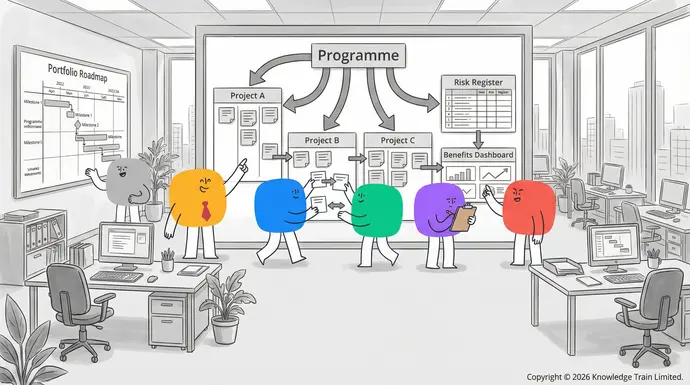
Differences between programmes and projectsBy looking at a collection of projects, programme management can identify, mitigate, and manage risks that might not be visible at the individual project level.: Larger and more complex projects are simplified when broken into a set of smaller, well-defined tasks.
Table showing the differences between programmes and projects.Enhanced stakeholder engagementResource optimisation
| ProjectsProvides a structured framework for consistent and effective communication with all stakeholders, fostering trust and collaboration.: It allows managers to evaluate if the allocated time and budget were spent properly, which can be used to drive resource optimisation in future projects. | ProgrammesManagement of interdependenciesBetter communication | |
| Purpose and objectivesEnables efficient handling of dependencies between projects, ensuring that the progress or outcome of one project doesn’t adversely impact another.: The regular meetings mandated by the chosen frameworks make for better communication of information to the team members. | Deliver specific, outputs within a set time and cost.Improved decision-makingBy using these three components, organisations can ensure that their | Achieve a broader set of strategic outcomes by managing a group of interrelated projects.Offers a holistic view of all projects, leading to better-informed decisions based on comprehensive data and insights.project management processes |
| Scope and timeframeBenefits realization are effective, efficient and appropriate for their needs. | Have a defined scope and timescale.Goes beyond just completing Popular project management frameworks | Have a broader scope, comprising multiple related projects. Their timescale continues until all the desired outcomes are achieved.projectsTraditional frameworks |
| Management approach on time and budget, focusing on achieving the desired outcomes and ensuring that the anticipated benefits are realized and sustained.Waterfall | Focuses on the delivery of specific outputs, Increased flexibilityDefinition and key characteristicsmanaging risksProvides a framework that can adapt to changes in the business environment or organizational strategy, ensuring projects remain relevant and aligned.Waterfall, issues, quality, and stakeholders.Consistency and standardization is a sequential project management framework that progresses through a series of phases, such as requirements, design, implementation, verification, and maintenance. In the waterfall framework, each phase must be completed before the next one can begin, and testing is performed at the end of the project. | Focuses on coordinating multiple related projects to achieve a common outcome. Also focuses on managing project interdependencies and realizing benefits.By adopting a standardized approach, organizations can ensure consistency in the delivery and quality of projects across the board.Pros and cons |
Benefits of programmesContinuous improvementPros: Easy to understand, well documented
There are multiple benefits to an organization if it manages its change initiatives as programmes.Facilitates a culture of learning and improvement by regularly reviewing performance, capturing Cons: Inflexible, difficult to change requirements, testing is performed too late.
Strategic alignmentlessons learnedBest use cases
Programme management, and implementing best practices across all projects.Waterfall can be used for software development ensures that all projects within a programme align with the broader organizational goals, ensuring resources are channelled towards initiatives that match the strategic vision.Value for moneyprojects
Optimized resource allocationEnsures that investments in individual projects culminate in the desired benefits, yielding a positive return on investment for the organization., where the requirements are well-understood and unlikely to change during the project, or for hardware development projects, such as those in the automotive industry.
Resources, including time, manpower, and finances, are allocated and utilized more efficiently across various projects, preventing redundancy and waste.Boosted morale and team cohesionAgile frameworks
Risk managementWith clear objectives and coordinated efforts, teams have a clearer sense of purpose, leading to increased motivation and collaboration.Scrum
By looking at a collection of projects, programme management can identify, mitigate, and manage risks that might not be visible at the individual project level.In essence, Definition and key characteristics
Enhanced stakeholder engagementprogramme managementScrum
Provides a structured framework for consistent and effective communication with all stakeholders, fostering trust and collaboration. offers organizations a structured and strategic approach to managing multiple projects, ensuring not just their successful delivery but also the realization of broader business objectives and benefits. is an iterative Agile framework for developing and delivering products. In Scrum, projects are divided into sprints, typically lasting two to four weeks, during which a minimum viable product (MVP) is developed and delivered.
Management of interdependenciesEnhance your skills with our expert-led coursesPros and cons
Enables efficient handling of dependencies between projects, ensuring that the progress or outcome of one project doesn’t adversely impact another. Pros: Flexible, focuses on collaboration, fast delivery of working products
Improved decision-making Cons: Requires skilled and experienced team members, difficult to scale.
Offers a holistic view of all projects, leading to better-informed decisions based on comprehensive data and insights. Best use cases
Benefits realizationInstructor-ledScrum can be used in software development projects, product development projects, and other projects where the requirements are not well-defined or where there is a need for frequent updates and client feedback.
Goes beyond just completing MSP Practitioner (with Foundation) courseKanbanprojects Definition and key characteristics on time and budget, focusing on achieving the desired outcomes and ensuring that the anticipated benefits are realized and sustained.£1,899 +vatKanban is an Agile framework that visualises the workflow and helps teams optimise work in progress (WIP) by using a board with cards representing tasks or work items.
Increased flexibility Pros and cons
Provides a framework that can adapt to changes in the business environment or organizational strategy, ensuring projects remain relevant and aligned.See all dates
Cons: May lack structure for complex
By adopting a standardized approach, organizations can ensure consistency in the delivery and quality of projects across the board.projects
Continuous improvement, requires discipline to maintain.
Facilitates a culture of learning and improvement by regularly reviewing performance, capturing Best use casesSelf-pacedlessons learnedKanban can be used in projects where work is continuous and there is a steady stream of tasks to be completed, such as support or maintenance work, or in projects where teams are trying to improve their current processes and workflows.MSP Practitioner (with Foundation) self-paced online, and implementing best practices across all projects.Lean
Value for moneyDefinition and key characteristics£1,399 +vat
Ensures that investments in individual projects culminate in the desired benefits, yielding a positive return on investment for the organization.Lean is a framework that aims to optimise value while minimising waste in project processes, with a focus on streamlining and simplifying the project workflow.
Boosted morale and team cohesionPros and cons
With clear objectives and coordinated efforts, teams have a clearer sense of purpose, leading to increased motivation and collaboration.Pros: Increases efficiency, reduces costs, improves quality
In essence, Cons: Requires cultural shift, can be difficult to implement in some industries.Instructor-ledprogramme managementBest use casesMSP Foundation course offers organizations a structured and strategic approach to managing multiple projects, ensuring not just their successful delivery but also the realization of broader business objectives and benefits.Lean can be used in manufacturing or production projects, as well as in healthcare or service industries where there is a need to improve efficiency and reduce waste.