Programmes

Key takeawaysDevOps promises steady growth
Programmes coordinate related projects to deliver strategic outcomes and sustained benefits.DevOps engineers require knowledge of the software development life cycle and must also be experts in implementing DevOps tools to resolve complex operations problems.
- Programmes bridge organisational strategy and project delivery by aligning work to measurable outcomes.A successful DevOps engineer must learn to juggle different tasks like coding, integration, and testing. Due to the demands of the role and the difficult career progression path (From release manager to DevOps test engineer to DevOps cloud engineer, and finally, DevOps architect), there is often a lack of adequately trained DevOps professionals. Those with the right skills are likely to be snapped up immediately.
- Managing interdependencies across projects reduces conflict, duplication, and hidden risks.Meeting these challenges requires extensive work experience and industry-recognized training in DevOps.
- Governance, clear roles, and transparent reporting improve accountability and decision-making.Knowledge Train
- Active stakeholder engagement and consistent communication build trust and maintain momentum. offers
- Benefits realisation and KPIs ensure investment delivers value beyond time and budget.DevOps Foundation
- Standard methods, training, and continual improvement help programmes stay adaptable and repeatable. certification that can help jump-start your career in DevOps.
Understanding programmesA career in DevOps demands a willingness to move outside your comfort zones and across-train in other specializations. You will need to gain hands-on expertise in different roles and environments. DevOps will help you keep from getting pigeonholed into one path as you’ll continuously learn new technologies and skills.
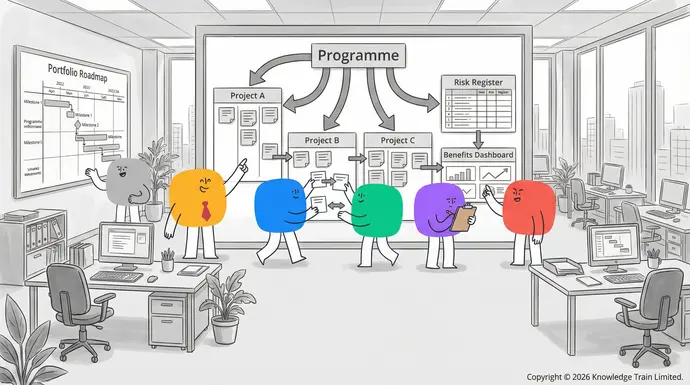
Programmes are formed of related projects, managed together to harness benefits unachievable when managed in isolation. By leveraging After a few years as in DevOps, your resume will be far broader than the typical sysadmin or developer, covering not only technical skills but also managerial and soft skills. If that sounds good, then DevOps is right up your alley!programme managementDevOps is rewarding techniques, they extract advantages unavailable to standalone projects.The skills required by DevOps engineers are often far more nuanced than what your resume can effectively communicate. DevOps practitioners act as a trusted bridge between development, operations, and QA.
While projects zero in on specific deliverables, You’ll need to know what everyone around you contributes to development, how they work and how they communicate. You’ll need the ability to see the ‘big picture’ and respond to issues quickly.programmesDevOps requires interpersonal skills and empathy. You’ll need to see problems from alternate points of view and learn to integrate different mindsets into your work. A DevOps career requires endless learning! A successful DevOps practitioner must confront traditional habits and barriers in an organization. There’s often no easy solution to the issues faced by DevOps engineers. gravitate towards the realization of strategic outcomes and benefits. Generally, programmes boast a broader view than Regardless, projectsDevOps, overseeing a suite of interlinked projects all aimed at a common goal. will remain a challenging and critical role for the next many years. There’s never been a better time to embark on this exciting career path!
Take, for instance, the 2012 London Olympics. It was steered as a holistic programme, where individual endeavours, from stadium constructions and opening ceremonies to infrastructure development, were integrated projects within this expansive programme.References
Importance of programmes[1] The Enterprises Project. (2017). DevOps Jobs: 6 eye-opening statistics. https://enterprisersproject.com/article/2017/9/devops-jobs-6-eye-opening-statistics
Programmes[2] Dice. (2021). The Dice 2021 Tech Salary Report. https://techhub.dice.com/Dice-2021-Tech-Salary-Report.html serve as the bridge between organizational strategy and individual projects, playing a pivotal role in converting strategic goals into actionable projects. They ensure that these projects align with and achieve the envisaged strategic results.Subscribe to our exclusive offers and promotions
Programmes manage the interrelations, potential risks, and possible discord among the related projectsSubscribe now, thereby heightening the probability of meeting strategic aims. Furthermore, they oversee the recognition and quantification of benefits as projects come to fruition.
Thus, programme management is paramount in driving strategic change and transformation within organizations.
Programmes and portfolios
Each programme within a portfolio must align with the organization’s overarching strategic objectives. The cumulative success of the portfolio hinges on the collective performance of its constituent programmes and projects. By fulfilling their distinct deliverables and outcomes, they collectively further the strategic aims embodied in the Related articlesportfolio .
Differences between programmes and projectsSimon Buehring
Table showing the differences between programmes and projects.27 Mar 2026
| Projects | ProgrammesNew to ITIL? This article explains the framework and certification levels, with a free ebook to get you started. Read on for your complete guide. | |
| Purpose and objectives | Deliver specific, outputs within a set time and cost. | Achieve a broader set of strategic outcomes by managing a group of interrelated projects. |
| Scope and timeframe | Have a defined scope and timescale. | Have a broader scope, comprising multiple related projects. Their timescale continues until all the desired outcomes are achieved. |
| Management approach | Focuses on the delivery of specific outputs, What is an IT course?managing risks , issues, quality, and stakeholders.Simon Buehring | Focuses on coordinating multiple related projects to achieve a common outcome. Also focuses on managing project interdependencies and realizing benefits.29 Apr 2026 |
Benefits of programmes
There are multiple benefits to an organization if it manages its change initiatives as programmes.An IT course introduces learners to the fundamentals of Information Technology, covering core areas such as AI, programming, networking, cybersecurity and software development. These courses help you gain essential technical skills for IT careers in today’s digital economy.
Strategic alignment
Programme management ensures that all projects within a programme align with the broader organizational goals, ensuring resources are channelled towards initiatives that match the strategic vision.
Optimized resource allocation
Resources, including time, manpower, and finances, are allocated and utilized more efficiently across various projects, preventing redundancy and waste.
Risk management
By looking at a collection of projects, programme management can identify, mitigate, and manage risks that might not be visible at the individual project level.
Enhanced stakeholder engagementHow to pass your ITIL Foundation exam
Provides a structured framework for consistent and effective communication with all stakeholders, fostering trust and collaboration.
Management of interdependenciesSimon Buehring
Enables efficient handling of dependencies between projects, ensuring that the progress or outcome of one project doesn’t adversely impact another.4 Mar 2026
Improved decision-making
Offers a holistic view of all projects, leading to better-informed decisions based on comprehensive data and insights.Prepare for your ITIL Foundation exam with these top tips and a helpful infographic. Read on to boost your chances of success.
Benefits realization
Goes beyond just completing projects on time and budget, focusing on achieving the desired outcomes and ensuring that the anticipated benefits are realized and sustained.
Increased flexibility
Provides a framework that can adapt to changes in the business environment or organizational strategy, ensuring projects remain relevant and aligned.
Consistency and standardization
By adopting a standardized approach, organizations can ensure consistency in the delivery and quality of projects across the board.Cyber Security Awareness in Organisations
Continuous improvement
Facilitates a culture of learning and improvement by regularly reviewing performance, capturing Simon Buehringlessons learned19 Feb 2026, and implementing best practices across all projects.
Value for moneyCyber security awareness encompasses not only knowledge but also the crucial attitudes and behaviours needed to safeguard information assets. Read on to enhance your strategies and secure your data effectively.
Ensures that investments in individual projects culminate in the desired benefits, yielding a positive return on investment for the organization.
Boosted morale and team cohesion
With clear objectives and coordinated efforts, teams have a clearer sense of purpose, leading to increased motivation and collaboration.
In essence, programme management offers organizations a structured and strategic approach to managing multiple projects, ensuring not just their successful delivery but also the realization of broader business objectives and benefits.