Programmes

Key takeaways
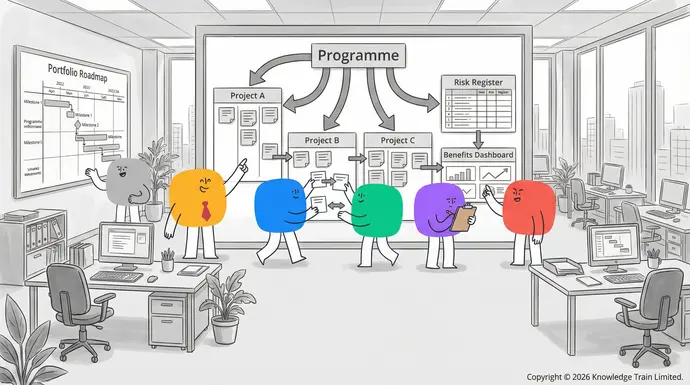
Programmes coordinate related projects to deliver strategic outcomes and sustained benefits.
- Programmes bridge organisational strategy and project delivery by aligning work to measurable outcomes.
- Managing interdependencies across projects reduces conflict, duplication, and hidden risks.
- Governance, clear roles, and transparent reporting improve accountability and decision-making.
- Active stakeholder engagement and consistent communication build trust and maintain momentum.
Differences between programmes and projects
Table showing the differences between programmes and projects.
| Projects | Programmes | |
| Purpose and objectives | Deliver specific, outputs within a set time and cost. | Achieve a broader set of strategic outcomes by managing a group of interrelated projects. |
| Scope and timeframe | Have a defined scope and timescale. | Have a broader scope, comprising multiple related projects. Their timescale continues until all the desired outcomes are achieved. |
| Management approach | Focuses on the delivery of specific outputs, managing risks , issues, quality, and stakeholders. | Focuses on coordinating multiple related projects to achieve a common outcome. Also focuses on managing project interdependencies and realizing benefits. |
Benefits of programmes
There are multiple benefits to an organization if it manages its change initiatives as programmes.
Strategic alignment
Programme management ensures that all projects within a programme align with the broader organizational goals, ensuring resources are channelled towards initiatives that match the strategic vision.
Optimized resource allocation
Resources, including time, manpower, and finances, are allocated and utilized more efficiently across various projects, preventing redundancy and waste.
Risk management
By looking at a collection of projects, programme management can identify, mitigate, and manage risks that might not be visible at the individual project level.
Enhanced stakeholder engagement
Provides a structured framework for consistent and effective communication with all stakeholders, fostering trust and collaboration.
Management of interdependencies
Enables efficient handling of dependencies between projects, ensuring that the progress or outcome of one project doesn’t adversely impact another.
Improved decision-making
Offers a holistic view of all projects, leading to better-informed decisions based on comprehensive data and insights.
Benefits realization
Goes beyond just completing projects on time and budget, focusing on achieving the desired outcomes and ensuring that the anticipated benefits are realized and sustained.
Increased flexibility
Provides a framework that can adapt to changes in the business environment or organizational strategy, ensuring projects remain relevant and aligned.
Consistency and standardization
By adopting a standardized approach, organizations can ensure consistency in the delivery and quality of projects across the board. Request a quote
Continuous improvement
Facilitates a culture of learning and improvement by regularly reviewing performance, capturing lessons learned[email protected], and implementing best practices across all projects.
Value for money +44 (0)207 148 5985
Ensures that investments in individual projects culminate in the desired benefits, yielding a positive return on investment for the organization.Courses
Boosted morale and team cohesionPROJECT MANAGEMENT
With clear objectives and coordinated efforts, teams have a clearer sense of purpose, leading to increased motivation and collaboration.PRINCE2
In essence, ®programme managementFoundation offers organizations a structured and strategic approach to managing multiple projects, ensuring not just their successful delivery but also the realization of broader business objectives and benefits.Learn the fundamentals of the PRINCE2 method.