ProgrammesCzech RepublicLatvia

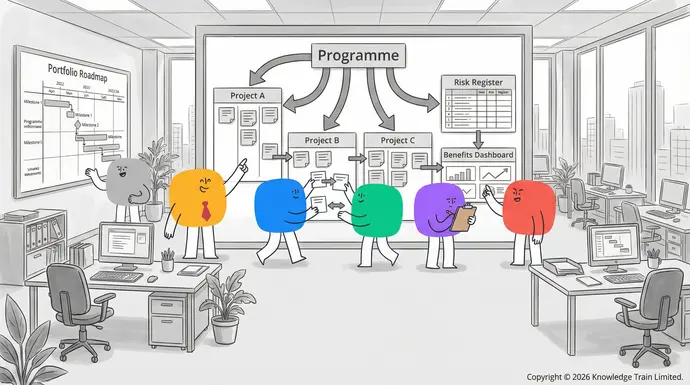
Understanding programmes Governance, clear roles, and transparent reporting improve accountability and decision-making.
Programmes are formed of related projects, managed together to harness benefits unachievable when managed in isolation. By leveraging Active stakeholder engagement and consistent communication build trust and maintain momentum.programme management Benefits realisation and KPIs ensure investment delivers value beyond time and budget. techniques, they extract advantages unavailable to standalone projects. Standard methods, training, and continual improvement help programmes stay adaptable and repeatable.
While projects zero in on specific deliverables, Copied! programmesKey takeaways gravitate towards the realization of strategic outcomes and benefits. Generally, programmes boast a broader view than Choose and run frameworks as adaptable structures that fit your project and organisation, not as rigid rules. projectsA framework brings consistency, clarity, and simpler delivery by breaking work into defined lifecycle stages with controls and templates.Contents, overseeing a suite of interlinked projects all aimed at a common goal.Waterfall suits stable requirements, while Scrum and Kanban suit change and flow, and Lean targets waste reduction.
Take, for instance, the 2012 London Olympics. It was steered as a holistic programme, where individual endeavours, from stadium constructions and opening ceremonies to infrastructure development, were integrated projects within this expansive programme.PRINCE2 fits complex or regulated work where governance and business justification matter.
Importance of programmesSelect a framework by weighing complexity, industry demands, team capability, stakeholder needs, and constraints, then pilot and refine.Contents
ProgrammesSuccessful rollout needs training, the right tools, active change management, and ongoing monitoring and adjustment. serve as the bridge between organizational strategy and individual projects, playing a pivotal role in converting strategic goals into actionable projects. They ensure that these projects align with and achieve the envisaged strategic results. Understanding programmes
Programmes manage the interrelations, potential risks, and possible discord among the related projects Importance of programmes
Differences between programmes and projectsUnderstanding project management frameworksMSP Practitioner (with Foundation) course
Table showing the differences between programmes and projects.Project management frameworks are structured approaches that provide guidance, processes and procedures to support project managers in the delivery of successful projects. These are often used as a starting point for organisations to design and implement their own project management processes and can be adapted to suit the specific needs and requirements of individual projects and teams.
| ProjectsComponents of a project management framework£1,899 +vat | ProgrammesProject lifecycle | |
| Purpose and objectives: This element of project management principles describes the series of stages a project goes through from beginning to end. It is typically composed of five stages:See all dates | Deliver specific, outputs within a set time and cost.Initiation | Achieve a broader set of strategic outcomes by managing a group of interrelated projects.Planning |
| Scope and timeframeExecution | Have a defined scope and timescale.Performance monitoringSelf-paced | Have a broader scope, comprising multiple related projects. Their timescale continues until all the desired outcomes are achieved.Project closure.MSP Practitioner (with Foundation) self-paced online |
| Management approachProject control cycle | Focuses on the delivery of specific outputs, : This element of project management principles is the cycle of controlling and monitoring a project from its start through to the end of the lifecycle. It involves developing the plan, monitoring, reporting actual progress, assessing progress against the plan, recognising deviations, and taking corrective action as necessary.£1,399 +vatmanaging risksTools and templates , issues, quality, and stakeholders.: This element of project management principles is concerned with the use of tools and templates to support a project. This could include a | Focuses on coordinating multiple related projects to achieve a common outcome. Also focuses on managing project interdependencies and realizing benefits.project plan |
is a structured project management method that provides processes and principles for managing a project in a controlled environment.Pros and consPros: Highly structured, scalable, business justification is emphasised
Cons: Can be bureaucratic, requires a lot of documentation.Best use casesPRINCE2 can be used for large, complex projects, especially in government or highly regulated industries, or for projects where there is a need for a high degree of control and governance.