Programmes

Key takeaways
Programmes coordinate related projects to deliver strategic outcomes and sustained benefits.Importance of IT
- Programmes bridge organisational strategy and project delivery by aligning work to measurable outcomes.
- Managing interdependencies across projects reduces conflict, duplication, and hidden risks.IT careers
- Governance, clear roles, and transparent reporting improve accountability and decision-making.
- Active stakeholder engagement and consistent communication build trust and maintain momentum.Future trends in IT
- Benefits realisation and KPIs ensure investment delivers value beyond time and budget.
- Standard methods, training, and continual improvement help programmes stay adaptable and repeatable.FAQs
Understanding programmes Protocols and platforms enabling global connectivity, web services, cloud computing, and e-commerce.
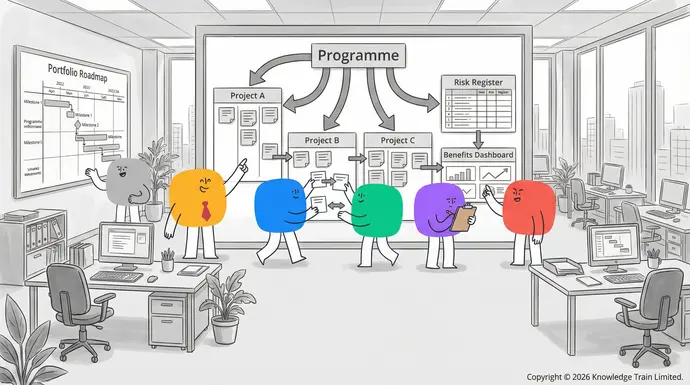
Programmes are formed of related projects, managed together to harness benefits unachievable when managed in isolation. By leveraging Cybersecurityprogramme management: techniques, they extract advantages unavailable to standalone projects. Practices and technologies designed to protect information, systems, and networks from threats or unauthorised access.
While projects zero in on specific deliverables, Applications and uses of ITprogrammesInformation technology has transformed many areas of society and industry. Key areas of application include: gravitate towards the realization of strategic outcomes and benefits. Generally, programmes boast a broader view than Business applications:projects Automation of processes, decision support, customer relationship management, enterprise resource planning, and e-commerce., overseeing a suite of interlinked projects all aimed at a common goal.Healthcare:
Take, for instance, the 2012 London Olympics. It was steered as a holistic programme, where individual endeavours, from stadium constructions and opening ceremonies to infrastructure development, were integrated projects within this expansive programme. Electronic health records, telemedicine, diagnostic tools using artificial intelligence (AI), and secure data exchange between providers and patients.
Importance of programmesEducation:
Programmes serve as the bridge between organizational strategy and individual projects, playing a pivotal role in converting strategic goals into actionable projects. They ensure that these projects align with and achieve the envisaged strategic results.Online learning
Programmes manage the interrelations, potential risks, and possible discord among the related environments, digital classrooms, educational management systems, and adaptive learning platforms.projectsGovernment:, thereby heightening the probability of meeting strategic aims. Furthermore, they oversee the recognition and quantification of benefits as projects come to fruition. E-government services, digital identity, public records management, and online citizen services.
Thus, programme management is paramount in driving strategic change and transformation within organizations.Daily life:
Programmes and portfolios Internet access via mobile devices, social media, online banking, smart home technologies, and digital entertainment.
Each programme within a IT examplesportfolioDescription must align with the organization’s overarching strategic objectives. The cumulative success of the portfolio hinges on the collective performance of its constituent programmes and projects. By fulfilling their distinct deliverables and outcomes, they collectively further the strategic aims embodied in the IT Components InvolvedportfolioCloud computing.On-demand access to computing resources and services over the internet
Differences between programmes and projectsCareers in IT span areas such as systems analysis,
Table showing the differences between programmes and projects.project management
| Projects, software development, network administration, | Programmescybersecurity | |
| Purpose and objectives, IT support, data management, and artificial intelligence. Professionals may work across sectors, supporting digital transformation and ensuring the reliable operation of information systems. Required skills range from technical proficiency in hardware and software to abilities in project management and problem-solving. | Deliver specific, outputs within a set time and cost.Future trends in IT | Achieve a broader set of strategic outcomes by managing a group of interrelated projects.The future of IT will be shaped by advances in artificial intelligence, machine learning, cloud computing, big data analytics, quantum computing, and enhanced cybersecurity solutions. Digital transformation across industries is set to accelerate, with increased focus on |
| Scope and timeframesustainability | Have a defined scope and timescale., automation, and digital ethics. The integration of IT with IoT (Internet of Things), blockchain, and 5G telecommunications will further expand its influence and applications. | Have a broader scope, comprising multiple related projects. Their timescale continues until all the desired outcomes are achieved.FAQs |
| Management approachWhat is the difference between Information Technology (IT) and Information and Communications Technology (ICT)? | Focuses on the delivery of specific outputs, Information technology (IT) refers to the use of computers, software, networks, and systems to manage and process information. Information and communications technology (ICT) is a broader term that includes IT as well as communication technologies like telephony, broadcasting, and the internet, emphasising the convergence of information processing and communication.managing risksWhat are some examples of information technology?, issues, quality, and stakeholders.Examples include computer systems, cloud computing platforms, business applications, cybersecurity tools, databases, telecommunications, and artificial intelligence applications. | Focuses on coordinating multiple related projects to achieve a common outcome. Also focuses on managing project interdependencies and realizing benefits.Why is information technology important? |
Benefits of programmesInformation technology is essential for modern communication, efficient business operations, data management, innovation, and secure access to services. It supports economic growth, digital transformation, and enhances everyday life.
There are multiple benefits to an organization if it manages its change initiatives as programmes.What careers are available in information technology?
Strategic alignmentIT careers include software development, network administration, cybersecurity, data analysis,
Programme managementproject management ensures that all projects within a programme align with the broader organizational goals, ensuring resources are channelled towards initiatives that match the strategic vision., information systems management, support roles, and emerging jobs in artificial intelligence and machine learning.
Optimized resource allocationWhat are the future trends in information technology?
Resources, including time, manpower, and finances, are allocated and utilized more efficiently across various projects, preventing redundancy and waste.Key trends include the growth of artificial intelligence, big data, cloud computing, quantum computing, advanced cybersecurity, and integrating IT with new technologies like IoT and 5G.
Risk managementReferences
By looking at a collection of projects, programme management can identify, mitigate, and manage risks that might not be visible at the individual project level.Information technology on Wikipedia
Enhanced stakeholder engagementThe Chartered Institute for IT
Provides a structured framework for consistent and effective communication with all stakeholders, fostering trust and collaboration.Computer and IT Occupations – US Bureau of Labor Statistics
Management of interdependenciesSubscribe to our exclusive offers and promotions
Enables efficient handling of dependencies between projects, ensuring that the progress or outcome of one project doesn’t adversely impact another.
Improved decision-makingSubscribe now
Offers a holistic view of all projects, leading to better-informed decisions based on comprehensive data and insights.
Benefits realization
Goes beyond just completing projects