Change management: models, steps, and best practices

Key takeaways
Effective change management blends clear planning with sustained support for adoption.
- Use structured frameworks such as Kotter, Lewin, or ADKAR to sequence activities and maintain momentum.
- Visible leadership sponsorship and consistent communication reduce uncertainty and resistance.
- Engage stakeholders early, using influence and impact mapping to target effort where it matters most.
- Integrate change work with project delivery so training, readiness, risks, and benefits stay aligned.
- Measure adoption with KPIs and feedback, then reinforce new behaviours through governance, coaching, and policy.
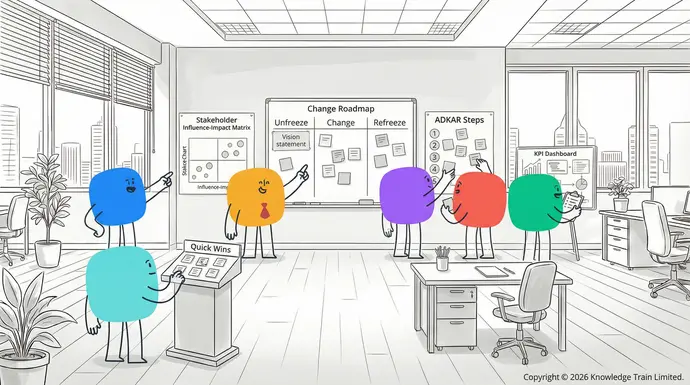
What is change management?
Change management refers to the systematic process of planning, implementing, and overseeing organisational changes to achieve desired business outcomes.
Change management encompasses strategies, techniques, and tools that help organisations prepare for, execute, and sustain change, whether related to processes, technologies, culture, or organisational structure.
Effective change management seeks to minimise disruption, address resistance to change, and strengthen engagement among all stakeholders.
Importance of change management
Organisational change is inevitable as businesses adapt to evolving markets, technologies, and regulations. By using structured frameworks and engaging leadership, organisations can minimise risks, foster innovation, and achieve sustainable success.
Effective change management ensures smooth transitions, maintains productivity during transformation, increases return on investment, and supports employee engagement.
Here are some reasons why change management is important.
External factors
External factors play a big role in organisational change. Globalisation and the rapid developments in new digital solutions are forcing organisations to respond. Ignoring such external factors is likely to jeopardise your organisation’s success.
Nokia was once the biggest mobile phone company in the world, but it almost went out of business. That’s because it didn’t keep up with changes in mobile technologies. As a result, Nokia’s products didn’t appeal to consumers, and its market share rapidly declined.
Making ideas succeed
Many organisations use change management methodologies to enable ideas to succeed. Working alongside project managers
Almost every functional unit within a modern organisation relies on change management to enable it to:
- Align the change plan to the business’s overall strategy.
- Improve internal and external services and requests.
- Track and resolve issues.
Engaging people with the change process
A key part of managing change in an organisation is to engage those people affected by a change initiative. Staff will be involved in the change process eventually, therefore communicating and engaging with staff about a change plan early helps lay the groundwork for its later success.
Preparing for organisational transition
Change managers are often appointed to make organisational change go smoothly. They use change management frameworks to make changes such as:
- Restructuring job roles.
- Restructuring business processes.
- Implementing new technologies.
Decreasing resistance to a change initiative
Resistance is inevitable in any change initiative because people often find it unsettling being asked to work in new and different ways. So, change managers can often expect a denial reaction from staff. It takes time to overcome those reactions. When change managers are transparent from day one, the less resistance they are likely to face.
Improving performance and productivity
When an organisation adapts improved ways of working, it tends to increase productivity. At the same time, it encourages innovation. As a result, it guarantees improved performance and places an organisation in a healthier environment better able to succeed.
Reducing costs
When positive change is applied correctly, it helps to reduce waste and therefore reduce costs. Effective change management helps an organisation make smart choices. It increases productivity, decreases risks, and helps to improve the profitability of an organisation.
| Kotter’s 8-Step | 8 outlined steps | Building urgency, vision, momentum |
| Lewin’s Change | Unfreeze, Change, Refreeze | Preparing, transitioning, embedding |
| ADKAR | Awareness, Desire, Knowledge, Ability, Reinforcement | Individual adoption stages |