Change management: models, steps, and best practices

Key takeawaysCopied!
Effective change management blends clear planning with sustained support for adoption.Key takeaways
- Use structured frameworks such as Kotter, Lewin, or ADKAR to sequence activities and maintain momentum.DevOps improves delivery by combining collaboration, automation, and continuous feedback across the full lifecycle.
- Visible leadership sponsorship and consistent communication reduce uncertainty and resistance.DevOps unites development and operations to deliver software faster without sacrificing stability.
- Engage stakeholders early, using influence and impact mapping to target effort where it matters most.CI/CD and automation reduce manual effort, cut errors, and enable frequent, reliable releases.
- Integrate change work with project delivery so training, readiness, risks, and benefits stay aligned.Infrastructure as code and GitOps make environments repeatable, auditable, and easier to scale.
- Measure adoption with KPIs and feedback, then reinforce new behaviours through governance, coaching, and policy.Monitoring, metrics, and feedback loops speed up detection, recovery, and continuous improvement.
Reduces manual tasks, increasing efficiency and reliability in processes such as testing, deployment, and monitoring.
- Implementing new technologies.Planning:
Decreasing resistance to a change initiative Define requirements, prioritise work, and coordinate across teams.
Resistance is inevitable in any change initiative because people often find it unsettling being asked to work in new and different ways. So, change managers can often expect a denial reaction from staff. It takes time to overcome those reactions. When Coding:change managers Write and review code using version control systems such as are transparent from day one, the less resistance they are likely to face.
- Subscribe now
- Integrate change into company culture to ensure lasting results.
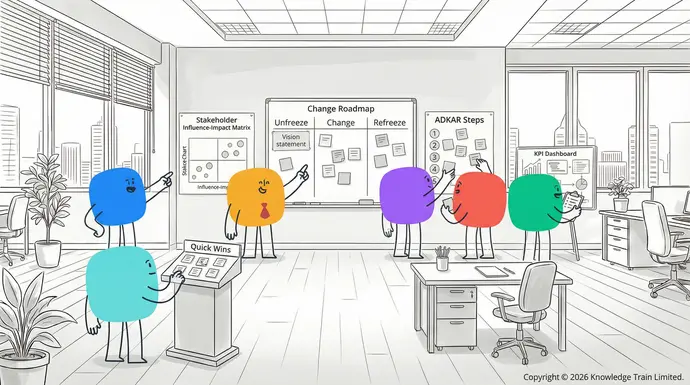
| Model | Core StepsRelated articles | Main Focus |
|---|---|---|
| Kotter’s 8-Step | 8 outlined steps | Building urgency, vision, momentum |
| Lewin’s Change | Unfreeze, Change, Refreeze | Preparing, transitioning, embedding |
| ADKAR | Awareness, Desire, Knowledge, Ability, Reinforcement | Individual adoption stages |
FAQs
What is change management and why is it important?
Change management is the process of guiding organisations, individuals, or teams through transitions. It is important because it enables smoother implementation of change, reduces resistance, and ensures that strategic objectives are achieved efficiently.
What are common change management frameworks?
The most common frameworks are Kotter’s 8-Step Process, Lewin’s Change, and the ADKARWhat is GDPR? framework. Each provides a structured approach to planning and implementing change.
How do you overcome resistance to change?Simon Buehring
Overcome resistance by communicating benefits clearly, involving stakeholders, offering support and training, addressing concerns promptly, and recognising employee contributions throughout the transition.19 Feb 2026
What role do leaders play in change management?
Leaders set the direction, communicate the vision, build trust, allocate resources, and provide motivation and support to drive successful change.GDPR has significantly changed data protection in the EU. Learn what it means for you and your organization by reading on.
How can employees be engaged during change initiatives?
Engage employees by involving them early, asking for input, addressing worries, providing training, celebrating successes, and continuously seeking feedback to make improvements.