
Key takeawaysThe right certification depends on the environment you work in and the experience you can evidence.
Effective change management blends clear planning with sustained support for adoption.Business analysts drive structured change by clarifying needs, shaping solutions, and maximising stakeholder value.
- Use structured frameworks such as Kotter, Lewin, or ADKAR to sequence activities and maintain momentum.Strong communication and problem-solving matter as much as technical competence, with basic SQL often sufficient.
- Visible leadership sponsorship and consistent communication reduce uncertainty and resistance.BCS qualifications are widely favoured in the UK and offer a flexible pathway from foundation to diploma level.
- Engage stakeholders early, using influence and impact mapping to target effort where it matters most.AgileBA suits characters working in agile teams, progressing from overview knowledge to applied practitioner capability.
- Integrate change work with project delivery so training, readiness, risks, and benefits stay aligned.PMI-PBA is highly respected but has strict eligibility requirements, making it a strong differentiator for experienced candidates.
- Measure adoption with KPIs and feedback, then reinforce new behaviours through governance, coaching, and policy.
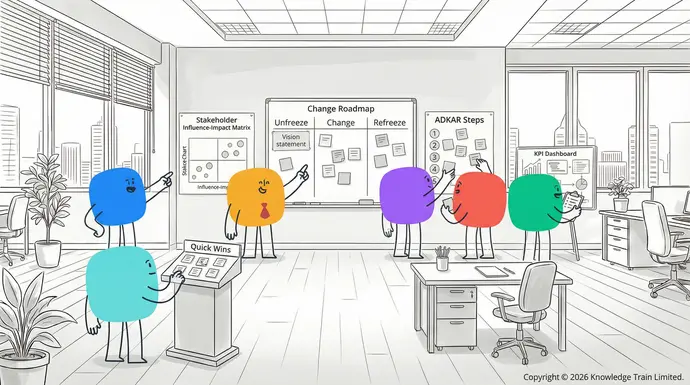
What is change management? must possess specialized knowledge and understanding that enables them to act as mentors, guides and business leaders. The effective use of business analysis methods can ensure that organizations improve their way of doing business.
Change managementDoing this requires a business analyst (or teams of Business analysts) able to identify new opportunities, avoid risks, address the human side of change, model business practices and much more. refers to the systematic process of planning, implementing, and overseeing organisational changes to achieve desired business outcomes.It is not a role for the faint hearted, but BAs enjoy a level of respect and freedom rarely accorded to middle-management roles.
Change management encompasses strategies, techniques, and tools that help organisations prepare for, execute, and sustain change, whether related to processes, technologies, culture, or organisational structure.Enhance your skills with our expert-led courses
Effective change management seeks to minimise disruption, address resistance to change, and strengthen engagement among all stakeholders .
Importance of change managementSelf-paced
Organisational change is inevitable as businesses adapt to evolving markets, technologies, and regulations. By using structured frameworks and engaging leadership, organisations can minimise risks, foster innovation, and achieve sustainable success.BCS Foundation Certificate in Business Analysis self-paced online
Effective change management£499 +vat ensures smooth transitions, maintains productivity during transformation, increases return on investment, and supports employee engagement.
Here are some reasons why change management is important.
External factorsSelf-paced
External factors play a big role in BCS International Diploma in Business Analysis self-paced onlineorganisational change . Globalisation and the rapid developments in new digital solutions are forcing organisations to respond. Ignoring such external factors is likely to jeopardise your organisation’s success.£2,199 +vat
Nokia was once the biggest mobile phone company in the world, but it almost went out of business. That’s because it didn’t keep up with changes in mobile technologies. As a result, Nokia’s products didn’t appeal to consumers, and its market share rapidly declined.
Making ideas succeed
Many organisations use change management methodologies to enable ideas to succeed. Working alongside project managersSelf-paced who deliver new capabilities into an organisation, BCS Business Analysis Practice self-paced onlinechange managers and change agents help ensure staff are able to fully utilise the new capabilities.£749 +vat
Enabling cross-functional changesWhat qualifications do you need to become a business analyst?
Almost every functional unit within a modern organisation relies on change management to enable it to:Business analysts need a good mix of ‘soft-skills’ and ‘hard-skills.’ You will need to be good at solving problems and analysing data. You will also need to have excellent communication skills.
- Align the change plan to the business’s overall strategy.The path you might take will depend on your qualifications, education and experience. Many analysts begin in a technical background such as software development. This is helpful, as IT systems and databases can often form a major part of a businesses’ development plans.
- Improve internal and external services and requests.If you don’t have any IT experience, don’t fret! Often some basic knowledge of SQL is all you’ll be required to have, as systems analysis is a closely related, but otherwise entirely distinct discipline that you won’t have to worry about as a Business analyst.
- Track and resolve issues.‘Soft skills’ vs. ‘hard skills’
Engaging people with the change processRecruiters will generally look for work experience or an education that may have imparted desirable skills. Any experience you may have had as a manager or team-leader will be especially desirable. Soft skills you may want to highlight in your CV include:
A key part of Attention to detail.managing changeCommunication. in an organisation is to engage those people affected by a change initiative. Staff will be involved in the change process eventually, therefore communicating and engaging with staff about a change plan early helps lay the groundwork for its later success.Interpersonal skills.
Preparing for organisational transitionLeadership.
Change managersOrganisation. are often appointed to make organisational change go smoothly. They use Problem-solving.change management frameworksTeamwork. to make changes such as:Time-management.
- Restructuring job roles.Additionally, a post-graduate qualification in any of the following studies will make you more marketable as a BA:
- Restructuring business processes.Business information systems.
- Implementing new technologies.Business management.
Decreasing resistance to a change initiativeComputing and systems development.
Resistance is inevitable in any change initiative because people often find it unsettling being asked to work in new and different ways. So, change managers can often expect a denial reaction from staff. It takes time to overcome those reactions. When Computer science.change managersBeyond this, many employers view recognized are transparent from day one, the less resistance they are likely to face.business analyst qualifications
Improving performance and productivity as an industry-standard. That’s not to say you can’t find work as a business analyst without one, but they will make you more desirable to potential employers and are a great way to make up for a lack of experience if you’re looking for your first business analyst role.
When an organisation adapts improved ways of working, it tends to increase productivity. At the same time, it encourages innovation. As a result, it guarantees improved performance and places an organisation in a healthier environment better able to succeed.Business analysis qualifications are offered by several professional bodies, namely the International Institute of Business Analysis UK (IIBA), The Chartered Institute for IT (BCS) and the
Reducing costsProject Management Institute
When positive change is applied correctly, it helps to reduce waste and therefore reduce costs. Effective change management helps an organisation make smart choices. It increases productivity, decreases risks, and helps to improve the profitability of an organisation. (PMI). In the UK,
Change management principlesBCS business analysis qualifications
- Clear communication are the most popular amongst employers.: Ensure transparency and regular updates throughout the process.What is the best business analyst certification?
- Leadership involvementWe offer 3 internationally recognized business analysis qualification schemes to aid your career progression in the business analysis profession. Each is tailored to suit a different type of candidate and as such, there’s no ‘best’ qualification. For more information on each individual course read on!: Leaders must champion change and encourage desired behaviours.BCS Business Analysis
- Stakeholder engagementBCS business analysis certifications: Involve and listen to those affected by the change. are unique in that BCS offers a structured training and career progression path.
- Process improvementBCS business analysis qualifications: Focus on refining and optimising business processes. range from entry-level
- Proactive BCS Business Analysis Foundationrisk management certification which requires no previous experience in business analysis, to the more advanced : Identify, assess, and mitigate potential challenges.BCS Business Analysis Diploma
- Continuous feedback and adaptation certification.: Monitor outcomes and adjust strategies where necessary.Owing to the flexibility of their training scheme, and the fact that you never have to venture outside the BCS scheme throughout your entire business analysis career, it’s no wonder BCS remains a firm favourite among business owners and practicing business analysts alike.
Change management processesWe offer a range of online Foundation and Practitioner BCS BA modules including:
- Identify the need for changeBCS Foundation Certificate in Business Analysis: Recognise drivers such as technological advancements, market shifts, or process inefficiencies.BCS Practitioner Certificate in Business Analysis Practice
- Define the vision and objectivesBCS Requirements Engineering: Set clear goals for what the change will achieve.BCS Modelling Business Processes
- Engage stakeholdersEach of these modules helps candidates work towards the highly regarded : Involve key groups early to build support and address concerns.BCS International Diploma in Business Analysis
- Develop a change management plan.: Outline actions, timelines, resources, and communication strategies.This qualification validates the experience you gain through our individual training modules and is designed for business and IT professionals who want to demonstrate they have a detailed understanding of business analysis tools, techniques, strategies and best-practices.
- Implement the changeIf you’re looking to begin a career in : Launch the initiative, ensuring leadership guidance and active support from business analysischange agents and .don’t
- Manage resistance to change want to work in an agile environment, there’s no better choice than a BCS BA Diploma.: Identify the sources of resistance and address them through communication and support.Agile BA
- Monitor progress and reinforceOffered by APMG International, this : Use metrics to track success and celebrate milestones.Business Analysis certification
- Sustain change is designed to help BAs work within agile environments.: Embed new ways of working into culture and practices for lasting results.APMG courses are generally favoured by agile practitioners because, in addition to giving an overall understanding of
Change management frameworksAgile
Several , they train candidates in the use of practical business analysis tools and techniques that you will go on to use in your career.change management frameworksWe offer this qualification at two levels: guide organisations through transitions. The most prominent include:AgileBA Foundation
- Kotter’s 8-Step ProcessThis entry-level course is best suited for any of the following:
- Lewin’s Change FrameworkProduct owners and managers who require an understanding of
- ADKAR frameworkagile business analysis
Kotter’s 8-Step Process.
- Establish a sense of urgencyWorking business analysts who wish to move into an agile environment.
- Form a guiding coalitionExperienced agile team-members who want to work as agile business analysts.
- Create a vision for changeAn
- Communicate the visionAgileBA Foundation course
- Empower broad-based action provides a general overview of Agile and the roles of an agile business analyst. The course includes the exam which leads to the Foundation certification. Topics include:
- Generate short-term winsThe philosophy and
- Consolidate gains and produce more changeprinciples of Agile
- Anchor new approaches in the culture.
Example: A retailer launching a new digital platform began with urgency around changing customer expectations, formed a cross-functional team, communicated a compelling vision, and celebrated early improvements to build momentum.The business analysis processes within an Agile project.
Lewin’s Change ModelThe practices used in an Agile project.
- UnfreezeThe benefits and limitations of Agile.: Prepare the organisation to accept change by challenging the status quo.The roles and responsibilities within an
- ChangeAgile project: Transition through adoption of new behaviours and processes..
- RefreezeAgileBA Foundation & Practitioner: Stabilise the organisation by embedding changes into everyday practice.An
Example: A manufacturer seeking to improve quality first destabilised old habits, implemented new protocols, then reinforced behaviours through training and recognition.AgileBA Foundation and Practitioner
ADKAR model course includes 2 exams leading to the AgileBA Practitioner certification. This course is best suited to practicing business analysts and those who wish to begin a career in agile business analysis.
- AwarenessThis course teaches candidates how to apply the AgileBA approach to any given context. Topics include: of the need for changeThe philosophy and principles of Agile.
- DesireThe business analysis processes within an Agile project. to support the changeThe roles and responsibilities within an Agile project.
- KnowledgePMI Professional in Business Analysis (PMI-PBA)® of how to changePMI qualifications are, by a wide margin, some of the most widely recognized and respected qualifications in the project management world and are highly sought after.
- AbilityThe high opinions many people hold of this certification is due to the demanding and strict entry requirements which candidates must meet to be eligible for the PMI-PBA® exam. Eligibility requirements are as follows: to implement changeEducation:
- ReinforcementRequired experience: to sustain changeRequired training:
Example: In a software roll-out, employees learned why the upgrade was essential (Awareness, Desire), received hands-on workshops (Knowledge, Ability), and were rewarded for adoption (Reinforcement).High school diploma, associate degree or global equivalent
Change management challenges5 years working as a business analyst
Organisations frequently encounter obstacles when managing change. Common challenges include:35 hours in the topic of business analysis practices.
- Resistance to changeBachelor’s degree, higher degree or global equivalent.: Employees may fear job loss, uncertainty, or increased responsibilities.3 years working as a business analyst
35 hours in the topic of business analysis practices.SolutionBachelor’s or postgraduate degree from a GAC accredited program or global equivalent: Foster open communication, involve employees in decision-making, and provide adequate support.2 years working as a business analyst - Poor communication35 hours in the topic of business analysis practices.: Inadequate information can cause confusion and low morale.If you meet these requirements, our
PMI-PBASolution omline course helps you prepare for the certification exam.: Communicate regularly, using clear and consistent messaging across channels.If you’re lucky enough to hold a PMI qualification, you’ll be a stand-out candidate in your field. There’s no better way to advertise your skills in - Lack of leadership commitmentbusiness analysis: Without executive support, initiatives may falter., this qualification should be a goal for every dedicated business analyst!
Enhance your skills with our expert-led coursesSolution : Gain leadership buy-in and ensure visible commitment throughout the transition. - Cultural misalignment : Change may conflict with existing organisational culture.Self-paced
BCS Foundation Certificate in Business Analysis self-paced onlineSolution : Integrate change efforts with culture change and organisational development strategies.£499 +vat - Insufficient resources or planning : Poor planning can delay or derail change projects.
SolutionSelf-paced: Invest in BCS International Diploma in Business Analysis self-paced onlineproject management , transition planning, and risk assessment.£2,199 +vat
Change management and business functions
- Organisational development : Change management techniques are often a core part of organisational development, aiming for long-term improvement in effectiveness.
- Project managementSelf-paced: Integrating change management with BCS Business Analysis Practice self-paced onlineproject management ensures project deliverables are adopted and sustained.£749 +vat
Overcome resistance by communicating benefits clearly, involving stakeholders, offering support and training, addressing concerns promptly, and recognising employee contributions throughout the transition.
What role do leaders play in change management?
Leaders set the direction, communicate the vision, build trust, allocate resources, and provide motivation and support to drive successful change.
How can employees be engaged during change initiatives?
Engage employees by involving them early, asking for input, addressing worries, providing training, celebrating successes, and continuously seeking feedback to make improvements.