Change management: models, steps, and best practicesBudget-related KPIs

Key takeawaysTeam productivity
Effective change management blends clear planning with sustained support for adoption.: This KPI measures the efficiency of the team, showing their output for a unit of time or effort. This rate indicates the general productivity and areas that can be improved to raise efficiency.
- Use structured frameworks such as Kotter, Lewin, or ADKAR to sequence activities and maintain momentum.Monitoring these essential KPIs in projects provides a broad view of how well your project is working. This will help you to take data-driven and timely decisions and manage it proactively for its success.
- Visible leadership sponsorship and consistent communication reduce uncertainty and resistance.Implementing KPIs in project management
- Engage stakeholders early, using influence and impact mapping to target effort where it matters most.Applying KPIs is another important stage to fully leverage them in
- Integrate change work with project delivery so training, readiness, risks, and benefits stay aligned.project management
- Measure adoption with KPIs and feedback, then reinforce new behaviours through governance, coaching, and policy.. It requires selecting KPIs, tracking them in a structured manner, communicating, and refining them.
- project management practices
- Leadership involvement. Begin by identifying the most relevant indicators for your projects and establishing systems for measuring and analysing them. Remember that the goal is continuous improvement, not perfection. With careful and diligent application of KPI practices, you can guide your : Leaders must champion change and encourage desired behaviours.projects
- Stakeholder engagement towards greater success and efficiency.: Involve and listen to those affected by the change.Enhance your skills with our expert-led courses
- Process improvement : Focus on refining and optimising business processes.
- Proactive risk managementSelf-paced: Identify, assess, and mitigate potential challenges.APM PFQ blended online
- Continuous feedback and adaptation : Monitor outcomes and adjust strategies where necessary.£749 +vat
Change management processes
- Identify the need for change : Recognise drivers such as technological advancements, market shifts, or process inefficiencies.
- Define the vision and objectivesSelf-paced: Set clear goals for what the change will achieve.PRINCE2 Agile Practitioner (with Foundation) self-paced online
- Engage stakeholders : Involve key groups early to build support and address concerns.£1,399 +vat
- Develop a change management plan : Outline actions, timelines, resources, and communication strategies.
- Implement the change : Launch the initiative, ensuring leadership guidance and active support from Self-pacedchange agentsAgilePM Practitioner (with Foundation) self-paced online.
- Manage resistance to change£1,299 +vat: Identify the sources of resistance and address them through communication and support.FAQs
- Monitor progress and reinforceWhat is the difference between a KPI and a metric in project management?: Use metrics to track success and celebrate milestones.KPIs are metrics that are directly linked to key project goals, while metrics are measurements used more generally.
- Sustain changeHow many KPIs should I use for my project?: Embed new ways of working into culture and practices for lasting results.Generally, 5-7 key KPIs are enough. It is more important to choose the right KPIs than to have a large number of KPIs which may just add to information overload.
Change management frameworksHow often should I review and update my project KPIs?
Several Review and update your project KPIs on a monthly or quarterly basis, or as the needs of the project change.change management frameworksCan KPIs be used in Agile project management? guide organisations through transitions. The most prominent include:Yes, KPIs are a useful tool for
- Kotter’s 8-Step ProcessAgile
- Lewin’s Change Framework project management, particularly for measuring sprint and release performance.
- ADKAR frameworkHow do I align my project KPIs with overall business objectives?
Kotter’s 8-Step ProcessTalk to key stakeholders and refer to your organisation’s strategy when deciding on project KPIs, in order to ensure they are aligned with overall business objectives.
- Establish a sense of urgencyInfographic
- Form a guiding coalitionSubscribe to our exclusive offers and promotions
- Create a vision for change
- Communicate the visionSubscribe now
- Empower broad-based action
- Generate short-term wins
- Consolidate gains and produce more change
- Anchor new approaches in the culture{"@context":"https://schema.org","@type":"ImageObject","contentUrl":"https://www.knowledgetrain.co.uk/training-courses/project-management-kpis-infographic-v1.0.webp ","description":"Project management kpis infographic","license":"https://www.knowledgetrain.co.uk/license","acquireLicensePage":"https://www.knowledgetrain.co.uk/license","creditText":"Knowledge Train","uploadDate":"2024-10-31T09:00:55.000Z","copyrightNotice":"© 2024 Knowledge Train Limited. All rights reserved.","creator":{"@type":"Organization","name":"Knowledge Train","url":"https://www.knowledgetrain.co.uk"}}
Example: A retailer launching a new digital platform began with urgency around changing customer expectations, formed a cross-functional team, communicated a compelling vision, and celebrated early improvements to build momentum.
Lewin’s Change ModelRelated articles
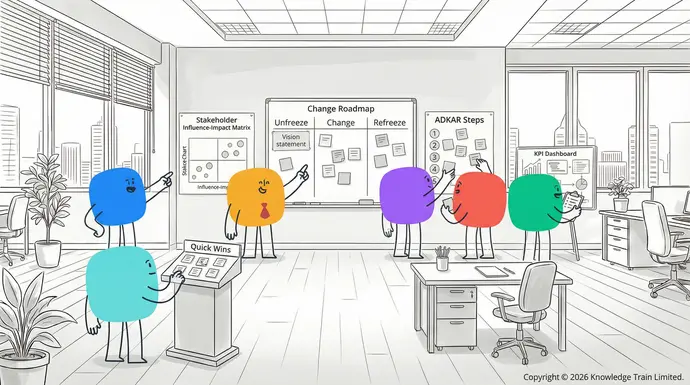
- Unfreeze : Prepare the organisation to accept change by challenging the status quo.
- Change : Transition through adoption of new behaviours and processes.
- Refreeze : Stabilise the organisation by embedding changes into everyday practice.
Example: A manufacturer seeking to improve quality first destabilised old habits, implemented new protocols, then reinforced behaviours through training and recognition.
ADKAR model
- Awareness of the need for change
- Desire to support the change
- Knowledge of how to changeMastering High-Performance Teams: Strategies for Success – Nick Fewings
- Ability to implement changeSevcan Yasa
- Reinforcement19 Feb 2026 to sustain change
Example: In a software roll-out, employees learned why the upgrade was essential (Awareness, Desire), received hands-on workshops (Knowledge, Ability), and were rewarded for adoption (Reinforcement).Discover strategies for high-performance teamwork in this insightful webinar with Nick Fewings. Scroll down to apply these lessons to your teams.
Change management challenges
Organisations frequently encounter obstacles when managing change. Common challenges include:
- Resistance to change : Employees may fear job loss, uncertainty, or increased responsibilities.
Solution : Foster open communication, involve employees in decision-making, and provide adequate support. - Poor communicationProject management steps: Inadequate information can cause confusion and low morale.
Knowledge TrainSolution19 Feb 2026: Communicate regularly, using clear and consistent messaging across channels. - Lack of leadership commitmentProject management is crucial for success. Discover the essential phases and elevate your skills to ensure projects from start to finish deliver exceptional outcomes.: Without executive support, initiatives may falter.
Solution : Gain leadership buy-in and ensure visible commitment throughout the transition. - Cultural misalignment : Change may conflict with existing organisational culture.
SolutionRisk management on projects: Integrate change efforts with culture change and organisational development strategies. - Insufficient resources or planningKnowledge Train: Poor planning can delay or derail change projects.19 Feb 2026
SolutionDiscover how risk management on projects contributes to project success. Learn proven strategies to mitigate risks and increase the chance of achieving your project goals.: Invest in project management , transition planning, and risk assessment.
Change management and business functions
- Organisational development : Change management techniques are often a core part of organisational development, aiming for long-term improvement in effectiveness.
- Project management : Integrating change management with The importance of a business caseproject management ensures project deliverables are adopted and sustained.Simon Buehring
- Business transformation19 Feb 2026: Large-scale initiatives such as mergers or digitalisation depend on robust change management for success.
- Stakeholder engagementUnderstand why a business case is crucial for informed decision-making and effective resource allocation. Read on to master how to craft a powerful business case.: Identifying and actively involving key stakeholders is crucial in minimising resistance and ensuring buy-in.
- Leadership : Strong, credible leadership drives the success of change initiatives through clear direction and support.
Change management best practices
- Establish clear communication strategies tailored to different stakeholder groups.
- Appoint dedicated change agents to guide and support the change process.Kanban management – from chaos to clarity when transforming projects
- Use data to inform decisions and measure progress through key performance indicators (KPIs).Knowledge Train
- Encourage feedback19 Feb 2026 from employees at every stage.
- Provide training and supportKanban project management provides an effective route for transforming chaotic projects into structured success. Use Kanban to create a smoother workflow and increase your productivity levels. Advance your projects today by reading further. to build new skills and confidence.
- Integrate change into company culture to ensure lasting results.