Change management: models, steps, and best practices

Key takeaways
Effective change management blends clear planning with sustained support for adoption.Contents
- Use structured frameworks such as Kotter, Lewin, or ADKAR to sequence activities and maintain momentum.
- Visible leadership sponsorship and consistent communication reduce uncertainty and resistance.
- Engage stakeholders early, using influence and impact mapping to target effort where it matters most.Contents
- Integrate change work with project delivery so training, readiness, risks, and benefits stay aligned.
- Measure adoption with KPIs and feedback, then reinforce new behaviours through governance, coaching, and policy.PMO fact sheet
What is change management?Roles:
Change management Methodology enforcement, resource management, training, portfolio oversight. refers to the systematic process of planning, implementing, and overseeing organisational changes to achieve desired business outcomes.Related organisations:
Change management encompasses strategies, techniques, and tools that help organisations prepare for, execute, and sustain change, whether related to processes, technologies, culture, or organisational structure. PMI (
Effective change management seeks to minimise disruption, address resistance to change, and strengthen engagement among all Project Management Institutestakeholders).Certifications:
Importance of change management PMO Certification, PMP, CAPM
Organisational change is inevitable as businesses adapt to evolving markets, technologies, and regulations. By using structured frameworks and engaging leadership, organisations can minimise risks, foster innovation, and achieve sustainable success.Examples:
Effective Corporate IT PMOs, government programme offices.change managementRelated terms: ensures smooth transitions, maintains productivity during transformation, increases return on investment, and supports Project Portfolio, Project Manager, Stakeholders, Best Practices, PMO Tools.employee engagementLearn more on Wikipedia.Visit PMI.org
Here are some reasons why change management is important.PMO definition
External factorsA Project Management Office (PMO) is an organisational structure that defines and maintains project management standards, supports project teams, and ensures alignment with business objectives. PMOs play a crucial role in enabling successful project, programme and
External factors play a big role in portfolio managementorganisational change by offering governance, methodology, resource management and oversight.. Globalisation and the rapid developments in new digital solutions are forcing organisations to respond. Ignoring such external factors is likely to jeopardise your organisation’s success.The concept of a PMO has evolved as organisations recognise the need for a dedicated group to enhance consistency, optimise resources, and improve
Nokia was once the biggest mobile phone company in the world, but it almost went out of business. That’s because it didn’t keep up with changes in mobile technologies. As a result, Nokia’s products didn’t appeal to consumers, and its market share rapidly declined.project delivery
Making ideas succeed outcomes. PMOs may operate at the project, programme, or portfolio level and are commonly found in sectors such as
Many organisations use change management methodologies to enable ideas to succeed. Working alongside ITproject managers, government, construction, and finance. who deliver new capabilities into an organisation, PMO functions and roleschange managersPMOs perform a wide range of functions, adapting their roles according to organisational needs. The main functions and roles typically include: and change agents help ensure staff are able to fully utilise the new capabilities.Governance:
Enabling cross-functional changes Establishing frameworks, processes and controls for effective decision-making and
Almost every functional unit within a modern organisation relies on change management to enable it to:risk management
- Align the change plan to the business’s overall strategy. across the project lifecycle.
- Improve internal and external services and requests.Standardisation:
- Track and resolve issues. Implementing and maintaining
Engaging people with the change processproject management methodologies
A key part of , best practices, and standards.managing changeSupport: in an organisation is to engage those people affected by a change initiative. Staff will be involved in the change process eventually, therefore communicating and engaging with staff about a change plan early helps lay the groundwork for its later success. Providing guidance, templates, tools, training and mentoring for Project Managers and teams.
Preparing for organisational transitionMethodology Enforcement:
Change managers Ensuring consistent application of are often appointed to make organisational change go smoothly. They use project management approacheschange management frameworks for delivery excellence. to make changes such as:Resource Management:
- Restructuring job roles. Coordinating allocation and utilisation of project personnel, tools, and budgets.
- Restructuring business processes.Portfolio Management
- Implementing new technologies.:
Decreasing resistance to a change initiative Overseeing and prioritising
Resistance is inevitable in any change initiative because people often find it unsettling being asked to work in new and different ways. So, change managers can often expect a denial reaction from staff. It takes time to overcome those reactions. When projectschange managers to align with strategic objectives and maximise value. are transparent from day one, the less resistance they are likely to face.Process Improvement:
Improving performance and productivity Reviewing and refining
When an organisation adapts improved ways of working, it tends to increase productivity. At the same time, it encourages innovation. As a result, it guarantees improved performance and places an organisation in a healthier environment better able to succeed.project delivery
Reducing costs processes to ensure continuous improvement.
When positive change is applied correctly, it helps to reduce waste and therefore reduce costs. Effective change management helps an organisation make smart choices. It increases productivity, decreases risks, and helps to improve the profitability of an organisation.Stakeholder Engagement:
Change management principles Acting as an interface between project teams, senior management, and other stakeholders.
- Clear communicationChange Management: Ensure transparency and regular updates throughout the process.:
- Leadership involvement Supporting change initiatives and minimising resistance through structured strategies.: Leaders must champion change and encourage desired behaviours.Types of PMOs
- Stakeholder engagementPMOs are not one-size-fits-all. Their structure, authority and level of influence can vary significantly. The three primary PMO types are:: Involve and listen to those affected by the change.Supportive PMO:
- Process improvement Provides consultative services, best practices, templates, and guidance. Has low control and operates as a resource for Project Managers.: Focus on refining and optimising business processes.Controlling PMO:
- Proactive Requires compliance with risk managementproject management: Identify, assess, and mitigate potential challenges. standards and methodologies. Has moderate control—enforces processes and reviews adherence.
- Continuous feedback and adaptationDirective PMO:: Monitor outcomes and adjust strategies where necessary. Directly manages projects and assigns Project Managers. Exercises high control and is responsible for
Change management processesproject delivery
- Identify the need for change and outcomes.: Recognise drivers such as technological advancements, market shifts, or process inefficiencies.Organisations may adapt their PMO model based on size, maturity, and strategic needs. A PMO may evolve from supportive to controlling or directive as project management capability matures.
- Define the vision and objectivesPMO best practices: Set clear goals for what the change will achieve.Implementing a PMO involves defining objectives, selecting the right PMO type, securing stakeholder support, setting up governance structures, and continuously reviewing processes. Best practices for successful PMO implementation include:
- Engage stakeholdersAligning PMO objectives with organisational strategy.: Involve key groups early to build support and address concerns.Engaging stakeholders and securing executive sponsorship.
- Develop a change management planAdopting recognised standards and methodologies (such as those from : Outline actions, timelines, resources, and communication strategies.PMI
- Implement the change).: Launch the initiative, ensuring leadership guidance and active support from Investing in PMO tools for tracking, reporting, and collaboration.change agentsDeveloping competency through PMO certification and staff training..Emphasising process improvement and
- Manage resistance to changechange management: Identify the sources of resistance and address them through communication and support..
- Monitor progress and reinforcePMO certification & standards: Use metrics to track success and celebrate milestones.Professional recognition is available for PMO practitioners through PMO certification programmes. The Project Management Institute (PMI), a leading standards organisation, offers certifications such as the
- Sustain changeProject Management Professional: Embed new ways of working into culture and practices for lasting results. (PMP) and Certified Associate in Project Management (CAPM). PMO-specific certifications such as the PMO-CP (PMO Certified Practitioner) are also available.
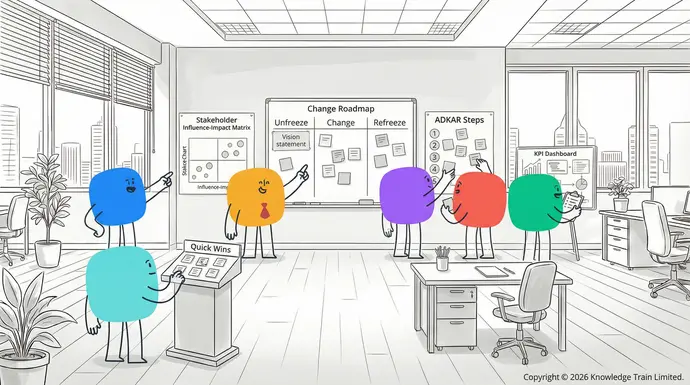
Change management frameworksCertifications
Several validate competency in project, programme, and portfolio management, enhancing PMO effectiveness and credibility. Learn more about certification options on change management frameworksPMI.org guide organisations through transitions. The most prominent include:.
- Kotter’s 8-Step ProcessPMO in practice
- Lewin’s Change FrameworkCorporate IT PMO:
- ADKAR framework A global retailer established an IT PMO to standardise project methodologies across numerous business units, leading to improved delivery times and enhanced resource management.
Kotter’s 8-Step ProcessGovernment Programme Office:
- Establish a sense of urgency A government department implemented a controlling PMO to oversee national infrastructure
- Form a guiding coalitionprogrammes
- Create a vision for change. This supported greater transparency, better risk management, and alignment with public policy objectives.
- Communicate the visionFinancial services PMO:
- Empower broad-based action A bank set up a directive PMO to directly manage regulatory compliance
- Generate short-term winsprojects
- Consolidate gains and produce more change, centralising project oversight for timely delivery.
- Anchor new approaches in the culturePMO vs. project manager
Example: A retailer launching a new digital platform began with urgency around changing customer expectations, formed a cross-functional team, communicated a compelling vision, and celebrated early improvements to build momentum.While a
Lewin’s Change ModelProject Manager
- Unfreeze is responsible for the planning, execution, and closure of individual projects, the PMO is a broader organisational entity. The PMO sets standards, provides resources and oversight, and may manage a portfolio of projects. In directive PMOs, the Project Manager may report directly to the PMO itself.: Prepare the organisation to accept change by challenging the status quo.FAQs
- ChangeCan a PMO be one person?: Transition through adoption of new behaviours and processes.Yes, a
- RefreezeProject Management Office (PMO): Stabilise the organisation by embedding changes into everyday practice. can consist of just one person. In smaller organisations or teams, a single PMO professional may handle essential functions such as tracking project performance, standardising documentation, and supporting
Example: A manufacturer seeking to improve quality first destabilised old habits, implemented new protocols, then reinforced behaviours through training and recognition.Project Managers
ADKAR model.
- Awareness of the need for changeAlthough capacity is limited, even a one-person PMO can significantly improve project consistency and governance by establishing clear standards and frameworks.
- DesireHow does a PMO add value? to support the changeA
- KnowledgePMO of how to change adds value by improving project success rates, optimising resource allocation, and ensuring projects align with organisational objectives. It also enhances communication across teams, enforces compliance with methodologies, and provides transparency on project performance through dashboards and reporting.
- AbilityUltimately, a well-functioning PMO ensures that project investments deliver measurable business benefits. to implement changeIs PMO a stressful job?
- ReinforcementWhether a to sustain changePMO role
Example: In a software roll-out, employees learned why the upgrade was essential (Awareness, Desire), received hands-on workshops (Knowledge, Ability), and were rewarded for adoption (Reinforcement). is stressful depends on the organisation’s structure and culture. When supported by leadership and empowered to influence project decisions, PMO professionals typically thrive. However, if the PMO is under-resourced or lacks authority, managing multiple priorities without visible impact can create pressure and stress.
Change management challengesStrong governance, clear goals, and management support help minimise stress and enable PMO teams to work effectively.
Organisations frequently encounter obstacles when managing change. Common challenges include:What are the 4 P’s of PMO?
- Resistance to changeThe 4 P’s of a : Employees may fear job loss, uncertainty, or increased responsibilities.PMO
are SolutionPeople, Product, Process,: Foster open communication, involve employees in decision-making, and provide adequate support. and - Poor communicationProject: Inadequate information can cause confusion and low morale.:
People:Solution Define clear roles and responsibilities for the : Communicate regularly, using clear and consistent messaging across channels.project - Lack of leadership commitment team.: Without executive support, initiatives may falter.Product:
Ensure the right deliverables reach the right stakeholders.SolutionProcess:: Gain leadership buy-in and ensure visible commitment throughout the transition. Implement consistent procedures to manage and control delivery. - Cultural misalignmentProject:: Change may conflict with existing organisational culture. Oversee the successful execution of initiatives aligned with strategy.
What are the different types of PMOs?SolutionThe three main types of : Integrate change efforts with culture change and organisational development strategies.PMOs - Insufficient resources or planning are:: Poor planning can delay or derail change projects.Supportive PMO:
Provides templates, best practices, and guidance to Project Managers.SolutionControlling PMO: