
- Copied!
- Apply holistic frameworks such as 7-S and POPIT to check both tangible and cultural factors.Measure adoption with KPIs and feedback, then reinforce new behaviours through governance, coaching, and policy.
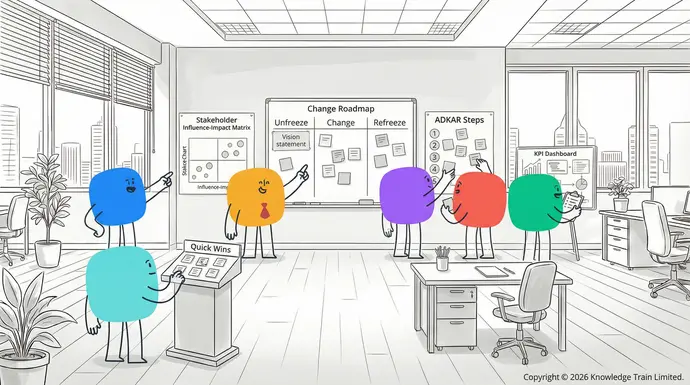
Help to clarify and define roles and responsibilities;managing changeProvide effective results; in an organisation is to engage those people affected by a change initiative. Staff will be involved in the change process eventually, therefore communicating and engaging with staff about a change plan early helps lay the groundwork for its later success.Enhance your skills with our expert-led courses
Preparing for organisational transition
Change managers are often appointed to make organisational change go smoothly. They use change management frameworksSelf-paced to make changes such as:BCS Foundation Certificate in Business Analysis self-paced online
- Restructuring job roles.
- Restructuring business processes.£499 +vat
- Implementing new technologies.
Decreasing resistance to a change initiative
Resistance is inevitable in any change initiative because people often find it unsettling being asked to work in new and different ways. So, change managers can often expect a denial reaction from staff. It takes time to overcome those reactions. When change managersSelf-paced are transparent from day one, the less resistance they are likely to face.BCS International Diploma in Business Analysis self-paced online
Improving performance and productivity
When an organisation adapts improved ways of working, it tends to increase productivity. At the same time, it encourages innovation. As a result, it guarantees improved performance and places an organisation in a healthier environment better able to succeed.£2,199 +vat
Reducing costs
When positive change is applied correctly, it helps to reduce waste and therefore reduce costs. Effective change management helps an organisation make smart choices. It increases productivity, decreases risks, and helps to improve the profitability of an organisation.
Change management principles
- Clear communicationSelf-paced: Ensure transparency and regular updates throughout the process.BCS Business Analysis Practice self-paced online
- Leadership involvement : Leaders must champion change and encourage desired behaviours.£749 +vat
- Stakeholder engagement1. McKinsey 7-S model: Involve and listen to those affected by the change.This model helps when executing strategy. It helps understand the tangible and intangible factors which can affect the implementation of strategy.
- Process improvementRead more about the : Focus on refining and optimising business processes.McKinsey 7-S model
- Proactive and see the colour infographic here.risk management2. POPIT model: Identify, assess, and mitigate potential challenges.The POPIT model ensures that all internal business aspects are considered when investigating a business area. It helps a business analyst identify where problems exist. This holistic approach helps ensure the analyst considers all relevant areas.
- Continuous feedback and adaptationRead more about the : Monitor outcomes and adjust strategies where necessary.POPIT model
Change management processes and see the colour infographic here.
- Identify the need for change3. SWOT analysis: Recognise drivers such as technological advancements, market shifts, or process inefficiencies.SWOT analysis is a technique used to analyse:
- Define the vision and objectivesExternal factors affecting an organisation (opportunities and threats);: Set clear goals for what the change will achieve.Internal factors (strengths and weaknesses) that can help an organisation address the external factors.
- Engage stakeholdersRead more about : Involve key groups early to build support and address concerns.SWOT analysis
- Develop a change management plan and see the colour infographic here.: Outline actions, timelines, resources, and communication strategies.4. MOST analysis
- Implement the changeAny successful change requires starting from a clear understanding of the organisation’s current business situation. MOST analysis can help to achieve this.: Launch the initiative, ensuring leadership guidance and active support from Read more about change agentsMOST analysis. and see the colour infographic here.
- Manage resistance to change5. PESTLE analysis: Identify the sources of resistance and address them through communication and support.PESTLE analysis is a tool used to analyse the key drivers of change in the strategic or business environment.
- Monitor progress and reinforceRead more about : Use metrics to track success and celebrate milestones.PESTLE analysis
- Sustain change and see the colour infographic here.: Embed new ways of working into culture and practices for lasting results.6. CATWOE analysis
Change management frameworksCATWOE is a technique that helps the business analyst understand different stakeholder perspectives.
Several Read more about change management frameworksCATWOE analysis guide organisations through transitions. The most prominent include: and see the colour infographic here.
- Kotter’s 8-Step Process7. SMART technique
- Lewin’s Change FrameworkThe SMART technique is used when conducting requirements analysis, which is the process of describing the users’ expectations of a business solution.
- ADKAR frameworkRead more about the
Kotter’s 8-Step ProcessSMART technique
- Establish a sense of urgency and see the colour infographic here.
- Form a guiding coalitionEnhance your skills with our expert-led courses
- Create a vision for change
- Communicate the vision
- Empower broad-based action
- Generate short-term winsSelf-paced
- Consolidate gains and produce more changeBCS Foundation Certificate in Business Analysis self-paced online
- Anchor new approaches in the culture
Example: A retailer launching a new digital platform began with urgency around changing customer expectations, formed a cross-functional team, communicated a compelling vision, and celebrated early improvements to build momentum.£499 +vat
Lewin’s Change Model
- Unfreeze : Prepare the organisation to accept change by challenging the status quo.
- ChangeSelf-paced: Transition through adoption of new behaviours and processes.BCS International Diploma in Business Analysis self-paced online
- Refreeze : Stabilise the organisation by embedding changes into everyday practice.£2,199 +vat
Example: A manufacturer seeking to improve quality first destabilised old habits, implemented new protocols, then reinforced behaviours through training and recognition.
ADKAR model
- Awareness of the need for changeSelf-paced
- DesireBCS Business Analysis Practice self-paced online to support the change
- Knowledge£749 +vat of how to change8. Fishbone diagrams
- AbilityA Fishbone diagram is a problem analysis technique. It helps understand the basic causes of a business problem. Sometimes the root cause of the problem may be obvious. At other times, only the symptoms may appear. to implement changeRead more about
- ReinforcementFishbone diagrams to sustain change and see the colour infographic here.
Example: In a software roll-out, employees learned why the upgrade was essential (Awareness, Desire), received hands-on workshops (Knowledge, Ability), and were rewarded for adoption (Reinforcement).9. Mind maps
Change management challengesMind maps are useful tools for brainstorming. Their simple visual form highlights connections between ideas and topics. They can help identify problems and solutions.
Organisations frequently encounter obstacles when managing change. Common challenges include:Read more about
- Resistance to changeMind maps: Employees may fear job loss, uncertainty, or increased responsibilities. and see the colour infographic here.
- : Inadequate information can cause confusion and low morale.
Solution: Communicate regularly, using clear and consistent messaging across channels.{"@context":"https://schema.org","@type":"ImageObject","contentUrl":"https://www.knowledgetrain.co.uk/training-courses/business-analysis-techniques-890x501.webp","description":"Business analysis techniques.","license":"https://www.knowledgetrain.co.uk/license","acquireLicensePage":"https://www.knowledgetrain.co.uk/license","creditText":"Knowledge Train","uploadDate":"2023-05-11T08:12:13.000Z","copyrightNotice":"© 2023 Knowledge Train Limited. All rights reserved.","creator":{"@type":"Organization","name":"Knowledge Train","url":"https://www.knowledgetrain.co.uk"}} - Lack of leadership commitment : Without executive support, initiatives may falter.{"@context":"https://schema.org","@type":"ImageObject","contentUrl":"https://www.knowledgetrain.co.uk/training-courses/business-analysis-techniques.webp","description":"Techniques for business analysts","license":"https://www.knowledgetrain.co.uk/license","acquireLicensePage":"https://www.knowledgetrain.co.uk/license","creditText":"Knowledge Train","uploadDate":"2023-05-11T08:12:13.000Z","copyrightNotice":"© 2023 Knowledge Train Limited. All rights reserved.","creator":{"@type":"Organization","name":"Knowledge Train","url":"https://www.knowledgetrain.co.uk"}}
SolutionRelated articles: Gain leadership buy-in and ensure visible commitment throughout the transition. - Cultural misalignment : Change may conflict with existing organisational culture.
Solution : Integrate change efforts with culture change and organisational development strategies. - Insufficient resources or planning : Poor planning can delay or derail change projects.
Solution : Invest in project management , transition planning, and risk assessment.
Change management and business functionsHow to become a business analyst with no experience?
- Organisational development : Change management techniques are often a core part of organisational development, aiming for long-term improvement in effectiveness.Simon Buehring
- Project management19 Feb 2026: Integrating change management with project managementExplore how to start a career in business analysis with no prior experience. Read on for pathways to enter the field. ensures project deliverables are adopted and sustained.
- Business transformation : Large-scale initiatives such as mergers or digitalisation depend on robust change management for success.
- Stakeholder engagement : Identifying and actively involving key stakeholders is crucial in minimising resistance and ensuring buy-in.
- Leadership : Strong, credible leadership drives the success of change initiatives through clear direction and support.
Change management best practicesUltimate guide to business analysis careers
- Establish clear communication strategies tailored to different stakeholder groups.Simon Buehring
- Appoint dedicated change agents19 Feb 2026 to guide and support the change process.
- Use data to inform decisionsExplore the various career paths in business analysis, from entry-level to senior roles. Understand salary prospects and job roles by reading further. and measure progress through key performance indicators (KPIs).
- Encourage feedback from employees at every stage.
- Provide training and support to build new skills and confidence.
- Integrate change into company culture to ensure lasting results.