Change management: models, steps, and best practicesKnowledge Train is a PRINCE2 Accredited Training Organization.

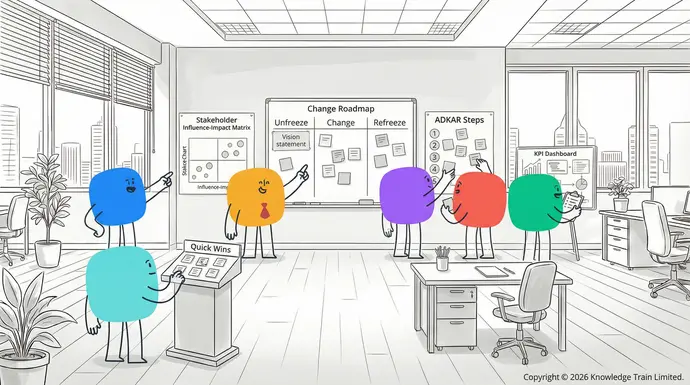
What is change management?Course manual where applicable.
Change management refers to the systematic process of planning, implementing, and overseeing organisational changes to achieve desired business outcomes.SELF-PACED ONLINE TRAINING COURSES
Change management encompasses strategies, techniques, and tools that help organisations prepare for, execute, and sustain change, whether related to processes, technologies, culture, or organisational structure.Self-paced online training courses (e-learning) include:
Effective change management seeks to minimise disruption, address resistance to change, and strengthen engagement among all Certification exam(s) where applicablestakeholdersAccredited training course materials.Support from expert, experienced trainers
Importance of change managementLatest educational technology.
Organisational change is inevitable as businesses adapt to evolving markets, technologies, and regulations. By using structured frameworks and engaging leadership, organisations can minimise risks, foster innovation, and achieve sustainable success.
Effective BUSINESS SOLUTIONSchange management ensures smooth transitions, maintains productivity during transformation, increases return on investment, and supports employee engagementTO HELP ORGANISATIONS IMPROVE.We offer solutions to help improve team performance including:
Here are some reasons why change management is important.Consultancy services
External factorsStaff development
External factors play a big role in Compliance trainingorganisational changeApprenticeship training. Globalisation and the rapid developments in new digital solutions are forcing organisations to respond. Ignoring such external factors is likely to jeopardise your organisation’s success.Custom e-Learning development
Nokia was once the biggest mobile phone company in the world, but it almost went out of business. That’s because it didn’t keep up with changes in mobile technologies. As a result, Nokia’s products didn’t appeal to consumers, and its market share rapidly declined.
Making ideas succeed
Many organisations use change management methodologies to enable ideas to succeed. Working alongside Find out moreproject managers who deliver new capabilities into an organisation, change managers and change agents help ensure staff are able to fully utilise the new capabilities.
Enabling cross-functional changes
Almost every functional unit within a modern organisation relies on change management to enable it to:CONTACT US
- Align the change plan to the business’s overall strategy.
- Improve internal and external services and requests.
- Track and resolve issues.
Engaging people with the change process
A key part of managing changeName in an organisation is to engage those people affected by a change initiative. Staff will be involved in the change process eventually, therefore communicating and engaging with staff about a change plan early helps lay the groundwork for its later success.
Preparing for organisational transition
Change managersEmail are often appointed to make organisational change go smoothly. They use change management frameworks to make changes such as:Phone
- Restructuring job roles.
- Restructuring business processes.
- Implementing new technologies.How can we help?
Decreasing resistance to a change initiative
Resistance is inevitable in any change initiative because people often find it unsettling being asked to work in new and different ways. So, change managers can often expect a denial reaction from staff. It takes time to overcome those reactions. When change managersSubmit are transparent from day one, the less resistance they are likely to face.
Improving performance and productivity
When an organisation adapts improved ways of working, it tends to increase productivity. At the same time, it encourages innovation. As a result, it guarantees improved performance and places an organisation in a healthier environment better able to succeed.OUR VALUES
Reducing costsOur 6 core values are everything we do. They include:
When positive change is applied correctly, it helps to reduce waste and therefore reduce costs. Effective change management helps an organisation make smart choices. It increases productivity, decreases risks, and helps to improve the profitability of an organisation.Integrity
Change management principlesDiversity
- Clear communicationFairness: Ensure transparency and regular updates throughout the process.Quality
- Leadership involvementInnovation: Leaders must champion change and encourage desired behaviours.Social responsibility
- Stakeholder engagement : Involve and listen to those affected by the change.SOCIAL RESPONSIBILITY
- Process improvementSome of the charities we have helped over the years:: Focus on refining and optimising business processes.
- Proactive risk management : Identify, assess, and mitigate potential challenges.
- Continuous feedback and adaptation : Monitor outcomes and adjust strategies where necessary.
- KnowledgeLithuania of how to changeLuxemburg
- AbilityMalta to implement changeNetherlands
- ReinforcementPoland to sustain changePortugal
Example: In a software roll-out, employees learned why the upgrade was essential (Awareness, Desire), received hands-on workshops (Knowledge, Ability), and were rewarded for adoption (Reinforcement).Romania
Change management challengesSlovakia
Organisations frequently encounter obstacles when managing change. Common challenges include:Slovenia
- Resistance to changeSpain: Employees may fear job loss, uncertainty, or increased responsibilities.Sweden
Other countriesSolutionHome: Foster open communication, involve employees in decision-making, and provide adequate support.Project Management - Poor communicationProject management examples: Inadequate information can cause confusion and low morale.
{"@context":"http://schema.org","@type":"BreadcrumbList","itemListElement":[{"@type":"ListItem","position":1,"name":"Home","item":"https://www.knowledgetrain.co.uk/"},{"@type":"ListItem","position":2,"name":"Project Management","item":"https://www.knowledgetrain.co.uk/project-management"},{"@type":"ListItem","position":3,"name":"Project management examples","item":"https://www.knowledgetrain.co.uk/project-management/project-management-examples"}]}Solution : Communicate regularly, using clear and consistent messaging across channels. - Lack of leadership commitment : Without executive support, initiatives may falter.Project management examples
SolutionKnowledge Train: Gain leadership buy-in and ensure visible commitment throughout the transition.19 Feb 2026 - Cultural misalignment : Change may conflict with existing organisational culture.
Solution : Integrate change efforts with culture change and organisational development strategies. - Insufficient resources or planning : Poor planning can delay or derail change projects.
Solution : Invest in project management , transition planning, and risk assessment.
Change management and business functions
- Organisational development : Change management techniques are often a core part of organisational development, aiming for long-term improvement in effectiveness.
- Project management : Integrating change management with project management ensures project deliverables are adopted and sustained.
- Business transformation : Large-scale initiatives such as mergers or digitalisation depend on robust change management for success.
- Stakeholder engagementCopied!: Identifying and actively involving key stakeholders is crucial in minimising resistance and ensuring buy-in.Key takeaways
- LeadershipProject management combines clear planning with disciplined delivery across many industries.: Strong, credible leadership drives the success of change initiatives through clear direction and support.Define scope, objectives, deliverables, resources, and timelines before work starts.
Change management best practicesExecute by coordinating tasks, departments, and decisions to keep progress aligned to the plan.
- Establish clear communication strategiesMonitor performance, risks, and issues continuously, then adapt without losing control of budget or schedule. tailored to different stakeholder groups.Close projects with proper handover, evaluation, and documented lessons learned.
- Appoint dedicated change agentsChoose methodologies and tools to match the work, from Waterfall to Agile, and from task tracking to risk management. to guide and support the change process.
- Use data to inform decisions and measure progress through key performance indicators (KPIs).
- Encourage feedbackContents from employees at every stage.
- Provide training and support to build new skills and confidence.Contents
- Integrate change into company culture to ensure lasting results.Introduction
| ModelUnderstanding project management fundamentals | Core Steps | Main FocusBenefits of a 10 real-world project management examples |
|---|---|---|
| Kotter’s 8-Step | 8 outlined stepsProject management methodologies and tools | Building urgency, vision, momentum |
| Lewin’s ChangeConclusion | Unfreeze, Change, Refreeze | Preparing, transitioning, embeddingFAQs |
| ADKARIntroduction | Awareness, Desire, Knowledge, Ability, ReinforcementProject management | Individual adoption stages is the process of leading a project or initiative from the initial idea to the final deliverable. It involves the planning, coordination, and execution of various tasks and activities to ensure the successful completion of the project. Project management has become increasingly important in recent years, as more and more organisations recognise the value of efficient and effective project execution. |