
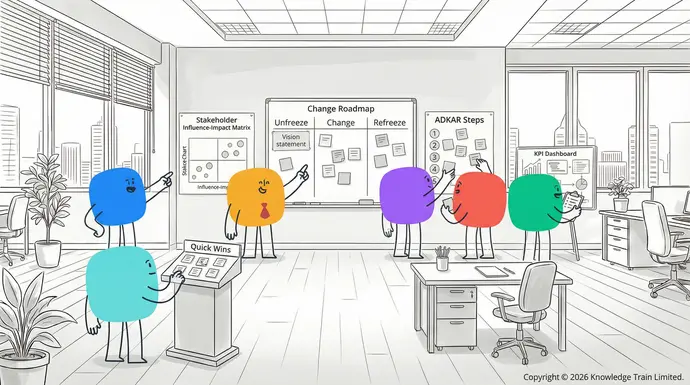
Importance of change management
Organisational change is inevitable as businesses adapt to evolving markets, technologies, and regulations. By using structured frameworks and engaging leadership, organisations can minimise risks, foster innovation, and achieve sustainable success.
Effective
- Improve internal and external services and requests.
- Track and resolve issues.
Engaging people with the change process
A key part of BETTER BUSINESS CASES COURSESmanaging changeSelect your preferred training course below: in an organisation is to engage those people affected by a change initiative. Staff will be involved in the change process eventually, therefore communicating and engaging with staff about a change plan early helps lay the groundwork for its later success.
Preparing for organisational transitionP3O COURSES
Change managersSelect your preferred training course below: are often appointed to make organisational change go smoothly. They use change management frameworksWORKSHOPS to make changes such as:Select your preferred workshop below:
- Restructuring job roles.
- Restructuring business processes.AGILE QUALIFICATIONS
- Implementing new technologies.Select your preferred qualification.
Decreasing resistance to a change initiative
Resistance is inevitable in any change initiative because people often find it unsettling being asked to work in new and different ways. So, change managers can often expect a denial reaction from staff. It takes time to overcome those reactions. When AGILE PROJECT MANAGEMENT COURSESchange managersSelect your preferred training course below: are transparent from day one, the less resistance they are likely to face.
Improving performance and productivityPRINCE2 AGILE COURSES
When an organisation adapts improved ways of working, it tends to increase productivity. At the same time, it encourages innovation. As a result, it guarantees improved performance and places an organisation in a healthier environment better able to succeed.Select your preferred training course below:
Reducing costs
When positive change is applied correctly, it helps to reduce waste and therefore reduce costs. Effective change management helps an organisation make smart choices. It increases productivity, decreases risks, and helps to improve the profitability of an organisation.SCRUM COURSES
Change management principlesSelect your preferred training course below:
- Clear communication : Ensure transparency and regular updates throughout the process.AGILE BUSINESS ANALYSIS COURSES
- Leadership involvementSelect your preferred training course below:: Leaders must champion change and encourage desired behaviours.
- Stakeholder engagementBUSINESS ANALYSIS QUALIFICATIONS: Involve and listen to those affected by the change.Select your preferred qualification.
- Process improvement : Focus on refining and optimising business processes.BCS BUSINESS ANALYSIS COURSES
- Proactive Select your preferred training course below:risk management : Identify, assess, and mitigate potential challenges.AGILE BUSINESS ANALYSIS COURSES
- Continuous feedback and adaptationSelect your preferred training course below:: Monitor outcomes and adjust strategies where necessary.
Change management challenges
Organisations frequently encounter obstacles when managing change. Common challenges include:APMG CHANGE MANAGEMENT COURSES
- Resistance to changeSelect your preferred training course below:: Employees may fear job loss, uncertainty, or increased responsibilities.
PROGRAMME MANAGEMENT COURSESSolutionSelect your self-paced training course topic.: Foster open communication, involve employees in decision-making, and provide adequate support. - Poor communicationMSP COURSES: Inadequate information can cause confusion and low morale.Select your preferred training course below:
SolutionIT QUALIFICATIONS: Communicate regularly, using clear and consistent messaging across channels.Select your preferred qualification. - Lack of leadership commitment : Without executive support, initiatives may falter.ITIL COURSES
Select your preferred training course below:Solution : Gain leadership buy-in and ensure visible commitment throughout the transition.IT QUALIFICATIONS - Cultural misalignmentSelect your preferred qualification.: Change may conflict with existing organisational culture.
ITIL COURSESSolutionSelect your preferred training course below:: Integrate change efforts with culture change and organisational development strategies. - Insufficient resources or planningLEARNING LIBRARIES: Poor planning can delay or derail change projects.Select your preferred training course topic.
SolutionAI QUALIFICATIONS & WORKSHOPS: Invest in Select your preferred qualification or workshop.project management , transition planning, and risk assessment.AIPGF COURSES
Change management and business functionsSelect your preferred training course below:
- Organisational development : Change management techniques are often a core part of organisational development, aiming for long-term improvement in effectiveness.BCS AI COURSES
- Project managementSelect your preferred training course below:: Integrating change management with project managementAIPGF COURSES ensures project deliverables are adopted and sustained.Select your preferred training course below:
FAQsKnowledge Train is an MSP Accredited Training Organization.
What is change management and why is it important?
Change management is the process of guiding organisations, individuals, or teams through transitions. It is important because it enables smoother implementation of change, reduces resistance, and ensures that strategic objectives are achieved efficiently.AXELOS Peoplecert accredited training organisation for ITIL (IT Infrastructure Library).
What are common change management frameworks?
The most common frameworks are Kotter’s 8-Step Process, Lewin’s Change, and the AXELOS Peoplecert accredited training organisation for ITIL (IT Infrastructure Library).ADKAR framework. Each provides a structured approach to planning and implementing change.Knowledge Train is an AIPGF Accredited Training Organization.