
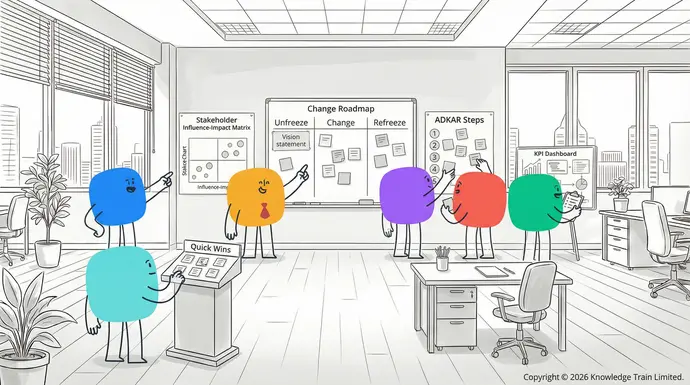
What is change management?
Change management refers to the systematic process of planning, implementing, and overseeing organisational changes to achieve desired business outcomes.
Change management encompasses strategies, techniques, and tools that help organisations prepare for, execute, and sustain change, whether related to processes, technologies, culture, or organisational structure.
Effective change management seeks to minimise disruption, address resistance to change, and strengthen engagement among all
Engaging people with the change process
A key part of managing change in an organisation is to engage those people affected by a change initiative. Staff will be involved in the change process eventually, therefore communicating and engaging with staff about a change plan early helps lay the groundwork for its later success.
Preparing for organisational transition
Change managers are often appointed to make organisational change go smoothly. They use change management frameworks to make changes such as:
- Restructuring job roles.
- Restructuring business processes.
- Implementing new technologies.
Decreasing resistance to a change initiative
Resistance is inevitable in any change initiative because people often find it unsettling being asked to work in new and different ways. So, change managers can often expect a denial reaction from staff. It takes time to overcome those reactions. When change managers are transparent from day one, the less resistance they are likely to face.
Improving performance and productivity
When an organisation adapts improved ways of working, it tends to increase productivity. At the same time, it encourages innovation. As a result, it guarantees improved performance and places an organisation in a healthier environment better able to succeed.
Reducing costs
When positive change is applied correctly, it helps to reduce waste and therefore reduce costs. Effective change management helps an organisation make smart choices. It increases productivity, decreases risks, and helps to improve the profitability of an organisation.
Change management principles
- Clear communication: Ensure transparency and regular updates throughout the process.
- Leadership involvement: Leaders must champion change and encourage desired behaviours.
- Stakeholder engagement: Involve and listen to those affected by the change.
- Process improvement : Focus on refining and optimising business processes.
- Proactive risk management : Identify, assess, and mitigate potential challenges.
- : Monitor outcomes and adjust strategies where necessary.
- Business transformationPractitioner : Large-scale initiatives such as mergers or digitalisation depend on robust change management for success.Includes Foundation & Practitioner combined option.
- Includes Foundation & Practitioner combined option.: Identifying and actively involving key stakeholders is crucial in minimising resistance and ensuring buy-in.P3O
- Leadership®: Strong, credible leadership drives the success of change initiatives through clear direction and support.Foundation
Change management best practicesLearn the fundamentals of the P3O project management office.
- Establish clear communication strategiesPractitioner tailored to different stakeholder groups.Includes Foundation & Practitioner combined option.
- Appoint dedicated change agentsWorkshops to guide and support the change process.Introduction to Project Management
- Use data to inform decisions1-day workshop to learn the basics of project management. and measure progress through key performance indicators (KPIs).Project Management Essentials
- Encourage feedback2-day workshop to learn how to manage projects without getting certified. from employees at every stage.Writing Business Cases
- Provide training and supportHalf-day workshop to learn to write robust business cases. to build new skills and confidence.AI in Project Management
- Integrate change into company cultureLearn how to use AI tools in everyday project work. to ensure lasting results.ARTIFICIAL INTELLIGENCE (AI)
| ModelFoundation | Core StepsLearn the fundamentals of artificial intellegence. | Main FocusAI Project Governance Framework (AIPGF) |
|---|---|---|
| Kotter’s 8-StepFoundation | 8 outlined stepsLearn the fundamentals of the governance framework. | Building urgency, vision, momentumPractitioner |
| Lewin’s ChangeIncludes Foundation & Practitioner combined option. | Unfreeze, Change, RefreezeWorkshops | Preparing, transitioning, embeddingAI in Project Management |
| ADKARLearn how to use AI tools in everyday project work. | Awareness, Desire, Knowledge, Ability, ReinforcementAGILE | Individual adoption stagesAgilePM |