
Many organisations use change management methodologies to enable ideas to succeed. Working alongside , and project managerscost who deliver new capabilities into an organisation, . By learning this concept, project managers can make informed decisions when trade-offs are required and ensure that they deliver high-quality results.change managersWe hope that our blog post on the project management triangle has provided you with a clear and concise understanding of the concept. Remember, project management is not just about executing tasks but also involves communication with stakeholders, ongoing monitoring and adjustment of project parameters, team collaboration, and accountability, and continuous process improvement. Balancing these constraints is critical for project success, regardless of the industry or project type. As the case studies have shown, the effective application of the project management triangle can lead to exceptional outcomes. and change agents help ensure staff are able to fully utilise the new capabilities.We encourage you to apply these principles to your projects and experience the benefits of successful project management. With the right mindset, tools, and techniques, you will be able to navigate through challenges, meet stakeholder expectations, and consistently deliver successful outcomes. Embrace the project management triangle as an invaluable part of your project management toolkit.
Enabling cross-functional changesFAQs
Almost every functional unit within a modern organisation relies on change management to enable it to:What is the iron triangle in project management?
- Align the change plan to the business’s overall strategy.The iron triangle is another name for the project management triangle, emphasising the importance of balancing scope, time, and cost.
- Improve internal and external services and requests.How does changing one constraint affect the others in the project management triangle?
- Track and resolve issues.Changing one constraint typically impacts the other two, requiring adjustments to maintain balance and quality.
Engaging people with the change processCan the project management triangle be applied to all types of projects?
A key part of Yes, the project management triangle is a versatile concept that can be applied to various industries and projects.managing changeWhat are some signs that a project’s constraints are out of balance? in an organisation is to engage those people affected by a change initiative. Staff will be involved in the change process eventually, therefore communicating and engaging with staff about a change plan early helps lay the groundwork for its later success.Signs of imbalance may include frequent scope changes, missed deadlines, budget overruns or quality issues.
Preparing for organisational transitionHow often should project managers review and adjust the project management triangle?
Change managersRegular reviews are crucial, especially at significant milestones or when major changes occur. are often appointed to make organisational change go smoothly. They use What role does innovation play in managing the project management triangle?change management frameworksInnovation can help optimise processes, potentially improving all constraints simultaneously. to make changes such as:Infographic
- Restructuring job roles.Subscribe to our exclusive offers and promotions
- Restructuring business processes.
- Implementing new technologies.Subscribe now
Decreasing resistance to a change initiative
Resistance is inevitable in any change initiative because people often find it unsettling being asked to work in new and different ways. So, change managers can often expect a denial reaction from staff. It takes time to overcome those reactions. When change managers{"@context":"https://schema.org","@type":"ImageObject","contentUrl":"https://www.knowledgetrain.co.uk/training-courses/project-management-triangle.png","description":"An image of a project management triangle that balances Cost, Time, and Scope, with Quality at the center.","license":"https://www.knowledgetrain.co.uk/license","acquireLicensePage":"https://www.knowledgetrain.co.uk/license","creditText":"Knowledge Train","uploadDate":"2024-10-14T09:00:28.000Z","copyrightNotice":"© 2024 Knowledge Train Limited. All rights reserved.","creator":{"@type":"Organization","name":"Knowledge Train","url":"https://www.knowledgetrain.co.uk"}} are transparent from day one, the less resistance they are likely to face.
Improving performance and productivity{"@context":"https://schema.org","@type":"ImageObject","contentUrl":"https://www.knowledgetrain.co.uk/training-courses/project-management-triangle-application.webp ","description":"Triangle steps: choose a flexible constraint, prioritise, manage risk, and create a change process.","license":"https://www.knowledgetrain.co.uk/license","acquireLicensePage":"https://www.knowledgetrain.co.uk/license","creditText":"Knowledge Train","uploadDate":"2024-10-14T09:00:28.000Z","copyrightNotice":"© 2024 Knowledge Train Limited. All rights reserved.","creator":{"@type":"Organization","name":"Knowledge Train","url":"https://www.knowledgetrain.co.uk"}}
When an organisation adapts improved ways of working, it tends to increase productivity. At the same time, it encourages innovation. As a result, it guarantees improved performance and places an organisation in a healthier environment better able to succeed.
Reducing costs{"@context":"https://schema.org","@type":"ImageObject","contentUrl":"https://www.knowledgetrain.co.uk/training-courses/project-management-triangle-infographic-v1.0.webp ","description":"Project management triangle infographic","license":"https://www.knowledgetrain.co.uk/license","acquireLicensePage":"https://www.knowledgetrain.co.uk/license","creditText":"Knowledge Train","uploadDate":"2024-10-14T09:00:28.000Z","copyrightNotice":"© 2024 Knowledge Train Limited. All rights reserved.","creator":{"@type":"Organization","name":"Knowledge Train","url":"https://www.knowledgetrain.co.uk"}}
When positive change is applied correctly, it helps to reduce waste and therefore reduce costs. Effective change management helps an organisation make smart choices. It increases productivity, decreases risks, and helps to improve the profitability of an organisation.
Change management principlesRelated articles
- Clear communication : Ensure transparency and regular updates throughout the process.
- Leadership involvement : Leaders must champion change and encourage desired behaviours.
- Stakeholder engagement : Involve and listen to those affected by the change.
- Process improvement : Focus on refining and optimising business processes.
- Proactive risk management : Identify, assess, and mitigate potential challenges.
- Continuous feedback and adaptation : Monitor outcomes and adjust strategies where necessary.
Change management processesWhat is PMP Certification? | How to Get Project Management Professional Certified
- Identify the need for change : Recognise drivers such as technological advancements, market shifts, or process inefficiencies.Knowledge Train
- Define the vision and objectives29 Apr 2026: Set clear goals for what the change will achieve.
- Engage stakeholdersPMP certification is a globally recognised qualification for project managers, awarded by the Project Management Institute (PMI). It demonstrates advanced knowledge and experience in project management and is highly valued across multiple industries worldwide.: Involve key groups early to build support and address concerns.
- Develop a change management plan
- project managementPRINCE2 Foundation exam mock questions ensures project deliverables are adopted and sustained.
- Business transformationSimon Buehring: Large-scale initiatives such as mergers or digitalisation depend on robust change management for success.19 Feb 2026
- Stakeholder engagement : Identifying and actively involving key stakeholders is crucial in minimising resistance and ensuring buy-in.Access a full PRINCE2 Foundation exam sample for free. Perfect for assessing your readiness for the actual exam.
- Leadership : Strong, credible leadership drives the success of change initiatives through clear direction and support.
Change management best practices
- Establish clear communication strategies tailored to different stakeholder groups.
- Appoint dedicated change agents to guide and support the change process.
- Use data to inform decisionsPRINCE2 practices: Free ebook and measure progress through key performance indicators (KPIs).
- Encourage feedbackSimon Buehring from employees at every stage.19 Feb 2026
- Provide training and support to build new skills and confidence.Get a free ebook on PRINCE2 practices to prepare for your PRINCE2 Foundation exam. Discover the integrated elements of PRINCE2 by reading further.
- Integrate change into company culture to ensure lasting results.
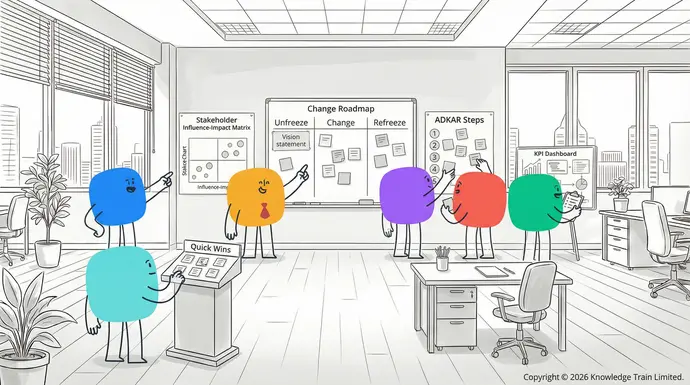
| Model | Core Steps | Main Focus |
|---|---|---|
| Kotter’s 8-Step | 8 outlined stepsPRINCE2 vs the PMBOK | Building urgency, vision, momentum® |
| Lewin’s Change Guide: A comparison | Unfreeze, Change, Refreeze | Preparing, transitioning, embeddingSimon Buehring |
| ADKAR19 Feb 2026 | Awareness, Desire, Knowledge, Ability, Reinforcement | Individual adoption stagesThis article offers a detailed comparison between PRINCE2 and the PMBOK® Guide, helping you understand their unique methods and frameworks. Scroll down for insights. |
What role do leaders play in change management?
Leaders set the direction, communicate the vision, build trust, allocate resources, and provide motivation and support to drive successful change.
How can employees be engaged during change initiatives?
Engage employees by involving them early, asking for input, addressing worries, providing training, celebrating successes, and continuously seeking feedback to make improvements.