Change management: models, steps, and best practices{"@context":"http://schema.org","@type":"BreadcrumbList","itemListElement":[{"@type":"ListItem","position":1,"name":"Home","item":"https://www.knowledgetrain.co.uk/"},{"@type":"ListItem","position":2,"name":"Project Management","item":"https://www.knowledgetrain.co.uk/project-management"},{"@type":"ListItem","position":3,"name":"Project management examples","item":"https://www.knowledgetrain.co.uk/project-management/project-management-examples"}]}

What is change management? are undertaken. This can include construction, engineering, software development, marketing, event planning, product development, and many others. The principles and practices of project management are widely applicable and can be used to improve the success rate of projects of all kinds.
Change managementSuccessful refers to the systematic process of planning, implementing, and overseeing organisational changes to achieve desired business outcomes.project management
Change management encompasses strategies, techniques, and tools that help organisations prepare for, execute, and sustain change, whether related to processes, technologies, culture, or organisational structure. helps ensure that resources are used efficiently, deliverables are completed on time, quality is maintained, and risks are managed appropriately.
Effective change management seeks to minimise disruption, address resistance to change, and strengthen engagement among all In and increasingly competitive and rapidly changing business environment, project management is more important than ever for organisational success. By adopting effective project management practices, organisations can better adapt to changing market needs and maintain a competitive edge.stakeholdersIn this article, we will take a look at .ten practical examples
Importance of change management of project management to give you an idea of the scope and application of this discipline in the real world. We will also discuss some of the key elements and skills that every project manager should possess in order to lead projects to success.
Organisational change is inevitable as businesses adapt to evolving markets, technologies, and regulations. By using structured frameworks and engaging leadership, organisations can minimise risks, foster innovation, and achieve sustainable success.Understanding project management fundamentals
Effective Successful project management begins with understanding the fundamentals of the process, as well as the key skills required to be a project manager. These include problem-solving and strategic planning, leadership and communication, technical expertise, and team and time management.change managementCore components of project management ensures smooth transitions, maintains productivity during transformation, increases return on investment, and supports Planningemployee engagement: Effective project management begins with a well-defined plan. The project manager needs to clearly outline the scope, objectives, and deliverables of the project, as well as the resources and timeline required to achieve them..Execution
Here are some reasons why change management is important.: The project manager and their team work together to carry out the tasks and activities outlined in the plan. This may involve coordinating with other departments, managing resources, and making decisions to keep the project on track.
External factorsMonitoring
External factors play a big role in : Project managers need to regularly monitor the progress of the project and track its performance against the plan. This includes identifying and addressing any issues or risks that may arise during the project.organisational changeCompletion. Globalisation and the rapid developments in new digital solutions are forcing organisations to respond. Ignoring such external factors is likely to jeopardise your organisation’s success.: Finally, once the project is complete, the project manager needs to ensure that the deliverables are handed over to the appropriate parties and that the success of the project is evaluated.
Nokia was once the biggest mobile phone company in the world, but it almost went out of business. That’s because it didn’t keep up with changes in mobile technologies. As a result, Nokia’s products didn’t appeal to consumers, and its market share rapidly declined.Essential project management skills
Making ideas succeed Problem-solving and strategic planning
Many organisations use change management methodologies to enable ideas to succeed. Working alongside : A good project manager is a strong problem solver and can develop effective strategies to overcome any challenges that arise during the project.project managersLeadership and communication who deliver new capabilities into an organisation, : The project manager should be able to effectively lead their team and communicate with stakeholders to ensure that everyone is on the same page and working towards the same goals.change managersTechnical expertise and change agents help ensure staff are able to fully utilise the new capabilities.: Project managers should have a solid understanding of the technical aspects of their industry, as well as the tools and methodologies used in project management.
Enabling cross-functional changesTeam and time management
Almost every functional unit within a modern organisation relies on change management to enable it to:: The project manager needs to be able to effectively manage their team and resources to ensure that the project stays on schedule and within budget.
- Align the change plan to the business’s overall strategy.These are the fundamental elements that every project manager needs to understand and manage to lead successful projects. With the right skills, a project manager can effectively plan, execute, monitor, and complete a project to achieve its goals and objectives.
- Improve internal and external services and requests.Enhance your skills with our expert-led courses
- Restructuring job roles.
- Restructuring business processes.
- Implementing new technologies.
Decreasing resistance to a change initiative
Resistance is inevitable in any change initiative because people often find it unsettling being asked to work in new and different ways. So, change managers can often expect a denial reaction from staff. It takes time to overcome those reactions. When
Reducing costsSelf-paced
When positive change is applied correctly, it helps to reduce waste and therefore reduce costs. Effective change management helps an organisation make smart choices. It increases productivity, decreases risks, and helps to improve the profitability of an organisation.AgilePM Practitioner (with Foundation) self-paced online
Change management principles
- Clear communication£1,299 +vat: Ensure transparency and regular updates throughout the process.10 real-world project management examples
- Leadership involvementProject management is a versatile skill set that can be applied to a wide variety of projects in the real world. Here are ten diverse examples of project management from various industries to demonstrate the broad applicability of this discipline.: Leaders must champion change and encourage desired behaviours.1. Organising a fundraiser
- Stakeholder engagementSetting goals and budgets: Involve and listen to those affected by the change.The
- Process improvementproject manager: Focus on refining and optimising business processes. establishes the fundraiser’s goals and objectives, including the target amount to be raised. They create a budget that includes all expenses associated with the fundraiser, such as venue rental, marketing materials, and refreshments.
- Proactive Volunteer managementrisk managementThe project manager recruits volunteers to assist with the fundraiser. They create a volunteer schedule, assign roles and responsibilities, and provide training and support to ensure that all volunteers understand their tasks and the event’s overall objectives.: Identify, assess, and mitigate potential challenges.Event execution and evaluation
- Continuous feedback and adaptationOn the day of the event, the project manager ensures that everything runs smoothly. They monitor the event’s progress, address any issues that arise, and ensure that all tasks are completed as planned. After the event, they evaluate its success and document any : Monitor outcomes and adjust strategies where necessary.lessons learned
Change management processes for future reference.
- Identify the need for change2. Home renovation project: Recognise drivers such as technological advancements, market shifts, or process inefficiencies.Blueprint creation and permit applications
- Define the vision and objectivesThe project manager works with the homeowner and architect to develop detailed blueprints for the renovation project. They also navigate the permit application process, ensuring that all necessary permits are obtained before work begins.: Set clear goals for what the change will achieve.Contractor coordination
- Engage stakeholdersThe project manager sources and manages contractors for the renovation project. They vet potential contractors, negotiate contracts, and coordinate their schedules to ensure that the renovation stays on track.: Involve key groups early to build support and address concerns.Budget and schedule management
- Develop a change management planThe project manager tracks the renovation project’s budget and timeline. They manage cash flow, handle payments, and adjust the timeline as needed to keep the project on track and within budget.: Outline actions, timelines, resources, and communication strategies.3. Process improvement innovation
- Implement the changeMarket research and consumer feedback: Launch the initiative, ensuring leadership guidance and active support from The change agentsproject manager. conducts market research to understand the current market landscape and identify potential opportunities for innovation and improvement. They also gather consumer feedback through surveys, focus groups, and other channels to understand their needs and pain points.
- Manage resistance to changeSolution brainstorming
- Implementation and integration
Coordinating with IT teams, the project manager oversees the integration of the loyalty programme into existing systems. They ensure seamless data flow between the programme and other customer-facing platforms.SolutionMonitoring and optimisation: Communicate regularly, using clear and consistent messaging across channels.After launch, the project manager continuously monitors programme performance. They analyse customer engagement data, gather feedback, and implement improvements to enhance the programme’s effectiveness and customer satisfaction. - Lack of leadership commitmentProject management methodologies and tools: Without executive support, initiatives may falter.Effective project management is grounded in proven methodologies and supported by robust tools. Familiarity with these can greatly improve the success rate of projects.
Popular methodologiesSolutionWaterfall: Gain leadership buy-in and ensure visible commitment throughout the transition.: A linear and sequential approach where each phase must be completed before the next begins. Ideal for projects with well-defined requirements and minimal expected changes. - Cultural misalignmentAgile: Change may conflict with existing organisational culture.: A flexible and iterative approach,
AgileSolution is suited for projects with evolving requirements. It promotes continuous improvement and customer collaboration.: Integrate change efforts with culture change and organisational development strategies.Lean - Insufficient resources or planning: Concentrates on maximising value while reducing waste and is popular in manufacturing and software development.: Poor planning can delay or derail change projects.Scrum
: A subset of Agile, SolutionScrum : Invest in utilises short, time-boxed iterations known as sprints. Effective for complex projects that need frequent reassessment.project managementSix Sigma, transition planning, and risk assessment.: A data-driven approach aimed at eliminating defects and reducing variability. Commonly used in quality improvement projects.
Change management and business functionsEssential project management tools
- Organisational developmentProject management software: Change management techniques are often a core part of organisational development, aiming for long-term improvement in effectiveness.:
- Project managementTools: Integrating change management with like Microsoft Project, Asana, and Trello help organise tasks, timelines, and team responsibilities.project managementCommunication tools ensures project deliverables are adopted and sustained.: Platforms such as Slack and Microsoft Teams enable real-time communication and collaboration.
- Business transformationDocument management systems: Large-scale initiatives such as mergers or digitalisation depend on robust change management for success.: SharePoint and Google Drive allow for centralised storage and easy access to project documents.
- Stakeholder engagementTime-tracking software: Identifying and actively involving key stakeholders is crucial in minimising resistance and ensuring buy-in.: Harvest and Toggl are useful for monitoring time spent on tasks, aiding in resource allocation and billing.
- LeadershipRisk management tools: Strong, credible leadership drives the success of change initiatives through clear direction and support.: Assist in identifying, assessing, and mitigating potential project risks.
Change management best practicesSelecting the appropriate methodology and tools depends on the project’s nature, team dynamics, and organisational culture. Proficiency in these methodologies and tools is essential for modern
- Establish clear communication strategiesproject managers tailored to different stakeholder groups. to navigate complex projects successfully.
- Appoint dedicated change agentsEnhance your skills with our expert-led courses to guide and support the change process.
- Use data to inform decisions and measure progress through key performance indicators (KPIs).
- Encourage feedbackSelf-paced from employees at every stage.APM PFQ blended online
- Provide training and support to build new skills and confidence.£749 +vat
- Integrate change into company culture to ensure lasting results.
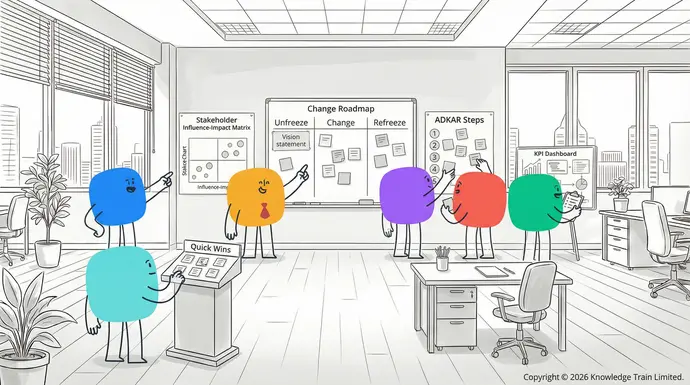
| ModelSelf-paced | Core StepsPRINCE2 Agile Practitioner (with Foundation) self-paced online | Main Focus |
|---|---|---|
| Kotter’s 8-Step£1,399 +vat | 8 outlined steps | Building urgency, vision, momentum |
| Lewin’s Change | Unfreeze, Change, RefreezeSelf-paced | Preparing, transitioning, embeddingAgilePM Practitioner (with Foundation) self-paced online |
| ADKAR | Awareness, Desire, Knowledge, Ability, Reinforcement£1,299 +vat | Individual adoption stagesConclusion |
FAQsHow can I gain project management experience without formal training?
What is change management and why is it important?You can gain project management experience by volunteering for leadership roles in community organisations or taking on small-scale projects at work. Offer to coordinate team initiatives or assist current project managers. Managing personal projects, such as event planning or home renovations, using
Change management is the process of guiding organisations, individuals, or teams through transitions. It is important because it enables smoother implementation of change, reduces resistance, and ensures that strategic objectives are achieved efficiently.project management principles
What are common change management frameworks? can also be beneficial.
The most common frameworks are Kotter’s 8-Step Process, Lewin’s Change, and the What are the most in-demand project management certifications?ADKARThe framework. Each provides a structured approach to planning and implementing change.Project Management Professional
How do you overcome resistance to change? (PMP) certification is the most widely recognised and valued. Other popular certifications include
Overcome resistance by communicating benefits clearly, involving stakeholders, offering support and training, addressing concerns promptly, and recognising employee contributions throughout the transition.PRINCE2
What role do leaders play in change management?,
Leaders set the direction, communicate the vision, build trust, allocate resources, and provide motivation and support to drive successful change.Agile Certified Practitioner
How can employees be engaged during change initiatives? (PMI-ACP), and Certified ScrumMaster (CSM). The best certification for you depends on your industry and career goals.
Engage employees by involving them early, asking for input, addressing worries, providing training, celebrating successes, and continuously seeking feedback to make improvements.How do I handle unexpected challenges during a project?