Change management: models, steps, and best practices

- Track and resolve issues.Understanding project scheduling
Engaging people with the change process
A key part of Steps to create a project scheduleProject scheduling techniques in an organisation is to engage those people affected by a change initiative. Staff will be involved in the change process eventually, therefore communicating and engaging with staff about a change plan early helps lay the groundwork for its later success.
Preparing for organisational transitionAdvanced scheduling concepts
Change managers are often appointed to make organisational change go smoothly. They use Tools for project schedulingchange management frameworks to make changes such as:Best practices for effective scheduling
- Restructuring job roles.
- Restructuring business processes.Common challenges in scheduling
- Implementing new technologies.
Decreasing resistance to a change initiativeConclusion
Resistance is inevitable in any change initiative because people often find it unsettling being asked to work in new and different ways. So, change managers can often expect a denial reaction from staff. It takes time to overcome those reactions. When change managersFAQs are transparent from day one, the less resistance they are likely to face.Introduction
Improving performance and productivityProject scheduling
When an organisation adapts improved ways of working, it tends to increase productivity. At the same time, it encourages innovation. As a result, it guarantees improved performance and places an organisation in a healthier environment better able to succeed. is an integral part of effective
Reducing costsproject management
When positive change is applied correctly, it helps to reduce waste and therefore reduce costs. Effective change management helps an organisation make smart choices. It increases productivity, decreases risks, and helps to improve the profitability of an organisation.. Project scheduling includes the development of a project timeline, including tasks, resources, and milestones, that is necessary to ensure a project’s successful completion. A solid schedule can provide a roadmap for project execution, allowing
Change management principlesproject managers
- Clear communication to allocate resources, monitor progress and recognise potential issues in advance.: Ensure transparency and regular updates throughout the process.In the modern workplace, having an edge in project scheduling is vital to the successful
- Leadership involvementdelivery of projects: Leaders must champion change and encourage desired behaviours. within the time and budget constraints. In this article, we will explore the fundamentals of project scheduling. We will discuss key concepts, techniques, and best practices for project scheduling. In addition, we will analyse the challenges commonly faced in project scheduling and review tools and software solutions that can simplify and optimise the process.
- Stakeholder engagementUnderstanding project scheduling: Involve and listen to those affected by the change.What is a project schedule?
- Process improvementA : Focus on refining and optimising business processes.project schedule
- Proactive is a detailed document that outlines the timeline of tasks and milestones that must be completed to accomplish the project. It acts as a roadmap for project execution and monitoring.risk managementComponents of a project schedule: Identify, assess, and mitigate potential challenges.Tasks and activities
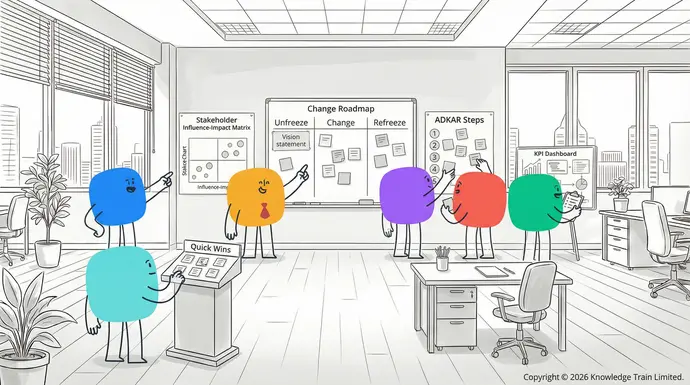
Kotter’s 8-Step ProcessWork Breakdown Structure
- Establish a sense of urgency (WBS).
- Form a guiding coalitionList all required tasks
- Create a vision for changeDetermine project milestones
- Communicate the visionGroup related tasks into work packages.
- Empower broad-based action2. Sequence activities
- Gantt chart
- Desire (or another visual representation). to support the change6. Share and monitor progress
- KnowledgeShare the finalised schedule with the team members and stakeholders and track and report on the progress. Consider using of how to changeproject management software
- Ability for real-time updates and collaboration. to implement changeSet up regular progress meetings
- ReinforcementEncourage team members to report the task completions as soon as they are done to sustain changeUpdate the schedule if necessary to account for the actual progress.
Example: In a software roll-out, employees learned why the upgrade was essential (Awareness, Desire), received hands-on workshops (Knowledge, Ability), and were rewarded for adoption (Reinforcement).With these steps, you can create a comprehensive project schedule that will guide your team to successful project completion.
Change management challengesEnhance your skills with our expert-led courses
Organisations frequently encounter obstacles when managing change. Common challenges include:
- Resistance to change : Employees may fear job loss, uncertainty, or increased responsibilities.
Self-pacedSolutionAPM PFQ blended online: Foster open communication, involve employees in decision-making, and provide adequate support. - Poor communication£749 +vat: Inadequate information can cause confusion and low morale.
Solution : Communicate regularly, using clear and consistent messaging across channels.Self-paced - Lack of leadership commitmentPRINCE2 Agile Practitioner (with Foundation) self-paced online: Without executive support, initiatives may falter.
£1,399 +vatSolution : Gain leadership buy-in and ensure visible commitment throughout the transition. - Cultural misalignment : Change may conflict with existing organisational culture.Self-paced
AgilePM Practitioner (with Foundation) self-paced onlineSolution : Integrate change efforts with culture change and organisational development strategies.£1,299 +vat - Insufficient resources or planningProject scheduling techniques: Poor planning can delay or derail change projects.There are several techniques available for the effective creation and management of project schedules. Some of these techniques include Gantt charts, task lists, and calendars. This knowledge train will cover the definition and purpose of each of these techniques, the advantages and limitations of using each, when it is appropriate to use each, and benefits for smaller projects. The knowledge train aims to provide a comprehensive understanding of project scheduling techniques to help project managers make informed decisions about which techniques to use for their projects.
Gantt chartsSolutionDefinition and purpose: Invest in A project managementGantt chart, transition planning, and risk assessment. is a type of bar chart that is commonly used in project management to visually represent a project schedule. It shows the start and end dates of project tasks, as well as their duration, as horizontal bars along a timeline. Gantt charts can also be used to display the dependencies between tasks.
Change management and business functionsAdvantages and limitations
- Organisational developmentAdvantages: Change management techniques are often a core part of organisational development, aiming for long-term improvement in effectiveness.Provides a visual representation of task dependencies
- Project managementSimplifies the identification of the critical path: Integrating change management with Capable of showing progress against the planned schedule.project managementLimitations ensures project deliverables are adopted and sustained.Can become cluttered and difficult to read for larger projects with many tasks
- Business transformationCan be time-consuming to create and maintain: Large-scale initiatives such as mergers or digitalisation depend on robust change management for success.Limited ability to show detailed task dependencies and resource allocation.
- Stakeholder engagementTask lists: Identifying and actively involving key stakeholders is crucial in minimising resistance and ensuring buy-in.When to use task lists
- LeadershipTask lists are often used in project management as a basic tool for organising and tracking project activities. They can be useful in the early stages of a project, or as a supplement to more advanced scheduling techniques. Task lists are appropriate to use when the project is relatively simple, and the team members are familiar with the tasks.: Strong, credible leadership drives the success of change initiatives through clear direction and support.Benefits for small projects
Change management best practicesSimple to develop and maintain
- Establish clear communication strategiesFacilitate clear communication of responsibilities tailored to different stakeholder groups.Allow quick changes and revisions.
- Appoint dedicated change agentsCalendars to guide and support the change process.Uses in project scheduling
- Use data to inform decisionsCalendars are often used in project management to help visualise and plan the timeline of a project. They can be used to track important project dates, such as milestones, deadlines, and deliverables. Calendars can also be used to provide an overall view of the project’s timeline. and measure progress through key performance indicators (KPIs).Limitations of calendar-based scheduling
- Encourage feedbackInadequate representation of task dependencies from employees at every stage.May lack necessary detail for more intricate projects
- Provide training and supportChallenges in depicting tasks with varying durations. to build new skills and confidence.Project scheduling techniques are an essential aspect of project management and choosing the right technique can greatly impact the success of a project. By understanding the advantages and limitations of each technique, as well as when and where to use them,
- Integrate change into company cultureproject managers to ensure lasting results. can effectively create and manage project schedules. Combining multiple techniques, such as using a Gantt chart to track progress and a calendar to visualise the timeline, can also be a useful strategy for managing project schedules.
| ModelThe more complex the | Core Stepsproject | Main Focus, the more benefit can be gained from advanced scheduling techniques. CPM and CCPM are methods to take your project planning to the next level. |
|---|---|---|
| Kotter’s 8-StepCritical Path Method (CPM) | 8 outlined stepsDefinition and importance | Building urgency, vision, momentumThe |
| Lewin’s ChangeCritical Path Method | Unfreeze, Change, Refreeze (CPM) is a project management technique used to identify the longest path of dependent tasks in a project schedule. The critical path determines the minimum project duration. | Preparing, transitioning, embedding |
| ADKAR | Awareness, Desire, Knowledge, Ability, Reinforcement | Individual adoption stagesIdentifying the critical path |
FAQsCCPM uses buffer time at the project level, rather than padding individual tasks
What is change management and why is it important?CCPM aims to reduce multitasking and encourage early task completion.
Change management is the process of guiding organisations, individuals, or teams through transitions. It is important because it enables smoother implementation of change, reduces resistance, and ensures that strategic objectives are achieved efficiently.Both methods can provide useful insights for optimising project schedules and enhancing overall project management efficiency.
What are common change management frameworks?Tools for project scheduling
The most common frameworks are Kotter’s 8-Step Process, Lewin’s Change, and the If you’re going to be doing project scheduling on a regular basis, you might find it useful to consider using specialist software to help you with this. A quick search online will pull up a range of tools. Some popular options include:ADKARProject management software options framework. Each provides a structured approach to planning and implementing change.Jira