Change management: models, steps, and best practicesEstonia

Effective Key responsibilities of a project managerchange management ensures smooth transitions, maintains productivity during transformation, increases return on investment, and supports Essential skills for project managersemployee engagement .Qualifications and career path
Here are some reasons why change management is important.
External factorsFuture trends in project management
External factors play a big role in organisational changeConclusion. Globalisation and the rapid developments in new digital solutions are forcing organisations to respond. Ignoring such external factors is likely to jeopardise your organisation’s success.
Nokia was once the biggest mobile phone company in the world, but it almost went out of business. That’s because it didn’t keep up with changes in mobile technologies. As a result, Nokia’s products didn’t appeal to consumers, and its market share rapidly declined.FAQs
Making ideas succeed Introduction
Many organisations use change management methodologies to enable ideas to succeed. Working alongside Project managersproject managers are in-demand professionals who can be found in virtually every industry. They are responsible for planning, executing, and overseeing who deliver new capabilities into an organisation, projectschange managers from start to finish, ensuring successful outcomes. and change agents help ensure staff are able to fully utilise the new capabilities.Project management
Enabling cross-functional changes skills are essential for:
Almost every functional unit within a modern organisation relies on change management to enable it to:Efficiently utilising resources
- Align the change plan to the business’s overall strategy.Reducing risks
- Improve internal and external services and requests.Promoting innovation
- Track and resolve issues.Achieving organisational goals.
Engaging people with the change processIn this article, we will discuss the core roles and skills required for
A key part of project managementmanaging change success. We’ll also cover qualifications, potential career paths, and future trends in this rapidly growing field. Whether you are interested in making a career change or enhancing your in an organisation is to engage those people affected by a change initiative. Staff will be involved in the change process eventually, therefore communicating and engaging with staff about a change plan early helps lay the groundwork for its later success.project management abilities
Preparing for organisational transition, read on to find out more!
Change managersKey responsibilities of a project manager are often appointed to make organisational change go smoothly. They use Project managers have a wide variety of roles and responsibilities, each of which is important for the overall success of a project. These can be broadly categorised into four main areas:change management frameworksProject planning and initiation to make changes such as:Define clear
Recruit and motivate the right team members for the projectWhen an organisation adapts improved ways of working, it tends to increase productivity. At the same time, it encourages innovation. As a result, it guarantees improved performance and places an organisation in a healthier environment better able to succeed.
- Engage stakeholders : Involve key groups early to build support and address concerns.
- Develop a change management plan : Outline actions, timelines, resources, and communication strategies.Self-paced
- Implement the changePRINCE2 Agile Practitioner (with Foundation) self-paced online: Launch the initiative, ensuring leadership guidance and active support from change agents£1,399 +vat.
- Manage resistance to change : Identify the sources of resistance and address them through communication and support.
- Monitor progress and reinforceSelf-paced: Use metrics to track success and celebrate milestones.AgilePM Practitioner (with Foundation) self-paced online
- Sustain change : Embed new ways of working into culture and practices for lasting results.£1,299 +vat
Change management frameworksEssential skills for project managers
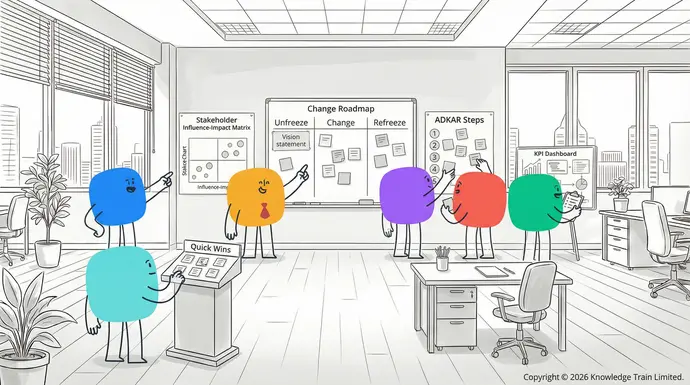
Several Project managers need a combination of hard and soft skills to lead their change management frameworksprojects guide organisations through transitions. The most prominent include: to success. This is what sets great project managers apart from the rest and makes them able to deliver results.
- Kotter’s 8-Step ProcessTechnical skills
- Lewin’s Change FrameworkIn-depth understanding of
- ADKAR frameworkproject management methodologies
Kotter’s 8-Step Process such as
- Establish a sense of urgencyPRINCE2
- Form a guiding coalition and
- Create a vision for changeAgile
- Communicate the visionProficiency in
- Empower broad-based actionproject management software
- Generate short-term wins like Microsoft Project or Jira
- Consolidate gains and produce more changeKnowledge of industry-specific tools and techniques related to the project field.
- Anchor new approaches in the cultureSoft skills
Example: A retailer launching a new digital platform began with urgency around changing customer expectations, formed a cross-functional team, communicated a compelling vision, and celebrated early improvements to build momentum.Leadership and team management
Lewin’s Change ModelAbility to inspire and motivate team members
- UnfreezeCreate a collaborative work environment: Prepare the organisation to accept change by challenging the status quo.Conflict resolution skills.
- ChangeCommunication and negotiation: Transition through adoption of new behaviours and processes.Clearly articulate project goals and expectations
- RefreezeNegotiation skills with stakeholders and team members: Stabilise the organisation by embedding changes into everyday practice.Ability to present complex information in a simple and understandable way.
Example: A manufacturer seeking to improve quality first destabilised old habits, implemented new protocols, then reinforced behaviours through training and recognition.Problem-solving and decision-making
ADKAR modelAnalyse problems from various angles
- AwarenessMake informed decisions under pressure of the need for changeImplement innovative solutions to overcome challenges.
- DesireTime management and organisation to support the changePrioritise tasks effectively
- KnowledgeManage multiple deadlines of how to changeMaintain accurate project documentation.
- AbilityBusiness acumen to implement changeIn-depth understanding of business processes and organisational structures.
- ReinforcementFinancial management skills for budget and resource allocation to sustain changeStrategic thinking to align
Example: In a software roll-out, employees learned why the upgrade was essential (Awareness, Desire), received hands-on workshops (Knowledge, Ability), and were rewarded for adoption (Reinforcement).projects
Change management challenges with overall business goals.
Organisations frequently encounter obstacles when managing change. Common challenges include:Developing these core skills, project managers can successfully guide teams, overcome obstacles, and achieve project goals. Embracing a mindset of continuous improvement is essential in this ever-evolving discipline.
- Resistance to changeQualifications and career path: Employees may fear job loss, uncertainty, or increased responsibilities.Educational background
Relevant degrees: Business, engineering, or SolutionIT: Foster open communication, involve employees in decision-making, and provide adequate support.. - Poor communicationProfessional certifications: : Inadequate information can cause confusion and low morale.APM
(Association for Project Management) and SolutionPMI: Communicate regularly, using clear and consistent messaging across channels. (Project Management Institute). - Lack of leadership commitmentEntry-level positions: Without executive support, initiatives may falter.Assistant project manager
Sector-specific project coordinator.SolutionThese roles typically offer experience in project support and coordination. They are an excellent opportunity to learn from experienced professionals and gain practical skills.: Gain leadership buy-in and ensure visible commitment throughout the transition.Career progression - Cultural misalignmentAs project managers gain experience, there are opportunities for career advancement such as:: Change may conflict with existing organisational culture.Senior project manager
Programme managerSolutionProject Management Office: Integrate change efforts with culture change and organisational development strategies. (PMO) manager. - Insufficient resources or planningEach role typically comes with increased responsibility and involvement in the strategic aspects of an organisation’s projects.: Poor planning can delay or derail change projects.Continuing professional development
To be effective, you need to keep learning and developing in Solutionproject management: Invest in :project managementAttend relevant conferences and workshops, transition planning, and risk assessment.Work towards higher level certifications (PMP,
Change management and business functionsPRINCE2 Practitioner
- Organisational development): Change management techniques are often a core part of organisational development, aiming for long-term improvement in effectiveness.Be active in professional networks and forums.
- Project managementCareer path example:: Integrating change management with Stageproject management ensures project deliverables are adopted and sustained.
FAQs
What is change management and why is it important?project management skills
Change management is the process of guiding organisations, individuals, or teams through transitions. It is important because it enables smoother implementation of change, reduces resistance, and ensures that strategic objectives are achieved efficiently. across industries and organisations.
What are common change management frameworks?AI and automation
The most common frameworks are Kotter’s 8-Step Process, Lewin’s Change, and the : The growing use of artificial intelligence and automation tools for ADKARproject planning framework. Each provides a structured approach to planning and implementing change. and resource allocation.
How do you overcome resistance to change?Remote management
Overcome resistance by communicating benefits clearly, involving stakeholders, offering support and training, addressing concerns promptly, and recognising employee contributions throughout the transition.: The rise of remote and virtual project management as teams become more geographically dispersed.
What role do leaders play in change management?Sustainability focus
Leaders set the direction, communicate the vision, build trust, allocate resources, and provide motivation and support to drive successful change.: The integration of
How can employees be engaged during change initiatives?sustainability
Engage employees by involving them early, asking for input, addressing worries, providing training, celebrating successes, and continuously seeking feedback to make improvements. and social responsibility considerations into project management practices.