
Our courses and workshops include:
Certification exam(s) where applicable
- Accredited training course materials
- Expert, experienced trainers to support you
- Course manual where applicable.
- SELF-PACED ONLINE TRAINING COURSES
Name
- Request a quote Statistics
Always active
The technical storage or access that is used exclusively for statistical purposes.
- The technical storage or access that is used exclusively for anonymous statistical purposes. Without a subpoena, voluntary compliance on the part of your Internet Service Provider, or additional records from a third party, information stored or retrieved for this purpose alone cannot usually be used to identify you.
Decreasing resistance to a change initiative AgileBA Certification Preferences
Resistance is inevitable in any change initiative because people often find it unsettling being asked to work in new and different ways. So, change managers can often expect a denial reaction from staff. It takes time to overcome those reactions. When – specifically designed for change managers+44 (0)207 148 5985Business AnalystsUnited Kingdom
- Search
- {"@context":"https://schema.org","@type":"WebPage","name":"Agile Business Analysis: Definition, Roles & Best Practices","url":"https://www.knowledgetrain.co.uk/agile/agile-business-analysis","description":"Explore Agile Business Analysis, its roles, frameworks, techniques and how BAs add value in Agile environments. Compare Agile and traditional business analysis.","significantLink":"https://www.iiba.org/certification/agile-analysis-certification-endorsement/","mainEntity":[{"@type":"Article","headline":"Agile Business Analysis explained","about":[{"@type":"DefinedTerm","name":"Agile Business Analysis","sameAs":["https://en.wikipedia.org/wiki/Agile_business_analysis","https://www.google.com/search?&kgmid=/g/11h_h7r8x7","https://www.wikidata.org/wiki/Q57496180"]},{"@type":"DefinedTerm","name":"Business Analyst","sameAs":["https://en.wikipedia.org/wiki/Business_Analyst","https://www.google.com/search?&kgmid=/m/0b1txf4","https://www.wikidata.org/wiki/Q2970349"]},{"@type":"DefinedTerm","name":"Scrum","sameAs":["https://en.wikipedia.org/wiki/Scrum_(software_development)","https://www.google.com/search?&kgmid=/m/01rfwj","https://www.wikidata.org/wiki/Q15900473"]},{"@type":"DefinedTerm","name":"Kanban","sameAs":["https://en.wikipedia.org/wiki/Kanban","https://www.google.com/search?&kgmid=/m/0131j1","https://www.wikidata.org/wiki/Q1146727"]},{"@type":"DefinedTerm","name":"Product Owner","sameAs":["https://en.wikipedia.org/wiki/Product_owner","https://www.google.com/search?&kgmid=/g/121xfpw0","https://www.wikidata.org/wiki/Q21660523"]},{"@type":"DefinedTerm","name":"Scrum Master","sameAs":["https://en.wikipedia.org/wiki/Scrum_master","https://www.google.com/search?&kgmid=/g/11c1wwjfcw","https://www.wikidata.org/wiki/Q21098157"]},{"@type":"DefinedTerm","name":"Stakeholder","sameAs":["https://en.wikipedia.org/wiki/Stakeholder_(corporate)","https://www.google.com/search?&kgmid=/m/02k0y4","https://www.wikidata.org/wiki/Q2380010"]},{"@type":"DefinedTerm","name":"Backlog","sameAs":["https://en.wikipedia.org/wiki/Product_backlog","https://www.google.com/search?&kgmid=/g/1219vjg1","https://www.wikidata.org/wiki/Q7605156"]},{"@type":"DefinedTerm","name":"User Stories","sameAs":["https://en.wikipedia.org/wiki/User_story","https://www.google.com/search?&kgmid=/m/0c6q5pr","https://www.wikidata.org/wiki/Q509695"]},{"@type":"DefinedTerm","name":"Requirements","sameAs":["https://en.wikipedia.org/wiki/Requirements_analysis","https://www.google.com/search?&kgmid=/m/01ypk_","https://www.wikidata.org/wiki/Q467915"]},{"@type":"DefinedTerm","name":"Requirements Elicitation","sameAs":["https://en.wikipedia.org/wiki/Requirements_elicitation","https://www.google.com/search?&kgmid=/g/121z4ljy","https://www.wikidata.org/wiki/Q7312824"]},{"@type":"DefinedTerm","name":"Prioritization","sameAs":["https://en.wikipedia.org/wiki/Priority_(project_management)","https://www.google.com/search?&kgmid=/m/09g5y_q","https://www.wikidata.org/wiki/Q3508070"]},{"@type":"DefinedTerm","name":"Sprint","sameAs":["https://en.wikipedia.org/wiki/Sprint_(software_development)","https://www.google.com/search?&kgmid=/g/1td1gpft","https://www.wikidata.org/wiki/Q3841694"]},{"@type":"DefinedTerm","name":"Agile Principles","sameAs":["https://en.wikipedia.org/wiki/Agile_software_development","https://www.google.com/search?&kgmid=/m/05jff","https://www.wikidata.org/wiki/Q1009523"]},{"@type":"DefinedTerm","name":"Iteration","sameAs":["https://en.wikipedia.org/wiki/Iterative_and_incremental_development","https://www.google.com/search?&kgmid=/m/05f_8c","https://www.wikidata.org/wiki/Q783076"]},{"@type":"DefinedTerm","name":"Acceptance Criteria","sameAs":["https://en.wikipedia.org/wiki/Acceptance_criteria","https://www.google.com/search?&kgmid=/g/11bwyznvj0","https://www.wikidata.org/wiki/Q10326466"]},{"@type":"DefinedTerm","name":"Agile Techniques","sameAs":["https://en.wikipedia.org/wiki/Agile_software_development","https://www.google.com/search?&kgmid=/m/05jff","https://www.wikidata.org/wiki/Q1009523"]},{"@type":"DefinedTerm","name":"Story Mapping","sameAs":["https://en.wikipedia.org/wiki/User_story_mapping","https://www.google.com/search?&kgmid=/g/11c6kg16l0","https://www.wikidata.org/wiki/Q98627867"]},{"@type":"DefinedTerm","name":"Continuous Improvement","sameAs":["https://en.wikipedia.org/wiki/Continual_improvement_process","https://www.google.com/search?&kgmid=/g/122q9g94","https://www.wikidata.org/wiki/Q784522"]},{"@type":"DefinedTerm","name":"Collaboration","sameAs":["https://en.wikipedia.org/wiki/Collaboration","https://www.google.com/search?&kgmid=/m/0162wm","https://www.wikidata.org/wiki/Q5438"]}],"mentions":[{"@type":"DefinedTerm","name":"Backlog Grooming","sameAs":["https://en.wikipedia.org/wiki/Product_backlog#Backlog_grooming","https://www.google.com/search?&kgmid=/g/1219vjg1","https://www.wikidata.org/wiki/Q7605156"]},{"@type":"DefinedTerm","name":"Agile Team","sameAs":["https://en.wikipedia.org/wiki/Agile_software_development#Agile_teams","https://www.google.com/search?&kgmid=/m/05jff","https://www.wikidata.org/wiki/Q1009523"]},{"@type":"DefinedTerm","name":"Product Increment","sameAs":["https://en.wikipedia.org/wiki/Product_increment","https://www.google.com/search?&kgmid=/g/11j99nt2nt","https://www.wikidata.org/wiki/Q107434386"]},{"@type":"DefinedTerm","name":"IIBA Agile Certification","sameAs":["https://www.iiba.org/certification/agile-analysis-certification-endorsement/","https://www.wikidata.org/wiki/Q105861915"]}]},{"@type":"FAQPage","mainEntity":[{"@type":"Question","name":"Do you need a business analyst in Agile?","acceptedAnswer":{"@type":"Answer","text":"
- p>Having a business analyst in an Agile environment is essential. They act as facilitators of clear communication between business and technical teams, ensuring everyone understands the project goals and the best path to achieve them. Their skill in translating business requirements into actionable insights helps ensure the success of Agile projects. >
- p>You can learn more about the business analyst role in Agile environments by taking an Agile BA course.United Kingdom>"}},{"@type":"Question","name":"How do Agile Business Analysts contribute to backlog grooming?","acceptedAnswer":{"@type":"Answer","text":"Austria
- p>Agile Business Analysts help clarify, refine, and prioritise backlog items so the development team understands each user story before implementation. They ensure stories meet the definition of ready, facilitate stakeholder feedback, and support the Product Owner in maintaining a balanced, value-driven backlog. This improves sprint planning and ensures business goals are consistently met.Belgium>"}},{"@type":"Question","name":"How is the Agile BA role different from a traditional BA?","acceptedAnswer":{"@type":"Answer","text":"Bulgariap>Agile Business Analysts work iteratively and collaboratively, focusing on delivering Croatia
- strong>incremental business valueCyprus> through short development cycles. Traditional Business Analysts often document all requirements upfront and manage change via formal processes. In contrast, Agile BAs embrace change, encourage ongoing feedback, and continuously reprioritise work to align with evolving business needs.Czech Republic
>"}},{"@type":"Question","name":"How to become an Agile business analyst?","acceptedAnswer":{"@type":"Answer","text":"Denmark
- p>To become an Agile business analyst, start by learning the Agile principles and frameworks such as Scrum and Kanban. Gain hands-on experience by contributing to Agile projects and using tools like Jira, Confluence, and Miro.Estonia>Finland
- p>Develop skills in stakeholder communication, facilitation, and backlog management. You can strengthen your expertise by earning an Agile Business Analyst certification through a structured training programme.France>"}},{"@type":"Question","name":"What does an Agile Business Analyst do?","acceptedAnswer":{"@type":"Answer","text":"Germany
- p>An Agile Business Analyst collaborates with Product Owners, stakeholders, and development teams to translate business requirements into user stories, manage backlogs, and facilitate prioritisation. They ensure each product increment delivers measurable business value while supporting continuous improvement and adaptive planning.Greece>Ireland
- p>Typical responsibilities include:Italy>Latvia
- ul>Lithuaniali>Eliciting and analysing requirements collaborativelyLuxemburg>Maltali>Facilitating backlog refinement sessionsNetherlands
- >Polandli>Supporting sprint reviews and retrospectivesPortugal
- >Romaniali>Ensuring alignment between business goals and technical deliverySlovakia
- >Slovenia>"}},{"@type":"Question","name":"What is an Agile business analyst?","acceptedAnswer":{"@type":"Answer","text":"Spain
p>An Agile business analyst bridges the gap between business needs and technical delivery. They ensure that Agile teams deliver high-value outcomes aligned with organisational objectives while adhering to Agile principles.Sweden
>Other countriesp>They prioritise collaboration, transparency, and responsiveness, helping teams adapt to change and continuously improve. You can learn more about the Agile BA role by enrolling in an Agile Business Analyst certification course.Home>"}},{"@type":"Question","name":"What is the role of a business analyst in Agile?","acceptedAnswer":{"@type":"Answer","text":"Business analysis
- p>The role of a business analyst in Agile is to connect business goals with technical solutions. They ensure requirements are clear, testable, and prioritised to deliver maximum value. Unlike in traditional projects, Agile BAs collaborate continuously with Product Owners and teams throughout delivery cycles.
- >
- p>You can learn more about this role through an Agile Business Analyst certification course.What is business analysis?
>"}},{"@type":"Question","name":"What is the value of continuous improvement in Agile Business Analysis?","acceptedAnswer":{"@type":"Answer","text":"
- p>Continuous improvement is central to Agile Business Analysis. It ensures teams regularly assess performance, gather feedback, and make iterative adjustments to improve efficiency and outcomes.Simon Buehring
- >28 Apr 2026
- p>For Agile BAs, continuous improvement means refining processes, facilitating retrospectives, and identifying opportunities to deliver higher value. This culture of learning helps maintain alignment between project goals and evolving business needs.
- >"}},{"@type":"Question","name":"What tools do Agile BAs use?","acceptedAnswer":{"@type":"Answer","text":"
- p>Agile Business Analysts use various tools to collaborate, document, and manage work efficiently. Common tools include:
- >
- ul>
- li>
strong>Jira
> – for backlog management and sprint tracking
- > li>
- strong>Confluence > – for documentation and collaboration
- > li>
strong>Trello
> – for lightweight visual task management
- > li>
- strong>Miro > – for virtual whiteboarding and workshop facilitation
- > The technical storage or access is necessary for the legitimate purpose of storing preferences that are not requested by the subscriber or user.>Copied!
- p>These tools enable Agile BAs to maintain transparency, streamline communication, and support continuous feedback loops within teams.Key takeaways >"}},{"@type":"Question","name":"Which certifications are relevant for Agile BAs?","acceptedAnswer":{"@type":"Answer","text":"Business analysis turns business needs into clear requirements and evidence-based decisions.
- p>Several certifications are valuable for Agile Business Analysts seeking to validate their skills and advance their careers. Popular options include:Business analysis aligns strategic goals with delivery by bridging stakeholders and technical teams. >Clear requirements and validation reduce project risk and improve solution fit, cost and feasibility.
Statisticsul>Techniques like SWOT, gap analysis, process modelling and data analysis expose opportunities and bottlenecks.
Change management challenges li>Embedding analysis in governance strengthens planning, transparency and measurable outcomes.
Organisations frequently encounter obstacles when managing change. Common challenges include: strong>IIBA Agile Analysis Certification (IIBA-AAC)Rigour can be maintained alongside speed by using consistent standards, templates and lightweight frameworks.
- Resistance to change > – focuses on applying business analysis within Agile environments. APMG Change Management Practitioner course: Employees may fear job loss, uncertainty, or increased responsibilities.Statistics> Apply APMG Change Management in real projects with accredited Practitioner training, offered online as instructor-led or self-paced, either on its own or combined with Foundation.
li> Solution strong>Certified ScrumMaster (CSM)Contents : Foster open communication, involve employees in decision-making, and provide adequate support. > – ideal for those working closely with Scrum teams. - Poor communication > : Inadequate information can cause confusion and low morale. li>Contents4.9/5 average rating
strong>AgileBA Certification Solution > – specifically designed for Business Analysts working in Agile projects.Business analysis: definition and overview : Communicate regularly, using clear and consistent messaging across channels.The technical storage or access that is used exclusively for statistical purposes.> APMG accredited - Lack of leadership commitment >The objectives and value of business analysis : Without executive support, initiatives may falter.The technical storage or access that is used exclusively for anonymous statistical purposes. Without a subpoena, voluntary compliance on the part of your Internet Service Provider, or additional records from a third party, information stored or retrieved for this purpose alone cannot usually be used to identify you.p>These certifications demonstrate professional competence and help strengthen your understanding of Agile frameworks and business analysis practices.
>"}}]}]}Key responsibilities of a business analyst25,000+ professionals trainedSolution : Gain leadership buy-in and ensure visible commitment throughout the transition. Related articlesMain business analysis processes Enrol now - Cultural misalignment : Change may conflict with existing organisational culture. Common business analysis techniques More details
Marketing Solution Business analysis tools and methodologies : Integrate change efforts with culture change and organisational development strategies. - Insufficient resources or planning Essential skills and competencies for business analysts : Poor planning can delay or derail change projects.Marketing
Certification and career progression All major cards accepted.Solution Invoice/PO option available in checkout.: Invest in Related concepts project management , transition planning, and risk assessment. FAQs
Change management and business functions Business analysis: definition and overviewEnrol
- Organisational developmentHow Agile Business Analyst (AgileBA) training and qualifications can help your career The technical storage or access is required to create user profiles to send advertising, or to track the user on a website or across several websites for similar marketing purposes.
- Simon Buehring 19 Feb 2026Manage optionsOverview Manage servicesAgileBA training can elevate your career, offering both starter and advanced paths. Discover how by scrolling down. Manage {vendor_count} vendors
- Read more about these purposes Delivery
- Accept
- Deny Course
View preferences
- Agile methodologies Save preferences
- Simon BuehringExam 23 Feb 2026 View preferences
- {title}Discover the variety of Agile methodologies and their unique implementations across sectors. Read more to see which fits your needs. {title}
- Reviews{title} Manage consent
- Manage consent
- Contact us
| How do I become Agile certified? | Click or scroll | Simon BuehringEnrol on this course |
|---|---|---|
| 19 Feb 2026Please use the | region selector | Learn what it takes to become Agile certified and the advantages it brings to your professional life. Read on for examination tips. at the top of the website if you are purchasing from outside the UK. |
| Note: *All prices exclusive of VAT. | Choose how you want to study | |
| Choose delivery format: |
FAQs Requirements validation
What is change management and why is it important? £2,299Ensuring requirements are accurate, feasible, and aligned with business goals
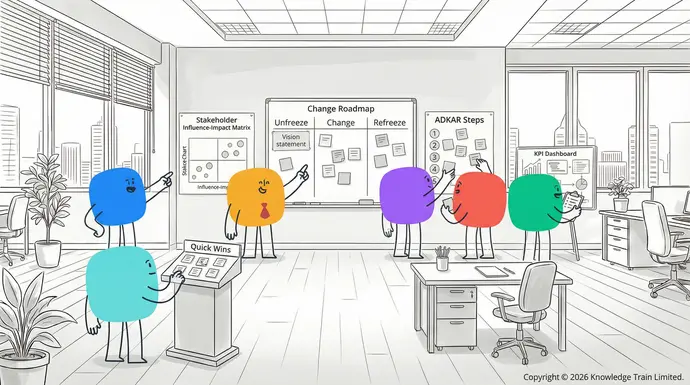
Change management is the process of guiding organisations, individuals, or teams through transitions. It is important because it enables smoother implementation of change, reduces resistance, and ensures that strategic objectives are achieved efficiently. Stakeholder engagement
What are common change management frameworks?Are Agile courses worth it?Enrol nowBuilding relationships with all parties affected by the change to ensure their needs are met
The most common frameworks are Kotter’s 8-Step Process, Lewin’s Change, and the Process improvementADKARSimon Buehring Analysing existing workflows and recommending enhancements for efficiency framework. Each provides a structured approach to planning and implementing change.23 Feb 2026 Solution assessment
How do you overcome resistance to change? Evaluating potential solutions against requirements
Overcome resistance by communicating benefits clearly, involving stakeholders, offering support and training, addressing concerns promptly, and recognising employee contributions throughout the transition.Find out if Agile courses are worth the investment and how they can fast-track your career. Scroll down for more details. {"@context":"http://schema.org","@type":"EducationEvent","name":"Change Management Practitioner (with Foundation) course","startDate":"2026-06-15","endDate":"2026-06-19","description":"Change Management Practitioner (with Foundation) course","url":"https://www.knowledgetrain.co.uk/change-management/change-management-courses/apmg-change-management-course/change-management-practitioner","eventStatus":"EventScheduled","eventAttendanceMode":"OnlineEventAttendanceMode","audience":{"@type":"Audience","name":"Change management
What role do leaders play in change management? ul>Supporting successful adoption of new processes or systems
Leaders set the direction, communicate the vision, build trust, allocate resources, and provide motivation and support to drive successful change. li>Common business analysis techniques
How can employees be engaged during change initiatives? span>Aspiring or current managers of organisational change, transition, or transformationSWOT analysis
Engage employees by involving them early, asking for input, addressing worries, providing training, celebrating successes, and continuously seeking feedback to make improvements. >: