Change management: models, steps, and best practicesAgile Project Management Course

Key takeaways
Effective change management blends clear planning with sustained support for adoption.
- Use structured frameworks such as Kotter, Lewin, or ADKAR to sequence activities and maintain momentum.
- Visible leadership sponsorship and consistent communication reduce uncertainty and resistance.
- Engage stakeholders early, using influence and impact mapping to target effort where it matters most.
- Integrate change work with project delivery so training, readiness, risks, and benefits stay aligned.
- Measure adoption with KPIs and feedback, then reinforce new behaviours through governance, coaching, and policy.Copied!
What is change management?Learn the 8 DSDM principles and ensure they stick in your mind with this handy graphic and article. Ideal if you are working on DSDM projects at the moment or taking an
Change managementAgilePM course refers to the systematic process of planning, implementing, and overseeing organisational changes to achieve desired business outcomes..
Change management encompasses strategies, techniques, and tools that help organisations prepare for, execute, and sustain change, whether related to processes, technologies, culture, or organisational structure.That’s because the Agile PM certification scheme is based upon the DSDM framework. So, by attending an
Effective change management seeks to minimise disruption, address resistance to change, and strengthen engagement among all Agile Project Management coursestakeholders (Agile PM course) you will essentially be learning about DSDM..DSDM (Dynamic Systems Development Method) – an agile method
Importance of change managementDSDM (Dynamic Systems Development Method) is an iterative agile framework which was originally developed to deliver software projects iteratively, and in a more efficient way. DSDM is sometimes referred to as DSDM Atern.
Organisational change is inevitable as businesses adapt to evolving markets, technologies, and regulations. By using structured frameworks and engaging leadership, organisations can minimise risks, foster innovation, and achieve sustainable success.DSDM became the first agile framework to incorporate agile project management aspects. Compared with
Effective Scrumchange management which focuses solely on product delivery during an iteration, DSDM also has built-in project management capabililties. DSDM therefore is quite different from other agile frameworks. ensures smooth transitions, maintains productivity during transformation, increases return on investment, and supports DSDM is not only useful on software projectsemployee engagementDSDM can be applied to .projects
Here are some reasons why change management is important. other than software projects. It can also be applied on any product development projects. By delivering a workable product incrementally at the end of each timebox, DSDM can deliver business value early in the product development lifecycle.
External factorsDSDM provides agile project management
External factors play a big role in In the UK, the Agile Business Consortium worked in partnership with APMG International to create Agile Project Management (AgilePM), an agile project management certification scheme with exams. agileKRC offers both classroom training in AgilePM, as well as e-learning solutions. Both training options include the organisational changeAgilePM exam. Globalisation and the rapid developments in new digital solutions are forcing organisations to respond. Ignoring such external factors is likely to jeopardise your organisation’s success..
Nokia was once the biggest mobile phone company in the world, but it almost went out of business. That’s because it didn’t keep up with changes in mobile technologies. As a result, Nokia’s products didn’t appeal to consumers, and its market share rapidly declined.Enhance your skills with our expert-led courses
Making ideas succeed
Many organisations use change management methodologies to enable ideas to succeed. Working alongside project managers who deliver new capabilities into an organisation, Instructor-ledchange managersAgilePM Practitioner (with Foundation) course and change agents help ensure staff are able to fully utilise the new capabilities.
Enabling cross-functional changes£1,699 +vat
Almost every functional unit within a modern organisation relies on change management to enable it to:
- Align the change plan to the business’s overall strategy.See all dates
- Improve internal and external services and requests.
- Track and resolve issues.
Engaging people with the change process
A key part of Self-pacedmanaging changeAgilePM Practitioner (with Foundation) self-paced online in an organisation is to engage those people affected by a change initiative. Staff will be involved in the change process eventually, therefore communicating and engaging with staff about a change plan early helps lay the groundwork for its later success.
Preparing for organisational transition£1,299 +vat
Change managers are often appointed to make organisational change go smoothly. They use change management frameworks to make changes such as:Instructor-led
- Restructuring job roles.AgilePM Foundation course
- Restructuring business processes.
- Implementing new technologies.£1,299 +vat
Decreasing resistance to a change initiative
Resistance is inevitable in any change initiative because people often find it unsettling being asked to work in new and different ways. So, change managers can often expect a denial reaction from staff. It takes time to overcome those reactions. When See all dateschange managersDSDM principles – the building blocks are transparent from day one, the less resistance they are likely to face.DSDM based upon principles
Improving performance and productivityBased upon 8 principles and an underlying agile philosophy, DSDM became a popular agile approach amongst software developers seeking an alternative to rapid application development (RAD) approaches in the years after 2000. RAD approaches did not scale well for people collaborating on a team however. DSDM thus became one of the first agile approaches to be used within the software development community.
When an organisation adapts improved ways of working, it tends to increase productivity. At the same time, it encourages innovation. As a result, it guarantees improved performance and places an organisation in a healthier environment better able to succeed.The 8 DSDM principles underpin the whole framework. Each principle must be adhered to by the project team, as ignoring any of the principles can increase the chance of project failure.
Reducing costsThe graphic below was created to help you learn about DSDM. If you like it, please show your appreciation by linking back to this page.
When positive change is applied correctly, it helps to reduce waste and therefore reduce costs. Effective change management helps an organisation make smart choices. It increases productivity, decreases risks, and helps to improve the profitability of an organisation.Now, let’s find out more about the
Change management principlesDSDM principles
- Clear communication and how teams can ensure they stick to them.: Ensure transparency and regular updates throughout the process.The 8 DSDM principles
- Leadership involvement1. Focus on the business need: Leaders must champion change and encourage desired behaviours.DSDM has a strong business-driven approach. A
- Stakeholder engagementbusiness case: Involve and listen to those affected by the change. must be established for the project and the team must understand project priorities. Every decision the team make during the project should help achieve the project goal and the team must ensure the project is delivered on time.
- Process improvementMoSCoW prioritisation: Focus on refining and optimising business processes.To adhere to this principle, DSDM teams have several tools at their disposal. For example, the
- Proactive MoSCoW techniquerisk management helps the team prioritise which of the business requirements : Identify, assess, and mitigate potential challenges.M
- Continuous feedback and adaptationust be, : Monitor outcomes and adjust strategies where necessary.S
Change management processeshould be,
- Identify the need for changeC: Recognise drivers such as technological advancements, market shifts, or process inefficiencies.ould be or
- Define the vision and objectivesW: Set clear goals for what the change will achieve.on’t be delivered. Timeboxing helps to separate work into manageable chunks of time, with each chunk having its own deliverables and deadline.
- Engage stakeholdersThe Foundation phase in DSDM also helps the team build focus. During this phase, team roles are established. The team then form the overall strategy, decide how risk/quality will be assessed, how technology will be used and how the project will be managed.: Involve key groups early to build support and address concerns.2. Deliver on time
- Develop a change management planFixed time periods: Outline actions, timelines, resources, and communication strategies.DSDM is an agile framework that works plans work in fixed time periods (timeboxes), rather like sprints in
- Implement the changeAgile Scrum: Launch the initiative, ensuring leadership guidance and active support from . The aim is to deliver a useable software product at the end of each timebox (iteration). DSDM is thus an incremental approach, as well as an iterative development approach to delivering software.change agentsDSDM places a strong emphasis on prompt delivery, proposing that even projects without any need for a fixed deadline still benefit from one. This is because having deadlines is the best way to control changing requirements. To stick to this principle, DSDM teams should focus on priorities, hit deadlines and manage their time by using the .MoSCoW
- Manage resistance to change and timeboxing techniques.: Identify the sources of resistance and address them through communication and support.3. Collaborate
- Monitor progress and reinforceTeam spirit and collaboration is highly important for DSDM teams. This is based on a rejection of having multiple departments that rarely interact. Teams should instead work as one unit and collaborate to encourage understanding, higher performance and shared ownership.: Use metrics to track success and celebrate milestones.Business and technical staff work together
- Sustain changeDSDM teams fulfil this principle by having business and technical staff together in the team, instead of separately. The team involve stakeholders throughout the project and ensure each team member feels empowered to make decisions. The team use ‘workshops’ to meet stakeholders and involve them in the project.: Embed new ways of working into culture and practices for lasting results.Ensuring collaboration
Change management frameworksThe visionary, ambassador and business advisor roles also ensure collaboration. The visionary conveys the sponsor’s needs to the team and ensures the business case objectives are achieved. Ambassadors communicate user’s needs to the development team, whilst business advisors assist with areas such as law or marketing. On a non-agile project, these roles would be performed outside of the project or would not exist at all.
Several 4. Never compromise qualitychange management frameworksQuality is always fixed on DSDM projects and must be decided at the start. The final product shouldn’t be any more or any less than the quality decided upon. guide organisations through transitions. The most prominent include:Continuous testing
- Kotter’s 8-Step ProcessTo adhere to this principle, DSDM teams must ensure quality doesn’t become a variable by testing continuously and reviewing constantly. This testing and reviewing occurs during the ‘exploration’ and ‘engineering’ iterative development phases. Testing should happen early in the project. Again, MoSCoW and timeboxing can be used to ensure testing is appropriate and organized.
- Lewin’s Change Framework5. Build incrementally from firm foundations
- ADKAR frameworkDSDM differs from other
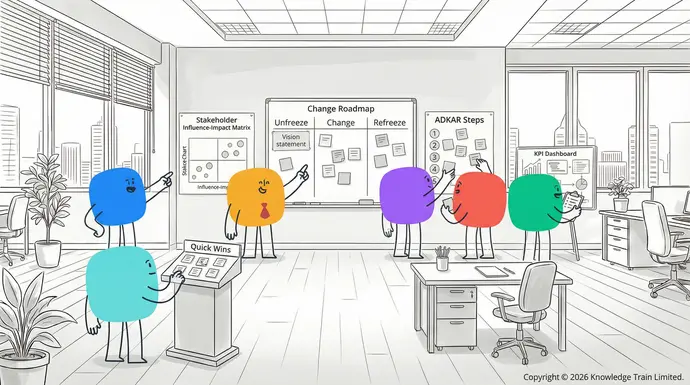
Kotter’s 8-Step Processagile methods
- Establish a sense of urgency as it requires the foundations of the project to be agreed early. The foundations don’t need to be in too much detail – just agree on what the problem is and how to solve it. Once foundations are established, the solution must be delivered incrementally.
- Form a guiding coalitionJust enough design up front
- Create a vision for changeTo adhere to this principle, DSDM teams must ensure they perform analysis and ‘enough design up front’ (EDUF) at the start of the project. During each increment, the team must re-assess priorities and project viability, ensuring they have taken stakeholder feedback into consideration. Both the feasibility and foundation phases allow for establishing a foundation; the exploration and engineering phases allow for incremental delivery.
- Communicate the vision6. Develop iteratively
- Empower broad-based actionDSDM proposes that nothing is created perfectly first time and projects operate in a constantly changing world. Incremental delivery allows for such change to be embraced and leads to higher stakeholder satisfaction. Each iteration is combined with testing, demonstrations and feedback. This ensures that each iteration improves upon the last and leads to a decent final product.
- Generate short-term winsFeedback loop
- Consolidate gains and produce more changeDSDM teams can adhere to this principle by building feedback into each iteration. They must also be in the mindset that details should emerge later, not sooner, and they must embrace change. During each iteration, they should encourage creativity and experimentation, which will lead to learning and improvement. Constant review and feedback allow for change and progress to occur.
- Anchor new approaches in the cultureTo deliver an incremental working release of software at the end of each iteration DSDM recommends the
Example: A retailer launching a new digital platform began with urgency around changing customer expectations, formed a cross-functional team, communicated a compelling vision, and celebrated early improvements to build momentum.MoSCoW prioritisation
Lewin’s Change Model technique to prioritise requirements to be worked on by the team during a timebox. Requirements are typically capture in the form of
- Unfreezeuser stories: Prepare the organisation to accept change by challenging the status quo..
- Change7. Communicate continuously and clearly: Transition through adoption of new behaviours and processes.Bad communication often leads to project failure and traditional non-agile approaches fail to address this. DSDM aims to improve communication by using frequent face-to-face meetings, visual communication (modelling), advance releases of prototypes and workshop sessions.
- RefreezeDaily stand-ups: Stabilise the organisation by embedding changes into everyday practice.DSDM teams can fulfil this principle with several methods. One way is to encourage team interaction through daily stand-up meetings. These informal meetings allow the team to meet and discuss issues or ideas together. Facilitated workshops are also an effective way for stakeholders to improve their understanding and discuss requirements.
Example: A manufacturer seeking to improve quality first destabilised old habits, implemented new protocols, then reinforced behaviours through training and recognition.DSDM teams commonly use modelling and prototyping to further improve communication. These practical methods help replace the need for heavy, useless documentation.
ADKAR modelModelling
- AwarenessModelling is a visual form of communication utilizing diagrams. This allows for complex systems, designs and products to be better understood. of the need for changeDSDM makes use of prototyping by creating prototypes of the product early in development, to allow stakeholders to ‘test-drive’ early versions of the solution. The idea is to build something fast, get feedback quickly, and to break it sooner, rather than later. The underlying DSDM philosophy is that if something isn’t going to work, it is better to find that out as soon as possible, and change course sooner, rather than later.
- DesirePrototyping to support the changePrototyping means creating prototypes of the product early in development, to allow stakeholders to ‘test-drive’ early versions of the solution.
- Knowledge8. Demonstrate control of how to changeIt is vital to keep control of the project. DSDM proposes that it is only possible to do this by using a plan aligned to the project aims, with both being accessible to the entire team.
- AbilityEnsure progress is visible to implement changeDSDM teams, especially the
- Reinforcementproject manager to sustain change and team leader, can fulfil this principle by ensuring plans and progress are visible to everyone. Managing must be proactive with an emphasis on reporting and tracking.
Example: In a software roll-out, employees learned why the upgrade was essential (Awareness, Desire), received hands-on workshops (Knowledge, Ability), and were rewarded for adoption (Reinforcement).Measure progress by delivery
Change management challengesAlso, progress must be measured by looking at what has been delivered, rather than activities completed. Timeboxing helps to control who is doing what and when. DSDM can also be combined with methods such as Kanban, which help teams to visualize project progress and see who is doing what, when and how long it will take them.
Organisations frequently encounter obstacles when managing change. Common challenges include:Enhance your skills with our expert-led courses
- Resistance to change : Employees may fear job loss, uncertainty, or increased responsibilities.
SolutionInstructor-led: Foster open communication, involve employees in decision-making, and provide adequate support.AgilePM Practitioner (with Foundation) course - Poor communication : Inadequate information can cause confusion and low morale.£1,699 +vat
SolutionSee all dates: Communicate regularly, using clear and consistent messaging across channels. - Lack of leadership commitment : Without executive support, initiatives may falter.
Self-pacedSolutionAgilePM Practitioner (with Foundation) self-paced online: Gain leadership buy-in and ensure visible commitment throughout the transition. - Cultural misalignment£1,299 +vat: Change may conflict with existing organisational culture.
Solution : Integrate change efforts with culture change and organisational development strategies.Instructor-led - Insufficient resources or planningAgilePM Foundation course: Poor planning can delay or derail change projects.
£1,299 +vatSolution : Invest in See all datesproject managementSummary, transition planning, and risk assessment.As you might have noticed, the eight
Change management and business functionsDSDM principles
- Organisational development embody the principles of the agile manifesto. The focus on iterative delivery, effective communication, collaboration and continuous delivery all align with the agile philosophy. DSDM also has some of its own characteristics – it’s process model and specific team roles – for instance. Yet, many of the other tools and techniques recommended by DSDM – modelling, prototyping and workshops, timeboxing, MoSCoW – are used by other agile methods.: Change management techniques are often a core part of organisational development, aiming for long-term improvement in effectiveness.Because DSDM sticks to the original agile philosophy, this makes it an effective method to adopt in any workplace. If these principles strike a chord with you, why not take an
- Project managementAgile PM course: Integrating change management with ?project managementDSDM ensures project deliverables are adopted and sustained.®
- Business transformation is a Registered Trade Mark of Agile Business Consortium Limited.: Large-scale initiatives such as mergers or digitalisation depend on robust change management for success.FAQs
- Stakeholder engagementWhat is the difference between Agile and DSDM?: Identifying and actively involving key stakeholders is crucial in minimising resistance and ensuring buy-in.Agile
- Leadership is an ‘umbrella’ term to represent a multitude of approaches, practices, and methods that are based upon the : Strong, credible leadership drives the success of change initiatives through clear direction and support.Agile principles
Change management best practices contained within the
- Establish clear communication strategiesAgile Manifesto tailored to different stakeholder groups..
- Appoint dedicated change agentsDSDM to guide and support the change process. is a specific Agile approach which was designed to manage Agile projects because until that point, all Agile methods were purely development methods and did not contain any broader project management focus. DSDM set out to incorporate a project management approach into Agile environments.
- Use data to inform decisionsSubscribe to our exclusive offers and promotions and measure progress through key performance indicators (KPIs).
- Encourage feedbackSubscribe now from employees at every stage.
- Provide training and support to build new skills and confidence.{"@context":"https://schema.org","@type":"ImageObject","contentUrl":"https://www.knowledgetrain.co.uk/training-courses/dsdm-principles-890x501.webp","description":"Agile DSDM principles.","license":"https://www.knowledgetrain.co.uk/license","acquireLicensePage":"https://www.knowledgetrain.co.uk/license","creditText":"Knowledge Train","uploadDate":"2023-05-18T02:52:22.000Z","copyrightNotice":"© 2023 Knowledge Train Limited. All rights reserved.","creator":{"@type":"Organization","name":"Knowledge Train","url":"https://www.knowledgetrain.co.uk"}}
- Integrate change into company culture to ensure lasting results.{"@context":"https://schema.org","@type":"ImageObject","contentUrl":"https://www.knowledgetrain.co.uk/training-courses/res/images/agile/agile-project-management/8-dsdm-principles.webp","description":"DSDM principles infographic","license":"https://www.knowledgetrain.co.uk/license","acquireLicensePage":"https://www.knowledgetrain.co.uk/license","creditText":"Knowledge Train","uploadDate":"2023-05-18T02:52:22.000Z","copyrightNotice":"© 2023 Knowledge Train Limited. All rights reserved.","creator":{"@type":"Organization","name":"Knowledge Train","url":"https://www.knowledgetrain.co.uk"}}
| ModelRelated articles | Core Steps | Main Focus |
|---|---|---|
| Kotter’s 8-Step | 8 outlined steps | Building urgency, vision, momentum |
| Lewin’s Change | Unfreeze, Change, Refreeze | Preparing, transitioning, embedding |
| ADKAR | Awareness, Desire, Knowledge, Ability, Reinforcement | Individual adoption stages |