
employee engagement.To provide the best experiences, we use technologies like cookies to store and/or access device information. Consenting to these technologies will allow us to process data such as browsing behavior or unique IDs on this site. Not consenting or withdrawing consent, may adversely affect certain features and functions.
Here are some reasons why change management is important.
External factors
External factors play a big role in organisational change . Globalisation and the rapid developments in new digital solutions are forcing organisations to respond. Ignoring such external factors is likely to jeopardise your organisation’s success.Functional
Nokia was once the biggest mobile phone company in the world, but it almost went out of business. That’s because it didn’t keep up with changes in mobile technologies. As a result, Nokia’s products didn’t appeal to consumers, and its market share rapidly declined.
Making ideas succeed
Many organisations use change management methodologies to enable ideas to succeed. Working alongside project managers who deliver new capabilities into an organisation, Functionalchange managers and change agents help ensure staff are able to fully utilise the new capabilities. Always active
Enabling cross-functional changes
Almost every functional unit within a modern organisation relies on change management to enable it to:
- Align the change plan to the business’s overall strategy.
- Improve internal and external services and requests.
- Track and resolve issues.
Engaging people with the change process
A key part of The technical storage or access is strictly necessary for the legitimate purpose of enabling the use of a specific service explicitly requested by the subscriber or user, or for the sole purpose of carrying out the transmission of a communication over an electronic communications network.managing change in an organisation is to engage those people affected by a change initiative. Staff will be involved in the change process eventually, therefore communicating and engaging with staff about a change plan early helps lay the groundwork for its later success.
Preparing for organisational transition
Change managers are often appointed to make organisational change go smoothly. They use Preferenceschange management frameworks to make changes such as:
Resistance is inevitable in any change initiative because people often find it unsettling being asked to work in new and different ways. So, change managers can often expect a denial reaction from staff. It takes time to overcome those reactions. When
- MarketingManage resistance to change: Identify the sources of resistance and address them through communication and support.
- Monitor progress and reinforce : Use metrics to track success and celebrate milestones.
- Sustain change : Embed new ways of working into culture and practices for lasting results.
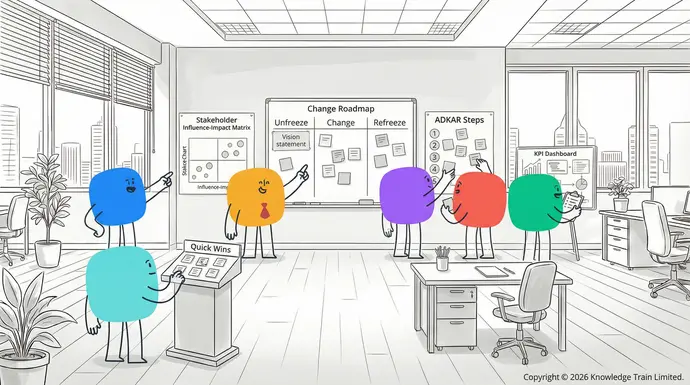
Change management frameworks
Several change management frameworksThe technical storage or access is required to create user profiles to send advertising, or to track the user on a website or across several websites for similar marketing purposes. guide organisations through transitions. The most prominent include:
- Kotter’s 8-Step ProcessManage options
- Lewin’s Change FrameworkManage services
- ADKAR frameworkManage {vendor_count} vendors
Kotter’s 8-Step ProcessRead more about these purposes
- Establish a sense of urgency
- Form a guiding coalitionAccept
- Create a vision for change
- Communicate the visionDeny
- Empower broad-based action
- Generate short-term winsView preferences
- Consolidate gains and produce more change
- Anchor new approaches in the cultureSave preferences
Example: A retailer launching a new digital platform began with urgency around changing customer expectations, formed a cross-functional team, communicated a compelling vision, and celebrated early improvements to build momentum.
Lewin’s Change ModelView preferences
- Unfreeze{title}: Prepare the organisation to accept change by challenging the status quo.{title}
- Change{title}: Transition through adoption of new behaviours and processes.Manage consent
- RefreezeManage consent: Stabilise the organisation by embedding changes into everyday practice.
Example: A manufacturer seeking to improve quality first destabilised old habits, implemented new protocols, then reinforced behaviours through training and recognition.
ADKAR model
- Awareness of the need for change
- Desire to support the change
- Knowledge of how to change
- Ability to implement change
- Reinforcement to sustain change
Example: In a software roll-out, employees learned why the upgrade was essential (Awareness, Desire), received hands-on workshops (Knowledge, Ability), and were rewarded for adoption (Reinforcement).
Change management challenges
Organisations frequently encounter obstacles when managing change. Common challenges include:
- Resistance to change: Employees may fear job loss, uncertainty, or increased responsibilities.
Solution: Foster open communication, involve employees in decision-making, and provide adequate support. - Poor communication: Inadequate information can cause confusion and low morale.
Solution: Communicate regularly, using clear and consistent messaging across channels. - Lack of leadership commitment: Without executive support, initiatives may falter.
Solution: Gain leadership buy-in and ensure visible commitment throughout the transition. - Cultural misalignment: Change may conflict with existing organisational culture.
Solution: Integrate change efforts with culture change and organisational development strategies. - Insufficient resources or planning: Poor planning can delay or derail change projects.
Solution: Invest in project management, transition planning, and risk assessment.
Change management and business functions
- Organisational development: Change management techniques are often a core part of organisational development, aiming for long-term improvement in effectiveness.
- Project management: Integrating change management with project management ensures project deliverables are adopted and sustained.
- Business transformation: Large-scale initiatives such as mergers or digitalisation depend on robust change management for success.
- Stakeholder engagement: Identifying and actively involving key stakeholders is crucial in minimising resistance and ensuring buy-in.
- Leadership: Strong, credible leadership drives the success of change initiatives through clear direction and support.
Change management best practices
- Establish clear communication strategies tailored to different stakeholder groups.
- Appoint dedicated change agents to guide and support the change process.
- Use data to inform decisions and measure progress through key performance indicators (KPIs).
- Encourage feedback from employees at every stage.
- Provide training and support to build new skills and confidence.
- Integrate change into company culture to ensure lasting results.
| Model | Core Steps | Main Focus |
|---|---|---|
| Kotter’s 8-Step | 8 outlined steps | Building urgency, vision, momentum |
| Lewin’s Change | Unfreeze, Change, Refreeze | Preparing, transitioning, embedding |
| ADKAR | Awareness, Desire, Knowledge, Ability, Reinforcement | Individual adoption stages |
FAQs
What is change management and why is it important?
Change management is the process of guiding organisations, individuals, or teams through transitions. It is important because it enables smoother implementation of change, reduces resistance, and ensures that strategic objectives are achieved efficiently.
What are common change management frameworks?
The most common frameworks are Kotter’s 8-Step Process, Lewin’s Change, and the ADKAR framework. Each provides a structured approach to planning and implementing change.
How do you overcome resistance to change?
Overcome resistance by communicating benefits clearly, involving stakeholders, offering support and training, addressing concerns promptly, and recognising employee contributions throughout the transition.
What role do leaders play in change management?
Leaders set the direction, communicate the vision, build trust, allocate resources, and provide motivation and support to drive successful change.
How can employees be engaged during change initiatives?
Engage employees by involving them early, asking for input, addressing worries, providing training, celebrating successes, and continuously seeking feedback to make improvements.