Change management: models, steps, and best practicesHome

Key takeaways
Effective change management blends clear planning with sustained support for adoption.
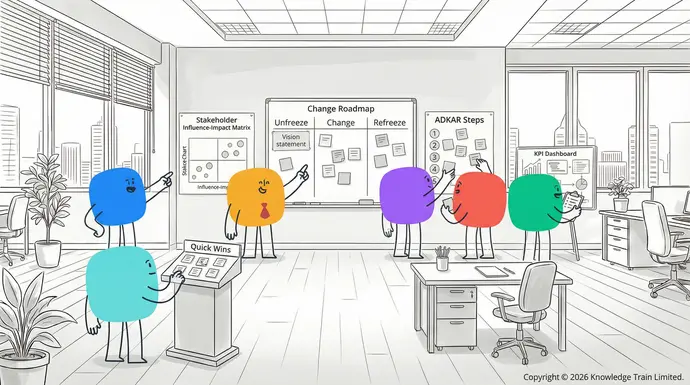
- Use structured frameworks such as Kotter, Lewin, or ADKAR to sequence activities and maintain momentum.
- Visible leadership sponsorship and consistent communication reduce uncertainty and resistance.
- Engage stakeholders early, using influence and impact mapping to target effort where it matters most.
- Integrate change work with project delivery so training, readiness, risks, and benefits stay aligned.
- Measure adoption with KPIs and feedback, then reinforce new behaviours through governance, coaching, and policy.
- PRINCE2 principles: Set clear goals for what the change will achieve.
- Engage stakeholders is a requirement if a project is to be a PRINCE2 project. The principles act as immutable laws that cannot be removed from a project.: Involve key groups early to build support and address concerns.The 7 principles within the methodology are described below.
- Develop a change management planEnsure continued business justification: Outline actions, timelines, resources, and communication strategies.A project is only successful if it realizes the expected benefits in return for its investment of money, time, and resources. Therefore, it is imperative that all investment decisions are based upon where the project is on course to achieve these objectives. If it isn’t, then it should be closed.
- Implement the changeLearn from experience: Launch the initiative, ensuring leadership guidance and active support from The experience of previous projects should be used to guide the practices on the current, and later projects.change agentsDefine roles, responsibilities, and relationships.Everyone involved in the
- Manage resistance to changeproject management team: Identify the sources of resistance and address them through communication and support. must be clear what they are accountable and responsible for.
- Monitor progress and reinforceManage by stages: Use metrics to track success and celebrate milestones.A project is broken down into 2 more management stages which form ‘stop/continue’ decision points. Any decision to continue necessitates the commitment of money and resources to the next stage.
- Sustain changeManage by exception: Embed new ways of working into culture and practices for lasting results.Authority to take decisions is granted by a higher authority to a lower authority which is an efficient use of senior managers’ time. The higher authority can be kept informed of progress via regular reports, but at the same time, the lower management level can manage with the delegated boundaries. If these boundaries are forecast to be exceeded, this exception is escalated to the higher level for a decision.
Change management frameworksFocus on products
Several Focusing on delivering on time and within budget cannot be done without first understanding what is to be delivered. All planning starts by focusing on products to understand what the plan should deliver.change management frameworksTailor to suit the project guide organisations through transitions. The most prominent include:Every project is different, therefore the methodology must be applied differently and sensibly in all situations.
Kotter’s 8-Step Process, both direct participants and those impacted by a project. Recognizing their needs, skills, motivations, and the relationships among them is essential for setting up and managing the project effectively. The methodology describes how the people impacted by the project’s outcomes, must ‘buy in’ to the proposed changes, otherwise the changes will be unsuccessful, and the project will be a wasted investment.
- Establish a sense of urgencyPractices
- Form a guiding coalitionThe
- Create a vision for changepractices
- Communicate the vision within the methodology are aspects of project management that are addressed throughout a project. They encompass areas like time, cost, risk, issues, quality, sustainability, and scope, common in other project management standards. These practices offer a decision-making framework, ensuring the project’s viability, desirability, and achievability from start to finish.
- Empower broad-based actionFor anyone familiar with the
- Generate short-term winsProject Management Body of Knowledge
- Consolidate gains and produce more change (PMBOK)
- Anchor new approaches in the culture®
Example: A retailer launching a new digital platform began with urgency around changing customer expectations, formed a cross-functional team, communicated a compelling vision, and celebrated early improvements to build momentum., the PRINCE2 practices are very similar to the knowledge areas of the PMBOK
Lewin’s Change Model®[2]
- Unfreeze.: Prepare the organisation to accept change by challenging the status quo.The 7 practices in the PRINCE2 methodology are described below.
- ChangeBusiness case: Transition through adoption of new behaviours and processes.This practice focuses on applying the ‘ensure business justification’ principle. It describes documenting the project’s rationale, initially in an outline business case, which is detailed further during the first management stage. The
- Refreezebusiness case: Stabilise the organisation by embedding changes into everyday practice. includes a cost-benefit analysis comparing project benefits against costs, timescales, and risks. It’s updated at each management stage’s end to guide the decision to continue or stop the project.
Example: A manufacturer seeking to improve quality first destabilised old habits, implemented new protocols, then reinforced behaviours through training and recognition.Organizing
ADKAR modelThis practice details the various project management team roles. Within
- AwarenessPRINCE2 of the need for change, the project board is the top decision-making body, consisting of the project executive, senior user, and senior supplier.
- DesireIt tasks the to support the changeproject manager
- Knowledge with the day-to-day project management, who operates within set tolerances. The project manager, in turn, assigns work packages for delivery by a team manager. of how to changeThe board operates on a ‘manage by exception’ principle, eliminating regular meetings with the project manager by receiving regular reports. Project assurance monitors project performance and advises both the project board and project manager.
- AbilityPlans to implement changePRINCE2 recommends distinct plans for each level of the project management team. The project board uses a high-level
- Reinforcementproject plan to sustain change to oversee project progress stage by stage. The project manager relies on a more detailed stage plan for in-stage progress, while team managers need detailed team plans to monitor their work package. Each plan is approved by the next highest management level.
Example: In a software roll-out, employees learned why the upgrade was essential (Awareness, Desire), received hands-on workshops (Knowledge, Ability), and were rewarded for adoption (Reinforcement).For planning, PRINCE2 suggests using product-based planning, emphasizing the ‘focus on products’ principles to identify products before using activity-based tools like Gantt charts.
Change management challengesPlans outline the “what, when, who, and how much?” Once approved, plans are set as baselines and are subject to change control.
Organisations frequently encounter obstacles when managing change. Common challenges include:Quality
- Resistance to changeThe project produces products which will later be used by users operating within the regular business operations. To achieve the expected outcomes and benefits, users need the correct products based on agreed specifications. PRINCE2 emphasizes planning to meet the anticipated quality standards, which must be actively overseen and managed.: Employees may fear job loss, uncertainty, or increased responsibilities.Risk
Risks are uncertain events that can positively or negatively affect a project. Every project faces risks that need proactive identification and management. A Solutionrisk management: Foster open communication, involve employees in decision-making, and provide adequate support. procedure should be set up to handle risks consistently. Risks surpassing the set tolerance level must be brought to senior management’s attention for resolution. - Poor communicationIssues: Inadequate information can cause confusion and low morale.Projects
inevitably face issues and changes, whether external, like new laws, or internal, such as shifting user requirements. PRINCE2 provides guidance for how issues can be managed to avoid them damaging the project, and how changes can be incorporated using cost-effective ways that contribute to the project’s outcomes and benefits.SolutionProgress: Communicate regularly, using clear and consistent messaging across channels.PRINCE2 identifies two types of controls: time-driven and event-driven. - Lack of leadership commitmentTime-driven controls, like regular highlight reports from the : Without executive support, initiatives may falter.project manager
to the board, track progress routinely (e.g., weekly). They compare actual progress to expected outcomes, facilitating necessary decisions and adjustments.SolutionEvent-driven controls arise in response to specific events. For instance, an exception report is created when a tolerance threat is predicted. These reports inform decision-making in response to events and are directed to the management level with decision-making authority.: Gain leadership buy-in and ensure visible commitment throughout the transition.Processes - Cultural misalignmentProcesses within the : Change may conflict with existing organisational culture.PRINCE2 methodology
outline the decisions to be made, by whom, and when during the project. The Solutionprocesses: Integrate change efforts with culture change and organisational development strategies. span from just before the project begins to its closure, aligning with management stages that act as ‘stop/continue’ major decision points. These processes ensure a structured project progression, with investment decisions made on a stage-by-stage basis. - Insufficient resources or planningThe PRINCE2 methodology outlines 7 processes which address:: Poor planning can delay or derail change projects.Required decisions
Decision-makersSolutionSupporting : Invest in management productsproject managementTiming of decisions., transition planning, and risk assessment.These processes are where PRINCE2’s principles and practices are implemented and equate ‘Process Groups’ in the PMBOK
Change management and business functions®
- Organisational development. The processes ensure methodical project progression, from before the project begins, through to when the project is closed.: Change management techniques are often a core part of organisational development, aiming for long-term improvement in effectiveness.Starting up a project
- Project managementFocuses on project idea feasibility. It results in a project brief answering why, what, how, and who. A positive decision leads to the project’s initiation stage.: Integrating change management with Directing a projectproject managementThe project board makes decisions based on regular and ad-hoc reports, approves plans, commits resources, manages the change budget, and addresses key project risks. ensures project deliverables are adopted and sustained.Initiating a project
- Business transformationThe project manager puts in place the firm foundations for the project. The project initiation documentation (PID) is developed, akin to the Project Management Plan in the PMBOK: Large-scale initiatives such as mergers or digitalisation depend on robust change management for success.®
- Stakeholder engagement. It details project specifics like scope, cost, duration, benefits, and roles and responsibilities.: Identifying and actively involving key stakeholders is crucial in minimising resistance and ensuring buy-in.Controlling a stage
- LeadershipHere, the project manager handles daily risk and issue management, delegates tasks, monitors work, reports regular progress to the project board, and ensures adherence to the stage plan.: Strong, credible leadership drives the success of change initiatives through clear direction and support.Managing product delivery
Change management best practicesConducted by a team manager, this involves overseeing work packages, delivering products, and reporting progress through regular checkpoint reports.
- Establish clear communication strategiesManaging a stage boundary tailored to different stakeholder groups.As a stage ends, the project manager prepares for the next stage, reports progress, updates the
- Appoint dedicated change agentsbusiness case to guide and support the change process., and revises forecasts. This informs the project board’s decision on project continuation or closure.
- Use data to inform decisionsClosing a project and measure progress through key performance indicators (KPIs).The project manager checks product acceptance and facilitates handover.
- Encourage feedbackLessons learned from employees at every stage. are documented, and an end project report is prepared. Upon project board’s approval, the project is archived and closed. This process can also be invoked for premature project closures.
- Provide training and supportProject context to build new skills and confidence.Every project is unique. In recognition of this fact, the PRINCE2 methodology must be applied sensibly in all projects. Applying PRINCE2 on one project
- Integrate change into company culturecontext to ensure lasting results., does not mean it should be applied the same way on another. This is where ‘tailoring’ comes in.
| ModelTailoring can be done to the processes and practices, but also to the roles and responsibilities, and | Core Stepsmanagement products | Main Focus. |
|---|---|---|
| Kotter’s 8-StepTailoring roles and responsibilities | 8 outlined stepsThe PRINCE2 methodology defines a set of responsibilities for every member of the | Building urgency, vision, momentumproject management team |
| Lewin’s Change. These responsibilities can be tailored by sharing (multiple people perform a role) or combining (one person performs multiple roles). | Unfreeze, Change, RefreezeProject board | Preparing, transitioning, embeddingHolds overarching authority over the project, representing all stakeholders: business, users, and suppliers. It is led by the executive (representing the funding organization) who holds the final decision-making power. Includes the senior user, representing the end-users, and the senior supplier, representing product providers. |
| ADKARProject executive | Awareness, Desire, Knowledge, Ability, ReinforcementHolds the primary decision-making power, appointed by the business. Chairs the project board. | Individual adoption stagesSenior user |
FAQsTailoring management products
What is change management and why is it important?The
Change management is the process of guiding organisations, individuals, or teams through transitions. It is important because it enables smoother implementation of change, reduces resistance, and ensures that strategic objectives are achieved efficiently.PRINCE2 manual
What are common change management frameworks? also describes a set of
The most common frameworks are Kotter’s 8-Step Process, Lewin’s Change, and the management productsADKAR that can be used throughout the project to assist with planning, monitoring and reporting by the project management team. These management products are available as framework. Each provides a structured approach to planning and implementing change.templates
How do you overcome resistance to change? which can also be tailored, both in their content, structure, and the form they take.
Overcome resistance by communicating benefits clearly, involving stakeholders, offering support and training, addressing concerns promptly, and recognising employee contributions throughout the transition.Enhance your skills with our expert-led courses
What role do leaders play in change management?
Leaders set the direction, communicate the vision, build trust, allocate resources, and provide motivation and support to drive successful change.
How can employees be engaged during change initiatives?
Engage employees by involving them early, asking for input, addressing worries, providing training, celebrating successes, and continuously seeking feedback to make improvements.Instructor-led