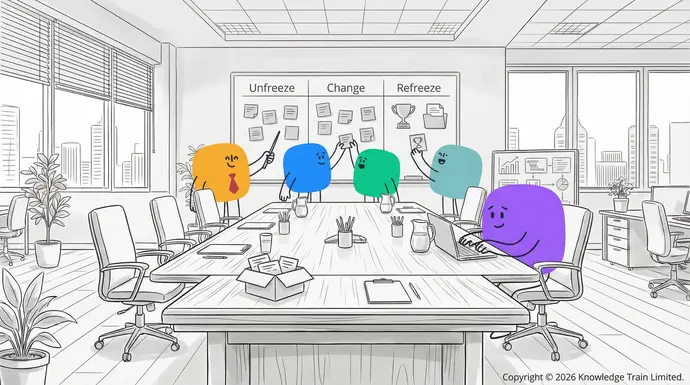
Key takeaways
Lewin’s model helps organisations manage change by focusing on both process and psychology.Contents
- Unfreezing works best when characters communicate clearly, involve stakeholders early, and challenge the status quo to reduce resistance.
- Changing succeeds when training, coaching, and practical support help characters adopt new ways of working.
- Feedback loops during implementation surface issues early and keep the transition on track.Contents
- Refreezing makes change stick through reinforcement, aligned policies, and cultural integration.
- Lewin’s simplicity is a strength, but fast moving environments may need more iterative or combined approaches such as Kotter or ADKAR.Introduction
IntroductionSee all dates
In today’s competitive environment, change management plays a crucial role in ensuring that organisations adapt effectively to shifting markets and technological advancements. Successful change management allows businesses to transform, innovate, and remain relevant. One of the most respected frameworks in this field is Kurt Lewin’s change modelSelf-paced, which offers a structured approach to implementing change. Developed in 1947, Lewin’s model breaks down the complex process of change into three distinct stages: Scrum Essentials self-paced onlineunfreezing£499 +vat, Becoming a certified Scrum Master is not difficultchangingBecoming a certified Scrum Master is easy. Scrum Masters do not require the same in-depth industry knowledge as , and project managersrefreezing as they’re not responsible for setting budgets, timeless and liaising with stakeholders.. This model is significant for its psychological foundation, which addresses human resistance to change by promoting stress reduction and enhancing acceptance. By understanding and applying Lewin’s principles, organisations can navigate the challenges of change more effectively, ensuring smoother transitions and sustained improvements, ultimately leading to a more resilient and adaptable business environment.Steppingstone
Overview of Lewin’s change modelBecoming the role of
Kurt Scrum MasterLewin’s change model is a great steppingstone on your way to more senior agile positions. All you need to be a Scrum Master is to understand how developers work in your industry, the tools they use, and the ability to communicate effectively. You usually have 2 choices to gaining this knowledge. Take basic is a widely recognised framework for managing Scrum trainingorganisational change or seek a qualification.. It breaks down the process into three distinct stages: In both routes you will learn about unfreezingAgile Scrum, and the core changingScrum Development, and processes.refreezingWhat is the best Scrum Master certification?. Each stage addresses specific aspects of change management, providing a comprehensive roadmap for organisations aiming to navigate transitions effectively.The first step to becoming a certified Scrum Master is
Historically, Lewin developed this model in 1947, a period marked by an increased focus on scientific approaches to psychology. His model remains relevant today due to its simplicity and emphasis on the psychological aspects of change, such as reducing resistance and promoting acceptance. In an era where change is constant, Lewin’s model offers a structured yet flexible approach, allowing organisations to adapt and thrive.earning a recognised Scrum qualification
Unfreezing. Unlike project management, where industry knowledge is equally (if not more) important than a qualification,
The Scrum Master trainingunfreezing is essential for learning the role. stage is critical in preparing an organisation for change. It involves creating awareness about the necessity for transformation and challenging existing norms and behaviours. The primary goal is to reduce resistance by showing the benefits of change and the drawbacks of maintaining the status quo. This stage often involves:There are 2 primary Scrum trainers – Scrum Alliance and Scrum.org. Below, we’ve outlined the key differences between these two accreditation bodies, so you can choose which type of
- Data Analysts.
- LessonAcquiring this qualification demonstrates your ability to balance multiple stakeholders’ needs, create a product vision, and communicate effectively with customers so that you can choose : Clear communication and support systems are crucial for overcoming resistance.projects
Example 2: Implementation in healthcare to bring to market for them.
A hospital implemented Lewin’s model to transition from paper-based to electronic medical records. The Advanced Scrum Product Owner (A-CSPO)unfreezingAdvanced Scrum Product Owner (A-CSPO) certification is aimed at those who already possess the entry-level CSPO qualification, have at least 12 months of applied experience as an agile Product Owner, and want to refine their ability to manage multiple business initiatives from competing stakeholders. phase involved addressing staff concerns through information sessions. During the The A-CSPO training builds on those ideas taught to CSPO certification holders and can help distinguish yourself in the globchanging stage, training sessions were conducted to familiarise staff with the new system. The refreezing
Scrum.org
The success of Certifications offeredchange managementScrum Master efforts is significantly influenced by the tactics employed to guide and motivate individuals within an organisation. Effective Scrum Product Ownerinfluence tactics Scrum Developer are essential for ensuring that changes are not only implemented but also sustained over time. These tactics include clear communication, employee involvement, and positive reinforcement, all of which contribute to a supportive environment for change.Scrum Master
Research on work outcomes in relation to change efforts highlights the importance of these tactics. The analysis reveals that successful change initiatives often involve: Scrum Product Owner
- Effective communication Scrum Developer: Keeping communication channels open and transparent helps align employees with the change objectives. It reduces uncertainty and stress, fostering an environment where employees feel informed and valued. Scrum with Kanban
- Employee involvement Agile Leadership: Actively involving employees in the change process enhances their commitment and ownership. It empowers them to contribute ideas and feedback, which can lead to more innovative solutions and smoother transitions.Training provision
- Positive reinforcementTightly controlled delivery and course materials. Accredited trainers.: Recognising and rewarding employees who adapt well to change encourages continued compliance and motivation. This reinforcement helps embed new behaviours and norms into the organisational culture.Course quality and delivery depends on course providers.
Furthermore, the psychological benefits of these tactics, such as stress reduction and enhanced acceptance, cannot be overstated. By addressing the human aspect of change, organisations can mitigate resistance and build resilience among their workforce. Accredited trainers.
Ultimately, the strategic use of influence tactics in Examschange managementShort exams. Easier questions. 65% required to pass. not only improves individual work outcomes but also contributes to the overall success of the organisation. By fostering an inclusive and supportive atmosphere, businesses can ensure that change is not just a temporary adjustment but a lasting transformation.Long exams. Hard questions. 85% required to pass.
ConclusionRenewal
In this article, we explored Certifications valid for 3 years. Can be renewed through retaking exams or CPD points.Lewin’s change modelCertifications do not expire and are valid for life, a foundational framework for implementing Both Scrum Alliance and Scrum.org are leaders in organisational changeScrum training. The model’s three stages – unfreezing, changing, and refreezing – provide a structured approach that emphasises the psychological aspects of change, such as stress reduction and enhanced acceptance. We discussed its real-world applications across corporate settings, healthcare, and educational institutions, highlighting its adaptability and effectiveness. While Lewin’s model offers simplicity and clarity, it is essential to acknowledge its limitations, especially in dynamic environments requiring more iterative approaches. Comparing it with other frameworks like Kotter’s 8-Step Process and and certification. Both are equally well-recognised and respected in agile circles.ADKARYour choice of Scrum course may be dictated by what local training providers can offer or your preferred training format. At Knowledge Train, we offer reveals the need to tailor strategies to specific organisational contexts. Ultimately, understanding and implementing Lewin’s model can facilitate successful Scrum courseschange management from both Scrum Alliance and Scrum.org. by addressing both human and structural elements, ensuring that transformations are sustainable and beneficial for organisations.Make sure you see our list of available Scrum courses including
FAQsonline Scrum courses
What are the key stages of Lewin’s change model? to learn more.
Lewin’s change model consists of three key stages: Subscribe to our exclusive offers and promotionsunfreezing , Subscribe nowchanging , and Related articlesrefreezing . Unfreezing prepares the organisation for change by challenging the current state. Changing involves implementing new processes or behaviours. Refreezing solidifies these changes, integrating them into the organisational culture.
How does unfreezing facilitate change in organisations?
Unfreezing facilitates change by creating awareness of the need for transformation. It involves dismantling existing mindsets and behaviours, reducing resistance, and preparing employees psychologically for the upcoming changes. This stage is crucial for establishing a foundation for successful change.
What are common challenges in the refreezing stage, and how can they be addressed?
Common challenges in the refreezing stage include reverting to old habits and lack of reinforcement. To address these, organisations can implement continuous support systems, provide ongoing training, and celebrate successes to reinforce new behaviours, ensuring they become part of the organisational norm.
How does Lewin’s change model compare to Kotter’s 8-step process?
While Lewin’s model offers a simple three-stage framework, Kotter’s 8-Step Process provides a more detailed approach. Kotter’s model outlines specific steps such as creating urgency and building a guiding coalition. Lewin’s model is ideal for straightforward changes, whereas Kotter’s is suited for complex transformations requiring extensive communication.
Can Lewin’s model be applied in small businesses? If so, how?Agile Manifesto
Yes, Lewin’s model can be effectively applied in small businessesSimon Buehring. Its simplicity makes it accessible for limited resources. Small businesses can use it to prepare employees for change, implement new practices incrementally, and ensure that these changes are sustained through regular feedback and reinforcement. This approach helps maintain agility while fostering a culture of continuous improvement.23 Feb 2026
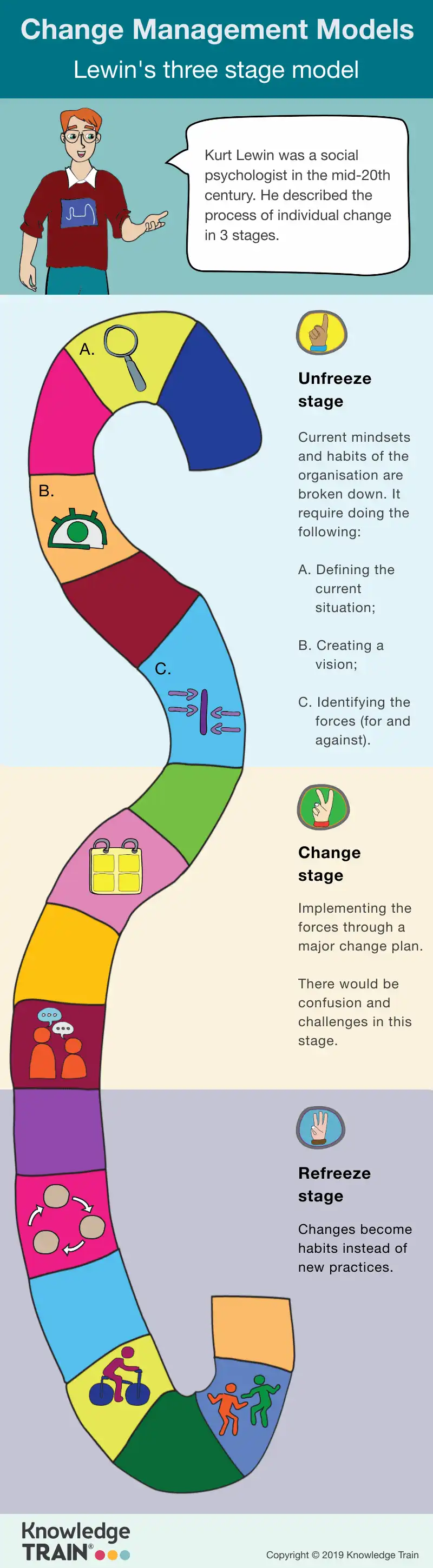
Infographic
Kurt Lewin’s Explore the origins of the Agile Manifesto and its creators' vision for software development. Scroll down to understand its impact.change management model has been summarised on this colourful infographic.