Key takeawaysSpecialist: DSV
Lewin’s model helps organisations manage change by focusing on both process and psychology.3-day ITIL Specialist: Drive Stakeholder Value (DSV) course.
- Unfreezing works best when characters communicate clearly, involve stakeholders early, and challenge the status quo to reduce resistance.Specialist: CDS
- Changing succeeds when training, coaching, and practical support help characters adopt new ways of working.3-day ITIL Specialist: Create, Deliver and Support (CDS) course.
- Feedback loops during implementation surface issues early and keep the transition on track.IT Learning Library (ITLL)™
- Refreezing makes change stick through reinforcement, aligned policies, and cultural integration.BUSINESS LEARNING LIBRARY (BLL)™
- Lewin’s simplicity is a strength, but fast moving environments may need more iterative or combined approaches such as Kotter or ADKAR.Agile Learning Library (ALL)™
changingBETTER BUSINESS CASES COURSES, and Select your preferred training course below:refreezing . This model is significant for its psychological foundation, which addresses human resistance to change by promoting stress reduction and enhancing acceptance. By understanding and applying Lewin’s principles, organisations can navigate the challenges of change more effectively, ensuring smoother transitions and sustained improvements, ultimately leading to a more resilient and adaptable business environment.P3O COURSES
Overview of Lewin’s change modelSelect your preferred training course below:
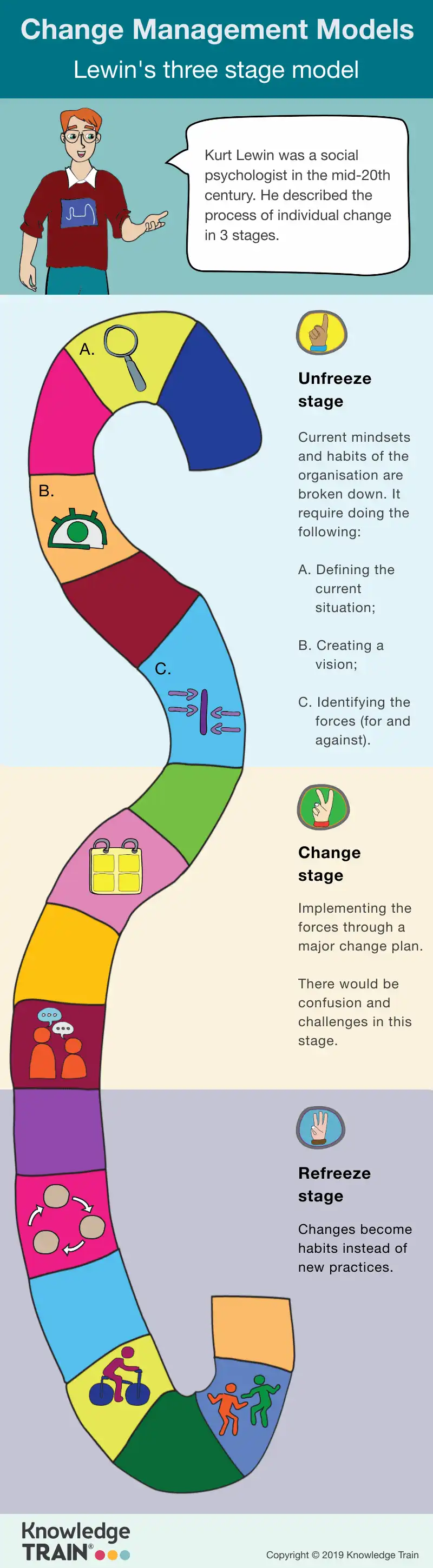
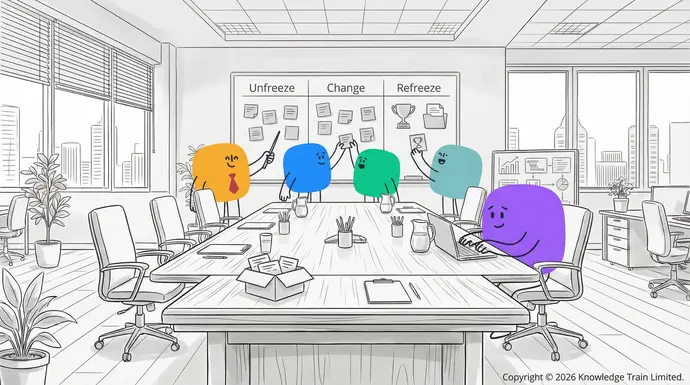
Kurt Lewin’s change modelWORKSHOPS is a widely recognised framework for managing Select your preferred workshop below:organisational change . It breaks down the process into three distinct stages: AGILE QUALIFICATIONSunfreezingSelect your preferred qualification., changingAGILE PROJECT MANAGEMENT COURSES, and Select your preferred training course below:refreezing . Each stage addresses specific aspects of change management, providing a comprehensive roadmap for organisations aiming to navigate transitions effectively.PRINCE2 AGILE COURSES
Historically, Lewin developed this model in 1947, a period marked by an increased focus on scientific approaches to psychology. His model remains relevant today due to its simplicity and emphasis on the psychological aspects of change, such as reducing resistance and promoting acceptance. In an era where change is constant, Lewin’s model offers a structured yet flexible approach, allowing organisations to adapt and thrive.Select your preferred training course below:
Unfreezing
The SCRUM COURSESunfreezingSelect your preferred training course below: stage is critical in preparing an organisation for change. It involves creating awareness about the necessity for transformation and challenging existing norms and behaviours. The primary goal is to reduce resistance by showing the benefits of change and the drawbacks of maintaining the status quo. This stage often involves:
- CommunicationAGILE BUSINESS ANALYSIS COURSES: Open and transparent communication helps employees understand the reasons for change. It reduces uncertainty and anxiety, fostering a supportive environment where individuals are more willing to let go of old habits.Select your preferred training course below:
- Leadership engagement : Leaders play a crucial role in modelling desired behaviours and attitudes. Their involvement is essential in building trust and commitment to the change process.BUSINESS ANALYSIS QUALIFICATIONS
- Stakeholder involvementSelect your preferred qualification.: Engaging key stakeholders early in the process ensures that their concerns are addressed, and their insights are incorporated into the change strategy. This involvement can lead to more innovative solutions and greater buy-in.
Psychologically, unfreezing helps individuals and groups prepare for change by breaking down existing mindsets and fostering a readiness to embrace new ideas. By addressing the emotional aspects of change, organisations can create a foundation for successful transformation.BCS BUSINESS ANALYSIS COURSES
Changing
Select your preferred qualification or workshop.changing stage, training sessions were conducted to familiarise staff with the new system. The AIPGF COURSESrefreezingSelect your preferred training course below: stage ensured the new process was standard practice, with ongoing technical support provided.
- OutcomeBCS AI COURSES: This change increased efficiency and accuracy in patient record management.Select your preferred training course below:
- Lesson : Continuous support and training are vital for successful technological adoption.AIPGF COURSES
Example 3: Educational institutionsSelect your preferred training course below:
A university applied Lewin’s model to innovate its teaching methodologies. UnfreezingAI WORKSHOPS involved recognising the limitations of traditional teaching. The Select your preferred workshop below:changing phase saw the introduction of digital tools and interactive techniques. Knowledge Train is a PRINCE2 Accredited Training Organization.Refreezing embedded these new practices through policy changes and faculty workshops.Knowledge Train is an AgilePM Accredited Training Organization.
- Outcome : Student engagement and learning outcomes improved significantly.Knowledge Train is a PRINCE2 Agile Accredited Training Organization.
- Lesson : Institutional support and policy alignment are key to sustaining educational change.Knowledge Train is a Better Business Cases Accredited Training Organization.
These examples highlight the model’s adaptability and the importance of addressing both human and structural elements in change initiatives.
Comparing Lewin’s model with other change management theoriesKnowledge Train is a P3O Accredited Training Organization.
Kurt Lewin’s change modelKnowledge Train is an AgilePM Accredited Training Organization. is often compared with frameworks such as Kotter’s 8-step processKnowledge Train is a PRINCE2 Agile Accredited Training Organization. and ADKARKnowledge Train is an Agile BA Accredited Training Organization.. Each model offers unique perspectives and methodologies for managing change within organisations.
- Lewin’s modelBCS accredited training partner for Business Analysis. is straightforward, focusing on three stages: unfreezing, changing, and refreezing. Its strength lies in its simplicity and emphasis on the psychological aspects of change, which can reduce stress and increase acceptance.
- Kotter’s 8-step processKnowledge Train is an Agile BA Accredited Training Organization. provides a more detailed approach, outlining specific steps like establishing a sense of urgency and creating short-term wins. This model is particularly useful for large-scale transformations requiring clear guidance and extensive communication.
- ADKARKnowledge Train is a Change Management Accredited Training Organization. focuses on individual change and is goal-oriented, emphasising AwarenessKnowledge Train is an MSP Accredited Training Organization., DesireKnowledge Train is a PRINCE2 Accredited Training Organization., KnowledgeKnowledge Train is an AgilePM Accredited Training Organization., AbilityKnowledge Train is a PRINCE2 Agile Accredited Training Organization., and ReinforcementKnowledge Train is a Better Business Cases Accredited Training Organization.. It is beneficial for understanding and managing personal impacts during organisational changes.
Lewin’s model is preferred when a concise and psychologically grounded approach is needed. It is particularly effective in scenarios where resistance to change is prominent, and fostering a supportive environment is crucial. However, in complex or large-scale organisational transformations, Kotter’s detailed steps or ADKAR’s individual focus might offer additional advantages.Knowledge Train is an AgilePM Accredited Training Organization.
Ultimately, the choice of model depends on the organisational context and the specific challenges faced. Integrating elements from different frameworks can often provide a more comprehensive strategy, catering to both structural and human elements of change.
Influence tactics and work outcomes in change managementExpert, experienced trainers to support you
The success of Course manual where applicable.change management efforts is significantly influenced by the tactics employed to guide and motivate individuals within an organisation. Effective SELF-PACED ONLINE TRAINING COURSESinfluence tacticsSelf-paced online training courses (e-learning) include: are essential for ensuring that changes are not only implemented but also sustained over time. These tactics include clear communication, employee involvement, and positive reinforcement, all of which contribute to a supportive environment for change.Certification exam(s) where applicable
Research on work outcomes in relation to change efforts highlights the importance of these tactics. The analysis reveals that successful change initiatives often involve:Accredited training course materials
- Effective communicationSupport from expert, experienced trainers: Keeping communication channels open and transparent helps align employees with the change objectives. It reduces uncertainty and stress, fostering an environment where employees feel informed and valued.Latest educational technology.
- Employee involvement : Actively involving employees in the change process enhances their commitment and ownership. It empowers them to contribute ideas and feedback, which can lead to more innovative solutions and smoother transitions.BUSINESS SOLUTIONS
- Positive reinforcement : Recognising and rewarding employees who adapt well to change encourages continued compliance and motivation. This reinforcement helps embed new behaviours and norms into the organisational culture.
Furthermore, the psychological benefits of these tactics, such as stress reduction and enhanced acceptance, cannot be overstated. By addressing the human aspect of change, organisations can mitigate resistance and build resilience among their workforce.TO HELP ORGANISATIONS IMPROVE
Ultimately, the strategic use of influence tactics in We offer solutions to help improve team performance including:change managementConsultancy services not only improves individual work outcomes but also contributes to the overall success of the organisation. By fostering an inclusive and supportive atmosphere, businesses can ensure that change is not just a temporary adjustment but a lasting transformation.Staff development