The essentials of Lewin’s change model for successful change management

Key takeawaysDefine benefits in measurable terms and distinguish outcomes from benefits so performance can be tracked.
Lewin’s model helps organisations manage change by focusing on both process and psychology.Include known dis-benefits and major risks, plus mitigations, to avoid one-sided decisions.
- Unfreezing works best when characters communicate clearly, involve stakeholders early, and challenge the status quo to reduce resistance.Use an investment appraisal, such as net benefits and break-even timing, to test viability.
- Changing succeeds when training, coaching, and practical support help characters adopt new ways of working.
- Feedback loops during implementation surface issues early and keep the transition on track.
Introduction
In today’s competitive environment, Instructor-ledchange managementBetter Business Cases Practitioner (with Foundation) course plays a crucial role in ensuring that organisations adapt effectively to shifting markets and technological advancements. Successful change management allows businesses to transform, innovate, and remain relevant. One of the most respected frameworks in this field is Kurt Lewin’s change model£2,400 +vat
- business case template
Example 3: Educational institutions is free to download.
A university applied Lewin’s model to innovate its teaching methodologies. SummaryUnfreezingA business case is the most important document on any project. That’s because it justifies the investment. involved recognising the limitations of traditional teaching. The It helps an organisation be clear about why a project is needed, and what the results of the investment will be. This is crucial because no organisation has unlimited funds to spend on an unlimited number of projects. Therefore, a business case gives confidence to senior managers when deciding to invest in one project rather than another.changingHowever, as you have seen in this article, a business case is something which you can find useful when taking major decisions in your own personal life. Remember – a business case doesn’t need to be a lengthy document. It could easily be a few notes scribbled on the back of something or even sent in an email. phase saw the introduction of digital tools and interactive techniques. Whatever form your business case takes, remember one thing – it will help you or your organisation take sensible decisions about committing time and resources to a project or activity.RefreezingRemember, if you want to learn more about developing a business case, and learn many of the techniques useful for assessing business problems, consider attending a classroom embedded these new practices through policy changes and faculty workshops.business analyst course
- Outcome.: Student engagement and learning outcomes improved significantly.Enhance your skills with our expert-led courses
- Lesson : Institutional support and policy alignment are key to sustaining educational change.
These examples highlight the model’s adaptability and the importance of addressing both human and structural elements in change initiatives.
Comparing Lewin’s model with other change management theoriesInstructor-led
Kurt Better Business Cases Practitioner (with Foundation) courseLewin’s change model is often compared with frameworks such as £2,400 +vatSee all dates and
Who owns a business case? reveals the need to tailor strategies to specific organisational contexts. Ultimately, understanding and implementing Lewin’s model can facilitate successful change managementA business case is owned by the person who is funding the project. The name of this role is different across organisations, but commonly this role is known as a project sponsor, or project executive. by addressing both human and structural elements, ensuring that transformations are sustainable and beneficial for organisations.By owning the business case, it means this person is accountable for ensuring that any investment decisions which are taken based upon the information within the business case are worthwhile.
FAQsSubscribe to our exclusive offers and promotions
What are the key stages of Lewin’s change model?
Lewin’s change model consists of three key stages: Subscribe nowunfreezing , changing{"@context":"https://schema.org","@type":"ImageObject","contentUrl":"https://www.knowledgetrain.co.uk/training-courses/how-to-write-a-business-case-890x501.webp","description":"How To Write a Business Case","license":"https://www.knowledgetrain.co.uk/license","acquireLicensePage":"https://www.knowledgetrain.co.uk/license","creditText":"Knowledge Train","uploadDate":"2023-05-18T08:21:15.000Z","copyrightNotice":"© 2023 Knowledge Train Limited. All rights reserved.","creator":{"@type":"Organization","name":"Knowledge Train","url":"https://www.knowledgetrain.co.uk"}}, and refreezingRelated articles. Unfreezing prepares the organisation for change by challenging the current state. Changing involves implementing new processes or behaviours. Refreezing solidifies these changes, integrating them into the organisational culture.
How does unfreezing facilitate change in organisations?
Unfreezing facilitates change by creating awareness of the need for transformation. It involves dismantling existing mindsets and behaviours, reducing resistance, and preparing employees psychologically for the upcoming changes. This stage is crucial for establishing a foundation for successful change.
What are common challenges in the refreezing stage, and how can they be addressed?
Common challenges in the refreezing stage include reverting to old habits and lack of reinforcement. To address these, organisations can implement continuous support systems, provide ongoing training, and celebrate successes to reinforce new behaviours, ensuring they become part of the organisational norm.
How does Lewin’s change model compare to Kotter’s 8-step process?
While Lewin’s model offers a simple three-stage framework, Kotter’s 8-Step Process
Can Lewin’s model be applied in small businesses? If so, how?PRINCE2 Agile certification
Yes, Lewin’s model can be effectively applied in small businessesSimon Buehring. Its simplicity makes it accessible for limited resources. Small businesses can use it to prepare employees for change, implement new practices incrementally, and ensure that these changes are sustained through regular feedback and reinforcement. This approach helps maintain agility while fostering a culture of continuous improvement.19 Feb 2026
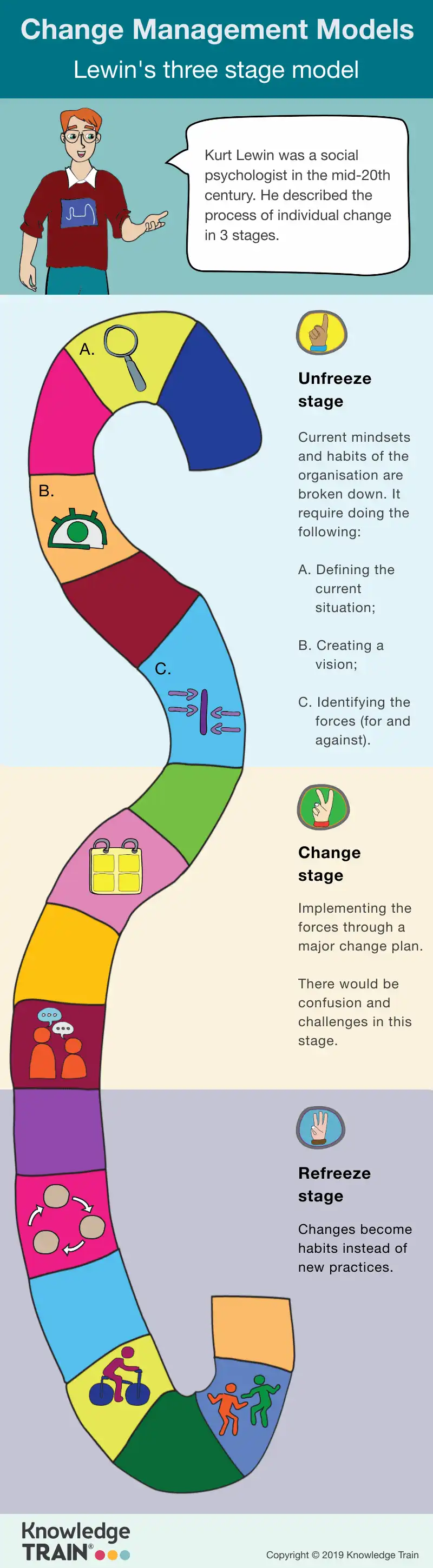
Infographic
Kurt Lewin’s Considering PRINCE2 Agile certification? Discover how it integrates PRINCE2 with Agile concepts to advance your project management skills.change management model has been summarised on this colourful infographic.