The essentials of Lewin’s change model for successful change management

Introduction
In today’s competitive environment, change management+44 (0)207 148 5985 plays a crucial role in ensuring that organisations adapt effectively to shifting markets and technological advancements. Successful change management allows businesses to transform, innovate, and remain relevant. One of the most respected frameworks in this field is Kurt Lewin’s change modelOr chat with us using the link at the bottom of the screen., which offers a structured approach to implementing change. Developed in 1947, Lewin’s model breaks down the complex process of change into three distinct stages: Contact us with questions about the courses on this page, or about which project management certification or training is best for you.unfreezingFinance FAQs, ContactchangingCookies, and PrivacyrefreezingTerms. This model is significant for its psychological foundation, which addresses human resistance to change by promoting stress reduction and enhancing acceptance. By understanding and applying Lewin’s principles, organisations can navigate the challenges of change more effectively, ensuring smoother transitions and sustained improvements, ultimately leading to a more resilient and adaptable business environment.Customer Support
Overview of Lewin’s change model
are registered trademarks of Agile Business Consortium Limited. All rights reserved. The APMG International AgilePM and Swirl Device logo, APMG International AgileBA and Swirl Device Logo, APMG International Change Management and APMG International Better Business Cases and Swirl Device logo are trademarks of The APM Group Limited, used under permission of The APM Group Limited. All rights reserved. Better Business Cases™ is a trademark of Her Majesty’s Treasury. All rights reserved. DevOps Foundation
Refreezing®
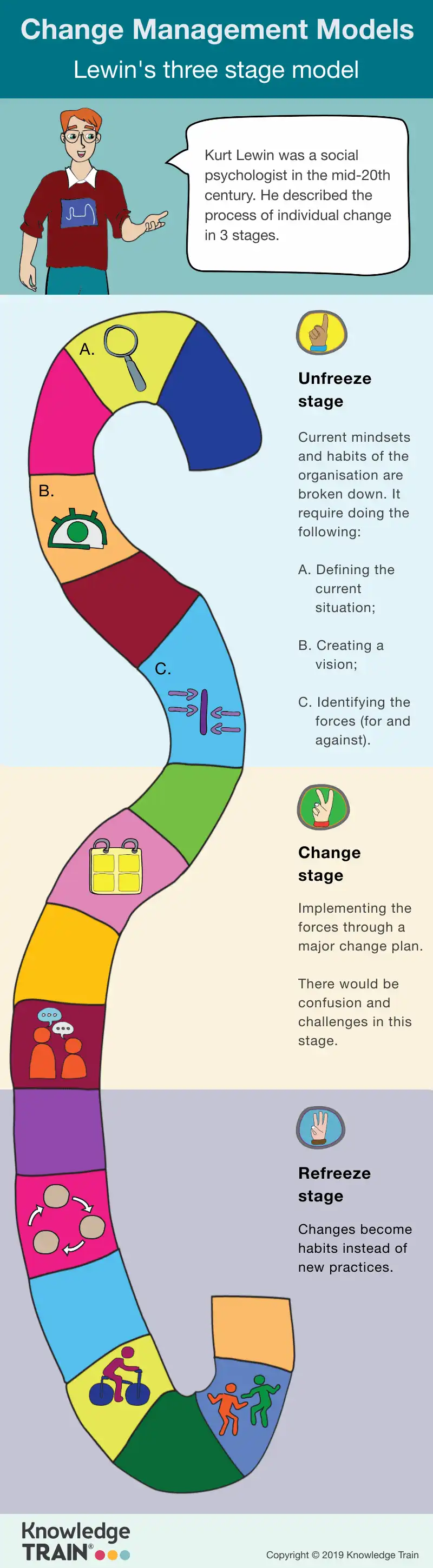
The is a registered mark of the DevOps Institute. “PMI”, “PMBOKrefreezing® stage is the final step, where new changes are solidified and integrated into the organisational culture. It ensures that the changes become permanent and prevents regression to old practices. Key aspects of refreezing include:
- Reinforcement Guide”, “PMP” and “CAPM” are registered marks of Project Management Institute, Inc. Knowledge Train Scrum Essentials™, Business Learning Library (BLL)™, Business Analysis Learning Library (BALL)™, Agile Learning Library (ALL)™, IT Learning Library (ITLL)™, and Compliance Learning Library (CLL)™ are trademarks of Knowledge Train Limited. All rights reserved.: Recognising and rewarding employees who successfully adapt to change reinforces desired behaviours. It encourages others to follow suit and helps embed new norms.Knowledge Train Ltd is an Introducer Appointed Representative of NewDay Cards Ltd for the Newpay finance product provided by NewDay Ltd. NewDay Cards Ltd acts as a credit broker, not a lender. We will introduce you exclusively to Newpay finance products provided by NewDay Limited under this Introducer Appointed Representative arrangement. Finance available from other lenders is not covered by this arrangement. NewDay Ltd and Newday Cards Ltd are authorised and regulated by the Financial Conduct Authority (ref nos 690292 and 682417 respectively).
- Policy and procedure alignment : Updating policies and procedures to reflect new practices ensures consistency and clarity. It provides a framework for maintaining changes over time.
- Cultural integration : Embedding changes into the organisational culture requires ongoing effort and commitment. It involves aligning values, beliefs, and behaviours with the new direction.
Refreezing is crucial for sustaining change, as it creates stability and reduces the likelihood of reverting to previous habits. By reinforcing new behaviours and aligning them with organisational goals, change becomes an integral part of the organisation’s identity.
In conclusion, Lewin’s change model offers a structured approach to managing organisational change, addressing both the psychological and practical aspects of transformation. Its enduring relevance lies in its ability to guide organisations through the complexities of change, ensuring successful and lasting outcomes.Search
Advantages and disadvantages of Lewin’s change modelFunctional
Kurt Lewin’s Always active force field analysis and three-stage model of change are renowned for their simplicity and clarity, making them accessible tools for organisations navigating change. One of its primary strengths is its straightforward three-stage process – unfreezing , changing , and refreezing . This structure provides a clear roadmap for implementing change, helping organisations manage transitions systematically. Additionally, the model emphasises the psychological aspects of change, such as reducing stress and enhancing acceptance, which fosters a supportive environment for transformation.
However, despite these advantages, Lewin’s model is not without criticism. A notable limitation is its planned approach to change, which some argue oversimplifies emergent and continuous organisational change processes. In today’s dynamic business environment, change often requires flexibility and adaptability, which a linear model may not sufficiently address. Critics also point out that the model assumes a relatively static environment, whereas many organisations face continuous or overlapping changes that demand more iterative processes.The technical storage or access is strictly necessary for the legitimate purpose of enabling the use of a specific service explicitly requested by the subscriber or user, or for the sole purpose of carrying out the transmission of a communication over an electronic communications network.
Furthermore, while Lewin’s model is effective in highlighting the human element of change, it may not fully account for technological advancements and rapid market shifts that influence contemporary change management . Therefore, while Lewin’s change model provides a foundational framework, organisations may need to adapt it or integrate it with other models to address the multifaceted nature of change in today’s world.
Real-world applications of Lewin’s change model
Lewin’s change model has been successfully applied across various sectors, demonstrating its versatility and effectiveness. These applications provide valuable insights into how organisations can manage transformation effectively.Preferences
Example 1: Application in a corporate setting
In a leading technology firm, Lewin’s model guided a transition to agile project management . During the Preferencesunfreezing stage, management identified the need for agility to stay competitive. Workshops and discussions were held to prepare employees for the shift. In the changing phase,
Example 2: Implementation in healthcare
- provides a more detailed approach, outlining specific steps like establishing a sense of urgency and creating short-term wins. This model is particularly useful for large-scale transformations requiring clear guidance and extensive communication.Save preferences
- ADKAR focuses on individual change and is goal-oriented, emphasising View preferencesAwareness{title}, {title}Desire{title}, Manage ConsentKnowledge , To provide the best experiences, we use technologies like cookies to store and/or access device information. Consenting to these technologies will allow us to process data such as browsing behavior or unique IDs on this site. Not consenting or withdrawing consent, may adversely affect certain features and functions.Ability , and Reinforcement . It is beneficial for understanding and managing personal impacts during organisational changes.
Lewin’s model is preferred when a concise and psychologically grounded approach is needed. It is particularly effective in scenarios where resistance to change is prominent, and fostering a supportive environment is crucial. However, in complex or large-scale organisational transformations, Kotter’s detailed steps or ADKAR’s individual focus might offer additional advantages.Functional
Ultimately, the choice of model depends on the organisational context and the specific challenges faced. Integrating elements from different frameworks can often provide a more comprehensive strategy, catering to both structural and human elements of change.
Influence tactics and work outcomes in change management
The success of change management efforts is significantly influenced by the tactics employed to guide and motivate individuals within an organisation. Effective influence tactics are essential for ensuring that changes are not only implemented but also sustained over time. These tactics include clear communication, employee involvement, and positive reinforcement, all of which contribute to a supportive environment for change. The technical storage or access is necessary for the legitimate purpose of storing preferences that are not requested by the subscriber or user.
Research on work outcomes in relation to change efforts highlights the importance of these tactics. The analysis reveals that successful change initiatives often involve:
- Effective communication : Keeping communication channels open and transparent helps align employees with the change objectives. It reduces uncertainty and stress, fostering an environment where employees feel informed and valued.
- Employee involvement : Actively involving employees in the change process enhances their commitment and ownership. It empowers them to contribute ideas and feedback, which can lead to more innovative solutions and smoother transitions. Statistics
- Positive reinforcement : Recognising and rewarding employees who adapt well to change encourages continued compliance and motivation. This reinforcement helps embed new behaviours and norms into the organisational culture.
Furthermore, the psychological benefits of these tactics, such as stress reduction and enhanced acceptance, cannot be overstated. By addressing the human aspect of change, organisations can mitigate resistance and build resilience among their workforce.
Ultimately, the strategic use of influence tactics in Statisticschange management not only improves individual work outcomes but also contributes to the overall success of the organisation. By fostering an inclusive and supportive atmosphere, businesses can ensure that change is not just a temporary adjustment but a lasting transformation.
Conclusion
In this article, we explored Lewin’s change model , a foundational framework for implementing organisational change . The model’s three stages – unfreezing, changing, and refreezing – provide a structured approach that emphasises the psychological aspects of change, such as stress reduction and enhanced acceptance. We discussed its real-world applications across corporate settings, healthcare, and educational institutions, highlighting its adaptability and effectiveness. While Lewin’s model offers simplicity and clarity, it is essential to acknowledge its limitations, especially in dynamic environments requiring more iterative approaches. Comparing it with other frameworks like Kotter’s 8-Step Process and The technical storage or access that is used exclusively for statistical purposes.ADKAR reveals the need to tailor strategies to specific organisational contexts. Ultimately, understanding and implementing Lewin’s model can facilitate successful The technical storage or access that is used exclusively for anonymous statistical purposes. Without a subpoena, voluntary compliance on the part of your Internet Service Provider, or additional records from a third party, information stored or retrieved for this purpose alone cannot usually be used to identify you.change management by addressing both human and structural elements, ensuring that transformations are sustainable and beneficial for organisations.