IrelandItalyLatviaLithuaniaLuxemburgMaltaNetherlandsPolandPortugalRomaniaSlovakiaSloveniaSpainSwedenOther countriesHome AgileAgile project management Agile project management: Frameworks, benefits and how it works Simon Buehring29 Apr 2026 Estimating for Agile FoundationAgile Learning Library (ALL)™ Agile Learning Library (ALL)™BUSINESS ANALYSIS BUSINESS ANALYSISBCS Business Analysis BCS Business AnalysisBusiness Analysis Foundation Business Analysis Foundation Learn the fundamentals of business analysis. Learn the fundamentals of business analysis.Modelling Business Processes Gain practitioner certificate in modelling business processes.Modelling Business Processes Business Analysis Practices Gain practitioner certificate in modelling business processes. Business Analysis Practices Gain practitioner certificate in business analysis practices. Gain practitioner certificate in business analysis practices.Requirements Engineering Requirements Engineering Gain practitioner certificate in requirements engineering. Gain practitioner certificate in requirements engineering.Business Analysis International Diploma Business Analysis International Diploma All 4 courses bundled into this Diploma certification package. All 4 courses bundled into this Diploma certification package.AgileBA AgileBA® ® – Agile Business Analysis – Agile Business AnalysisFoundation training Foundation training Learn the fundamentals of Agile Business Analysis. Learn the fundamentals of Agile Business Analysis.Practitioner Practitioner 4-day course including Foundation. Copied!4-day course including Foundation.PMI Key takeawaysPMI® Agile improves delivery by combining iterative planning, tight feedback loops and disciplined ways of working.®PMI-PBA Agile delivers value in short iterations, using regular reviews and retrospectives to adapt quickly to change.PMI-PBA Self-paced course to prepare you for the exam (exam not included). Scrum, Kanban, Lean and XP offer different structures, so choose based on workflow needs and team maturity.Self-paced course to prepare you for the exam (exam not included).Business Analysis Learning Library (BALL)™ Clear roles, prioritised backlogs and well-written user stories reduce confusion and keep work aligned to outcomes.Business Analysis Learning Library (BALL)™CHANGE MANAGEMENT Metrics such as velocity, cycle time and burn-down charts improve predictability when paired with a clear definition of done.CHANGE MANAGEMENTAPMG Change Management Lightweight governance, change management and technical debt controls help Agile scale without losing quality.Foundation APMG Change Management Learn the fundamentals of enterprise change management.Foundation Practitioner Learn the fundamentals of enterprise change management. Includes Foundation & Practitioner combined option. Practitioner PROGRAMME MANAGEMENTContentsIncludes Foundation & Practitioner combined option. MSP PROGRAMME MANAGEMENT ® MSP Foundation Contents® Learn the fundamentals of programme management. Foundation Practitioner What is Agile project management?Learn the fundamentals of programme management. Includes Foundation & Practitioner combined option. Practitioner INFORMATION TECHNOLOGY (IT)The Agile Manifesto: Values and principlesIncludes Foundation & Practitioner combined option. ITIL INFORMATION TECHNOLOGY (IT) ®Key Agile frameworks and methodologiesITIL Foundation ® Learn the fundamentals of ITIL service management.Agile vs traditional (waterfall) project managementFoundation Strategist DPI Learn the fundamentals of ITIL service management. 3-day ITIL Strategist: Direct, Plan & Improve (DPI) course.Key roles and concepts in Agile projectsStrategist DPI 3-day ITIL Strategist: Direct, Plan & Improve (DPI) course. Specialist: DSV Benefits of Agile project managementSpecialist: DSV 3-day ITIL Specialist: Drive Stakeholder Value (DSV) course. 3-day ITIL Specialist: Drive Stakeholder Value (DSV) course. Specialist: CDS Challenges and limitations 3-day ITIL Specialist: Create, Deliver and Support (CDS) course. Specialist: CDS IT Learning Library (ITLL)™Real-world applications and use cases3-day ITIL Specialist: Create, Deliver and Support (CDS) course. BUSINESS LEARNING LIBRARY (BLL)™ IT Learning Library (ITLL)™ Agile Learning Library (ALL)™Related resourcesBUSINESS LEARNING LIBRARY (BLL)™ Business Analysis Learning Library (BALL)™ Agile Learning Library (ALL)™ Compliance Learning Library (CLL)™FAQsBusiness Analysis Learning Library (BALL)™ IT Learning Library (ITLL)™What is Agile project management?Compliance Learning Library (CLL)™ Business solutionsAgile project managementIT Learning Library (ITLL)™ _blank is an iterative approach to planning, executing, and Business solutions Aboutdelivering projects_blank _blank by breaking work into small, manageable increments known as iterations or sprints. Rather than following a strict linear plan, About BlogAgile_blank focuses on adaptability, team collaboration, and continuous delivery of value to stakeholders. Blog EXPLORE SUBJECTSAgile principles Select your preferred subject. emphasise close communication, incremental progress, and regular feedback cycles to enhance quality and meet customer needs.EXPLORE SUBJECTS The Agile Manifesto: Values and principlesSelect your preferred subject. PROJECT MANAGEMENT QUALIFICATIONS & WORKSHOPSThe Select your preferred qualification or workshop.Agile ManifestoPROJECT MANAGEMENT QUALIFICATIONS & WORKSHOPS underpins Agile project management, defining four core values and twelve guiding principles. These foster a culture of collaboration, adaptability, and response to change.Select your preferred qualification or workshop. PRINCE2 COURSESAgile Manifesto core values Select your preferred training course below:Individuals and interactions over processes and toolsPRINCE2 COURSES Working software (or product) over comprehensive documentationSelect your preferred training course below: APM COURSESCustomer collaboration over contract negotiation Select your preferred training course below:Responding to change over following a planAPM COURSES Twelve principles of AgileSelect your preferred training course below: AGILE PROJECT MANAGEMENT COURSESCustomer satisfaction through early and continuous delivery Select your preferred training course below:Welcome changing requirements, even late in developmentAGILE PROJECT MANAGEMENT COURSES Deliver working products frequentlySelect your preferred training course below: PRINCE2 AGILE COURSESClose, daily cooperation between business people and developers Select your preferred training course below:Build PRINCE2 AGILE COURSES projectsSelect your preferred training course below: BETTER BUSINESS CASES COURSES around motivated individuals Select your preferred training course below:Face-to-face conversation as the best form of communicationBETTER BUSINESS CASES COURSES Working product as the primary measure of progressSelect your preferred training course below: P3O COURSESSustainable development pace Select your preferred training course below:Continuous attention to technical excellence and good designP3O COURSES Simplicity – the art of maximising the amount of work not done – is essentialSelect your preferred training course below: WORKSHOPSSelf-organising teams produce the best results Select your preferred workshop below:Regular reflections for continuous improvementWORKSHOPS Key Agile frameworks and methodologiesSelect your preferred workshop below: AGILE QUALIFICATIONSAgile Select your preferred qualification. encompasses various frameworks, each with its own practices and terminology. The most widely used Agile frameworks were designed for more efficient product delivery, rather than AGILE QUALIFICATIONS project managementSelect your preferred qualification.AGILE PROJECT MANAGEMENT COURSES. They include Select your preferred training course below:Scrum , Kanban, Lean, and Extreme Programming (XP):PRINCE2 AGILE COURSESScrumSelect your preferred training course below:Main focus: Team roles, time-boxed sprints, and iterative deliverySCRUM COURSESCore roles:Select your preferred training course below: Product Owner, Scrum MasterAGILE BUSINESS ANALYSIS COURSES, Team MembersSelect your preferred training course below:Artefacts: Product backlog, sprint backlogBUSINESS ANALYSIS QUALIFICATIONSKey events:Select your preferred qualification. Sprint planning, daily scrum, sprint review, sprint retrospectives Advantages:BCS BUSINESS ANALYSIS COURSES Well-defined structure, clear accountability, transparencySelect your preferred training course below:Kanban Main focus:AGILE BUSINESS ANALYSIS COURSES Visualisation of workflow, limiting work in progress, continuous flowSelect your preferred training course below:Core elements: Kanban board, work-in-progress limits, cards/tasksCHANGE MANAGEMENT QUALIFICATIONSAdvantages:Select your preferred qualification. Flexibility, real-time workflow visualisation, easy adoption without role changes LeanAPMG CHANGE MANAGEMENT COURSESMain focus:Select your preferred training course below: Elimination of waste, maximising value, continuous improvement Core elements:PROGRAMME MANAGEMENT QUALIFICATIONS Value stream mapping, optimised flow, customer focusSelect your preferred qualification.Advantages: Improved efficiency, reduced delays, enhanced qualityMSP COURSESExtreme Programming (XP)Select your preferred training course below:Main focus: Technical excellence, frequent releases, customer involvementCore practices:PMI COURSES Pair programming, test-driven development, continuous integration, Select your preferred training course below:user stories Advantages:PMI COURSES Rapid feedback, high product quality, adaptability to changeSelect your preferred training course below:Comparison: Scrum, Kanban, Lean, XP FrameworkPRINCE2 COURSESSelect your preferred training course below:Main focus Key practiceAPM COURSESTeam structureSelect your preferred training course below:Best use case ScrumAGILE PROJECT MANAGEMENT COURSESTime-boxed iterations (Sprints)Select your preferred training course below:Predefined roles and events Cross-functionalPRINCE2 AGILE COURSESComplex projects needing structureSelect your preferred training course below:Kanban Visual workflow & limitsBUSINESS CASE COURSESKanban board, WIP limitsSelect your preferred training course below:Flexible roles Ongoing support/operationsAGILE COURSESLeanSelect your self-paced training course topic.Eliminate waste Value stream mappingAGILE PROJECT MANAGEMENT COURSESAnySelect your preferred training course below:Process improvement, efficiency XPPRINCE2 AGILE COURSESTechnical best practicesSelect your preferred training course below:Pair programming, TDD Small, tech-focused teamsSCRUM COURSESSoftware projects needing qualitySelect your preferred training course below:Agile vs traditional (waterfall) project management The LEAN SIX SIGMA COURSESwaterfall modelSelect your preferred training course below: is a sequential, plan-driven approach where phases follow one another with minimal overlap. Agile project managementBUSINESS ANALYST COURSES contrasts this with its focus on flexible planning, iterative progress, and stakeholder feedback throughout:Select your self-paced training course topic.Aspect AgileBCS BUSINESS ANALYST COURSESWaterfallSelect your preferred training course below:Approach Iterative and incrementalCHANGE MANAGEMENT COURSESSequential and linearFlexibilityHighly adaptive to changeChange-resistantCustomer InvolvementContinuous collaborationPrimarily at start/endRisk managementEarly and ongoing detectionLate-stage identificationDeliveryWork delivered frequentlySingle final deliverySuitable forComplex, evolving projectsClear, fixed requirementsKey roles and concepts in Agile projectsProduct Owner: Represents stakeholders, manages product backlog, prioritises featuresScrum Master: Facilitates Scrum process, removes impedimentsUser stories: Short, simple descriptions of a feature told from the perspective of the userBacklog: Ordered list of project tasks and featuresSprint/Iteration: Short, time-boxed development cyclesStakeholders: Individuals or groups with interests in project outcomesRetrospectives: Regular meetings to assess and improve processesDeliverables: Outputs produced at the end of each iteration
Continuous Improvement:AI WORKSHOPS Commitment to reflect and implement enhanced ways of working
Select your preferred workshop below:Benefits of Agile project management
Accelerated delivery of value through iterative increments Knowledge Train is a PRINCE2 Accredited Training Organization.Improved team collaboration and transparency [email protected] Quick response to customer feedback and market changesKnowledge Train is a PRINCE2 Accredited Training Organization. Knowledge Train is an AgilePM Accredited Training Organization.Reduced project risks and higher stakeholder satisfaction Knowledge Train is an AgilePM Accredited Training Organization.
  • Knowledge Train is a PRINCE2 Agile Accredited Training Organization.
    • Knowledge Train is a PRINCE2 Agile Accredited Training Organization.
      • Knowledge Train is a Better Business Cases Accredited Training Organization. Knowledge Train is a Better Business Cases Accredited Training Organization.
        • Knowledge Train is a P3O Accredited Training Organization. Knowledge Train is a P3O Accredited Training Organization.
        • Knowledge Train is an AgilePM Accredited Training Organization. Knowledge Train is an AgilePM Accredited Training Organization.
      • Knowledge Train is a PRINCE2 Agile Accredited Training Organization.
        • Knowledge Train is a PRINCE2 Agile Accredited Training Organization.Knowledge Train is an Agile BA Accredited Training Organization.
        • Knowledge Train is an Agile BA Accredited Training Organization.BCS accredited training partner for Business Analysis.
        • BCS accredited training partner for Business Analysis.Knowledge Train is an Agile BA Accredited Training Organization.
      • Knowledge Train is an Agile BA Accredited Training Organization.Knowledge Train is a Change Management Accredited Training Organization. Knowledge Train is a Change Management Accredited Training Organization.
        • Knowledge Train is an MSP Accredited Training Organization. Knowledge Train is an MSP Accredited Training Organization.
        • Knowledge Train is a PRINCE2 Accredited Training Organization. Knowledge Train is a PRINCE2 Accredited Training Organization.
      • Knowledge Train is an AgilePM Accredited Training Organization. Knowledge Train is an AgilePM Accredited Training Organization.Knowledge Train is a PRINCE2 Agile Accredited Training Organization.
        • Knowledge Train is a PRINCE2 Agile Accredited Training Organization.Knowledge Train is a Better Business Cases Accredited Training Organization.
        • Knowledge Train is an AgilePM Accredited Training Organization.
      • Knowledge Train is an AgilePM Accredited Training Organization.
        • Knowledge Train is a PRINCE2 Agile Accredited Training Organization. Knowledge Train is a PRINCE2 Agile Accredited Training Organization.
        • Knowledge Train is a Lean Six Sigma Accredited Training Organization. Knowledge Train is a Lean Six Sigma Accredited Training Organization.
      • BCS accredited training partner for Business Analysis. BCS accredited training partner for Business Analysis.
        • Knowledge Train is a Change Management Accredited Training Organization. Knowledge Train is a Change Management Accredited Training Organization.
        • Knowledge Train is an MSP Accredited Training Organization. Knowledge Train is an MSP Accredited Training Organization.
      • AXELOS Peoplecert accredited training organisation for ITIL (IT Infrastructure Library). AXELOS Peoplecert accredited training organisation for ITIL (IT Infrastructure Library).
        • AXELOS Peoplecert accredited training organisation for ITIL (IT Infrastructure Library). AXELOS Peoplecert accredited training organisation for ITIL (IT Infrastructure Library).
        • Knowledge Train is an AIPGF Accredited Training Organization. Knowledge Train is an AIPGF Accredited Training Organization.
      • Knowledge Train is an AIPGF Accredited Training Organization.
      • Senge’s System Thinking Model | Knowledge Train
      • AWARDS
        • We don’t go seeking awards, but here are two of the awards we have received for our training.
        • Request a quote
      • +44 (0)207 148 5985
      • [email protected]
Knowledge Train is a PRINCE2 Accredited Training Organization.
Knowledge Train is an Agile PM Accredited Training Organization.
Knowledge Train is a PRINCE2 Agile Accredited Training Organization.
Knowledge Train is a Better Business Cases Accredited Training Organization.
Knowledge Train is a P3O Accredited Training Organization.
Knowledge Train is an Agile PM Accredited Training Organization.
Knowledge Train is a PRINCE2 Agile Accredited Training Organization.
Knowledge Train is an Agile BA Accredited Training Organization.
Strategic thinkingBCS accredited training partner for Business Analysis.
: Developing product roadmaps, making informed decisions, and prioritising features based on market demands and business goals.
User experience and customer focusKnowledge Train is an Agile BA Accredited Training Organization.
: Product managers need to have a strong understanding of their target audience and create products that resonate with them.
Technical understandingKnowledge Train is a Change Management Accredited Training Organization.
: While coding skills may not be essential, product managers should have a basic understanding of technology and development processes to communicate effectively with development teams and make informed product decisions.
Overlapping skills for both rolesKnowledge Train is an MSP Accredited Training Organization.
In addition to the distinct skills mentioned above, there are also skills that are important for both project and product managers. These skills include:
Problem-solvingKnowledge Train is a PRINCE2 Accredited Training Organization.
: Both roles often involve solving complex problems, whether during project execution or product development.
Stakeholder managementKnowledge Train is an Agile PM Accredited Training Organization.
: Navigating complex organisational structures and maintaining support for initiatives.
CommunicationKnowledge Train is a PRINCE2 Agile Accredited Training Organization.
: The ability to convey complex information clearly, facilitate collaboration, and present ideas persuasively to various stakeholders is crucial for both project and product managers.
The contexts in which these skills are applied might be different between project and product management, but those skills are useful and necessary in both roles. If you are working as a professional in either of these areas, the skills required might form part of a pathway to moving from one to another.Knowledge Train is a Better Business Cases Accredited Training Organization.
Tools and methodologies
Project management tools and frameworksKnowledge Train is an Agile PM Accredited Training Organization.
Project managers
use a variety of tools and frameworks to plan, execute, and monitor projects effectively. Some common tools and frameworks include:Knowledge Train is a PRINCE2 Agile Accredited Training Organization.
Knowledge Train is a Lean Six Sigma Accredited Training Organization.
BCS accredited training partner for Business Analysis.
Knowledge Train is a Change Management Accredited Training Organization.
Knowledge Train is an MSP Accredited Training Organization.
AXELOS Peoplecert accredited training organisation for ITIL (IT Infrastructure Library).
AI Project Governance Framework (AIPGF) training provider
BCS accredited training partner for Business Analysis.
Knowledge Train | Business Solutions

Client Earth
Friends of the Earth
Global Witness
Computer Aid
The Wildlife Trusts

AgilePM verified leader - spring 2020
AgilePM verified leader - autumn 2018
  • The technical storage or access is required to create user profiles to send advertising, or to track the user on a website or across several websites for similar marketing purposes.
  • Manage options
  • Manage services
  • Manage {vendor_count} vendors
  • Read more about these purposes
  • Accept
  • Deny
  • View preferences
  • Save preferences
  • View preferences
  • {title}
  • {title}
  1. {title}
  2. Manage consent
  3. Manage consent

image

Navigating the change curve for successful transitions

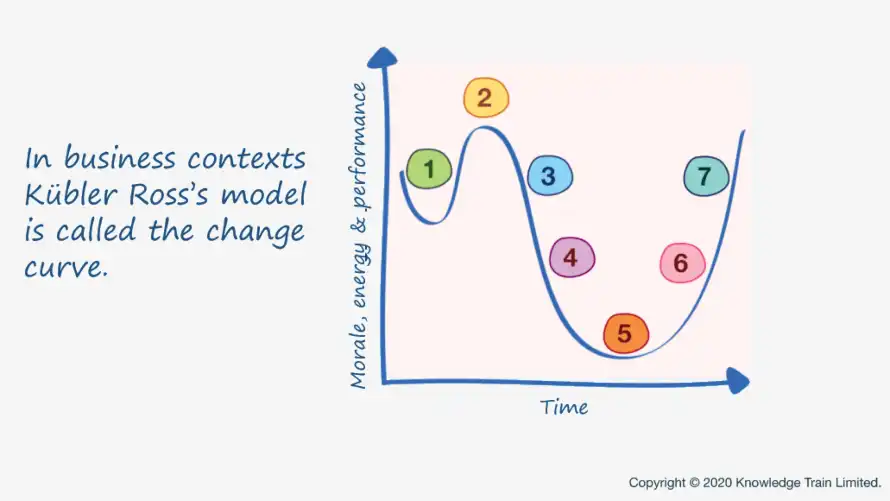
The Kubler Ross model is known as the change curve.

Kubler Ross Change Curve Infographic.

Guiding your team through change using the Satir change model
image
Navigating organisational change successfully with Kotter’s model
image
Is Change Management the course for you?
image
Change management skills
image
Unveiling the impact of Senge’s system thinking model on change management
image
The essentials of Lewin’s change model for successful change management
image
How ADKAR can revolutionise your change management strategy
image
How APMG Change Management qualifications can help your career
image
What is a business change manager?
image
What qualifications do change managers need?
image
logo


Copied! Key takeaways Systems thinking links the other four disciplines and helps reveal feedback loops, delays, and recurring patterns.
Technological advancementsBlog®Challenges and limitations Technological advancements drive business transformation by enhancing operational efficiency and enabling new business models. Companies must stay abreast of technological trends to capitalise on innovation, whether through automation, artificial intelligence, or other emerging technologies. AgileImplementation barriers[email protected]Research and developmentEXPLORE SUBJECTSFoundation Despite its benefits, adopting system thinking presents several implementation barriers. Organisations often face resistance from employees accustomed to traditional methods. The shift to a more interconnected approach requires changes in mindset and behaviour, which can be difficult to achieve. Additionally, the complexity of system thinking may overwhelm those unfamiliar with its principles. Legal factors Practitioner To overcome resistance, organisations can employ several strategies. Providing comprehensive training and support helps employees understand the value of system thinking. Encouraging small-scale pilot projects allows teams to experience its benefits firsthand. Leadership plays a crucial role in modelling the desired behaviours and reinforcing the importance of the new approach. By creating a supportive environment, organisations can cultivate a system thinking culture. Employment and labour lawsPROJECT MANAGEMENT QUALIFICATIONS & WORKSHOPSIncludes Foundation & Practitioner combined option.In conclusion, while implementing Senge’s model can enhance efficiency, innovation, and collaboration, it requires overcoming significant challenges. By addressing these barriers and fostering a culture of openness and learning, organisations can realise the full potential of system thinking. This transformation not only improves performance but also contributes to a more resilient and adaptable organisational culture. Employment and labour laws affect human resources by governing hiring practices, workplace safety, and employee rights. Businesses must ensure compliance with these laws to avoid litigation and foster a fair and productive work environment.Select your preferred qualification or workshop.AI Project Governance Framework (AIPGF)Case studies and real-world examples Regulatory compliance Foundation Successful implementations Regulatory compliance is vital for business operations across various sectors. Organisations must follow advertising standards, consumer protection legislation and product safety requirements. By doing so, they protect themselves from legal issues and build consumer trust, ensuring long-term success in the marketplace.PRINCE2 COURSESLearn the fundamentals of the governance framework.Corporate examples Environmental factorsSelect your preferred training course below:Practitioner Several companies have successfully integrated Senge’s system thinking model into their operations. For instance, Royal Dutch Shell applied systems thinking through scenario planning in the 1970s and 1980s, which helped them prepare for major oil market changes. Similarly, Unilever adopted system thinking to improve sustainability practices, resulting in significant reductions in waste and resource consumption.United KingdomClimate change and sustainability Includes Foundation & Practitioner combined option.Sector-specific applications
Climate change and APM COURSESBetter Business CasesIn the healthcare sector, system thinking has been applied to streamline patient care pathways, improving outcomes and reducing costs. Educational institutions have also embraced this model to foster collaborative learning environments, enhancing both teaching methods and student engagement. These sector-specific applications demonstrate the versatility of Senge’s model across different fields. sustainabilitySelect your preferred training course below:™Lessons learned
are increasingly important for industries worldwide. Businesses must consider their environmental impact and adopt sustainable practices to meet consumer expectations and regulatory requirements. This focus on sustainability can also result in cost savings and enhanced brand reputation. Foundation Key takeaways
Environmental regulationsAGILE PROJECT MANAGEMENT COURSESLearn the fundamentals of Better Business cases.The key takeaway from these examples is the importance of aligning the organisation’s vision with system thinking principles. Successful implementations often involve a strong commitment from leadership and a willingness to challenge existing mental models. Organisations that foster a culture of learning and open communication tend to reap the most benefits. Compliance with environmental regulations is essential for legal operation and maintaining a positive public image. Regulations may dictate waste management, emissions, and resource usage. Organisations must adapt processes to meet these standards, reducing their environmental footprint and avoiding legal penalties.Select your preferred training course below:By focusing on the interconnectedness of processes, companies can achieve improved efficiency and innovation. Moreover, the psychological benefits, such as reduced stress and increased job satisfaction, contribute to a more positive organisational culture. These lessons highlight the potential of Senge’s model to transform diverse workplace settings.Practitioner This framework provides businesses with a structured approach to analysing external factors, enabling informed strategic planning. By understanding these components, organisations can position themselves to navigate challenges and seize opportunities effectively. ConclusionIncludes Foundation & Practitioner combined option.SearchEnhance your skills with our expert-led coursesPRINCE2 AGILE COURSESSummary of key pointsP3O Select your preferred training course below:Senge’s system thinking model offers a holistic framework that enhances efficiency, innovation, and collaboration. By integrating personal mastery, mental models, shared vision, team learning, and systems thinking, organisations can address complex challenges effectively.® Future outlookFoundation BETTER BUSINESS CASES COURSESThe future of system thinking in organisational development is promising. As businesses navigate increasing complexity, this model’s principles will become even more relevant. By fostering a culture of continuous learning and adaptability, organisations can not only improve performance but also enhance employee well-being, leading to sustainable success.Learn the fundamentals of the P3O project management office. BCS Foundation Certificate in Business Analysis self-paced online What is Senge’s system thinking model?Includes Foundation & Practitioner combined option.United Kingdom P3O COURSESA framework for understanding organisational complexity through five interconnected disciplines. The model emphasises how personal mastery, mental models, shared vision, team learning, and systems thinking work together to create sustainable WorkshopsAustria£499 +vatSelect your preferred training course below:organisational changeIntroduction to Project Management Belgium .1-day workshop to learn the basics of project management.Bulgaria WORKSHOPSHow can system thinking improve organisational performance?Project Management Essentials Croatia Select your preferred workshop below:By enhancing efficiency, collaboration, and innovation. The approach helps organisations identify root causes of problems, understand feedback loops, and develop more sustainable solutions through holistic analysis.2-day workshop to learn how to manage projects without getting certified.Cyprus
Self-paced What are the challenges in implementing Senge’s model?Writing Business Cases Czech RepublicBCS International Diploma in Business Analysis self-paced onlineAGILE QUALIFICATIONSResistance to change and the need for mindset shifts. Organisations often struggle with moving from event-oriented thinking to recognising patterns and systemic structures, requiring sustained leadership commitment and cultural transformation.Half-day workshop to learn to write robust business cases.Denmark
Select your preferred qualification.Can Senge’s model be applied in small businesses?AI in Project Management Estonia
£2,199 +vat Yes, it is adaptable to different organisational sizes. Small businesses can particularly benefit from systems thinking by understanding interconnections between different business functions and making more informed strategic decisions.Learn how to use AI tools in everyday project work.Finland AGILE PROJECT MANAGEMENT COURSESWhat are some real-world examples of system thinking?ARTIFICIAL INTELLIGENCE (AI)France Select your preferred training course below:Royal Dutch Shell applied systems thinking for scenario planning in oil market changes. Other examples include Unilever’s sustainability initiatives and healthcare organisations improving patient care through systems approaches. These cases demonstrate how systems thinking can lead to better strategic planning and operational improvements.BCS AIGermany How does system thinking affect decision-making processes?Foundation GreeceSelf-pacedPRINCE2 AGILE COURSESIt promotes informed and sustainable decisions. Systems thinking helps leaders consider long-term consequences, understand feedback loops, and recognise how different parts of the organisation influence each other before making strategic choices.Learn the fundamentals of artificial intellegence.IrelandBCS Business Analysis Practice self-paced onlineSelect your preferred training course below:What role does “The fifth discipline” play in system thinking?AI Project Governance Framework (AIPGF)Italy It outlines the core principles of Senge’s model. Published in 1990, the book introduces the five disciplines and explains how systems thinking integrates them to create lasting organisational learning and change.Foundation LatviaApplication of PESTLE analysis in strategic planningSelect your preferred training course below:Peter Senge Practitioner LuxemburgIdentifying opportunities and threats change managementIncludes Foundation & Practitioner combined option.MaltaPESTLE analysis is a vital tool for recognising external opportunities and threats. By systematically examining Political, Economic, Social, Technological, Legal, and Environmental factors, businesses can identify potential growth areas and foresee challenges. This analysis enables organisations to adapt their strategies, ensuring they remain competitive. For instance, a change in government policy might present a new market opportunity, while economic downturns could pose threats that need mitigation. Understanding these dynamics allows companies to capitalise on favourable conditions and devise contingency plans for adverse scenarios, thus enhancing their strategic positioning.AGILE BUSINESS ANALYSIS COURSES model has been captured in this infographic.WorkshopsNetherlandsIntegrating PESTLE with SWOT analysisSelect your preferred training course below:Subscribe to our exclusive offers and promotionsAI in Project Management PolandIntegrating PESTLE with Learn how to use AI tools in everyday project work.PortugalSWOT analysisBUSINESS ANALYSIS QUALIFICATIONSSubscribe nowAGILERomania
provides a comprehensive strategic framework. While PESTLE focuses on external factors, SWOT examines internal strengths and weaknesses alongside external opportunities and threats. This combined approach offers a holistic view of the business environment, facilitating informed decision-making. By using PESTLE to inform SWOT, organisations can align their internal capabilities with external conditions, optimising strategic initiatives. This synergy not only aids in identifying areas for improvement but also highlights where the business can excel. Furthermore, the integration of these analyses can reduce stress and enhance confidence among stakeholders by providing clarity and direction. In workplace settings, this combined approach fosters a proactive culture, encouraging employees to anticipate changes and innovate accordingly. Ultimately, this strategic alignment drives sustainable growth and resilience in an ever-evolving business landscape.Select your preferred qualification. AgilePMSlovakiaCreating a PESTLE analysis template ®SloveniaKey elements to includeBCS BUSINESS ANALYSIS COURSES{"@context":"https://schema.org","@type":"ImageObject","contentUrl":"https://www.knowledgetrain.co.uk/training-courses/change-management-model-peter-senge-with-infographic-890x501.webp","description":"Peter Senge systems thinking model.","license":"https://www.knowledgetrain.co.uk/license","acquireLicensePage":"https://www.knowledgetrain.co.uk/license","creditText":"Knowledge Train","uploadDate":"2023-05-16T13:55:59.000Z","copyrightNotice":"© 2023 Knowledge Train Limited. All rights reserved.","creator":{"@type":"Organization","name":"Knowledge Train","url":"https://www.knowledgetrain.co.uk"}} – Agile Project ManagementSpainA comprehensive PESTLE analysis template should encompass all six macro-environmental factors: Political, Economic, Social, Technological, Legal, and Environmental. For each factor, consider including:Select your preferred training course below: Foundation Sweden
Political Related articlesLearn the key principles of Agile Project Management.Other countries
  • Manage optionsPMI COURSESLearn how Lewin's change model can guide your organisation through change. Uncover practical strategies and insights to facilitate smooth transitions. Scroll down for more information.Organise information – Agile Business AnalysisFoundation
  • Manage servicesSelect your preferred training course below: : Structure the data under the relevant categories in the template. Foundation Learn the fundamentals of the governance framework.
  • Manage {vendor_count} vendors Evaluate Impact Learn the fundamentals of Agile Business Analysis.Practitioner
  • Read more about these purposesPRINCE2 COURSES : Assess how each factor might present opportunities or threats. Practitioner Includes Foundation & Practitioner combined option.
Select your preferred training course below: Review and update 4-day course including Foundation.Better Business Cases APM COURSES By following these steps, you can ensure your PESTLE analysis remains relevant and actionable. This structured approach not only aids strategic planning but also reduces uncertainty, fostering a stable environment for decision-making. In turn, this can enhance workplace morale by clarifying organisational priorities and aligning them with external realities. Yellow Belt Foundation Navigating the change curve for successful transitionsCase study 1: Industry application PMIPractitioner Select your preferred training course below:Simon BuehringCase study 2: Country analysis PMI-ACP P3O PRINCE2 AGILE COURSES Conclusion KanbanFoundation View preferencesDiscover how the change curve can assist in managing transitions effectively. Gain insights and strategies to navigate change smoothly. Scroll down to explore more.Select your preferred training course below: PESTLE analysis is a crucial tool in strategic planning and decision-making. It provides a comprehensive view of external factors influencing an organisation, enabling businesses to identify opportunities and mitigate threats. By integrating PESTLE with other analytical tools, organisations can develop informed strategies that align with both internal strengths and external realities. This approach not only enhances operational effectiveness but also reduces strategic uncertainty. In workplace settings, the use of PESTLE instils confidence and clarity, contributing to stress reduction and improved decision-making. Ultimately, PESTLE analysis supports sustainable growth and competitive advantage in a complex business environment.Estimating for Agile FoundationLearn the fundamentals of the P3O project management office.
  • {title} FAQsAgile Learning Library (ALL)™Practitioner
  • {title} BUSINESS CASE COURSES What is the difference between PEST and PESTLE analysis?BUSINESS ANALYSISIncludes Foundation & Practitioner combined option.
  • {title} Select your preferred training course below:Copied!PEST analysis stands for Political, Economic, Social, and Technological factors. PESTLE expands this framework by including Legal and Environmental factors. This expansion provides a more comprehensive view of external influences on a business.BCS Business AnalysisWorkshops