Navigating organisational change successfully with Kotter’s modelReviews & success stories

Key takeawaysJonathan E., Programme Support Officer
Kotter’s 8-step model helps organisations deliver change that sticks by building urgency, alignment, and momentum.
- Start with evidence-based urgency drawn from real market and competitive pressures.
- Build a guiding coalition with enough influence and trust to lead across the organisation.
- Create a clear vision and practical strategy, then communicate it repeatedly through actions and messages.The live online sessions were engaging and interactive, and the self-paced materials slotted easily around my workload.
- Remove structural, cultural, and system barriers so teams can act without friction.Mark C., Delivery Lead
- Generate short-term wins to prove progress, then use them to sustain acceleration.Knowledge Train by numbers
- Anchor new behaviours in organisational culture to prevent relapse and enable continuous improvement.
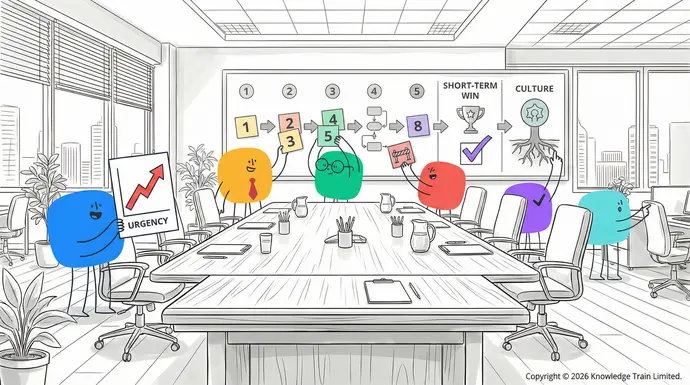
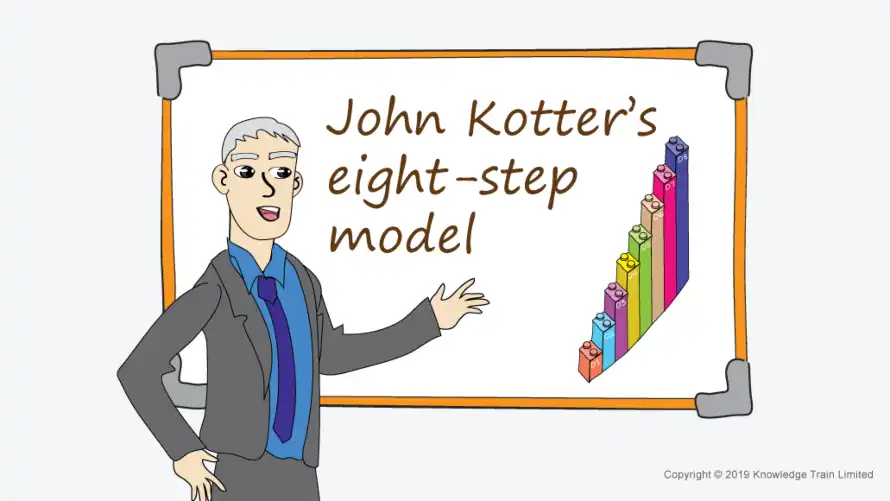
Introduction to Kotter’s change model
Why organisations need change
Change is essential for organisational success. The current business environment requires adaptation for sustained growth and competitive advantage. Organisations must embrace change to stay relevant, enhance efficiency, and meet evolving customer demands. Without change, stagnation can lead to obsolescence.
Overview of Kotter’s 8-step modelEnrol today!
- Motivating employees: Inspire employees by connecting the vision to individual values. Provide opportunities for them to contribute actively to the change process.The pass mark for the AgilePM Foundation exam is
Step 5: Enable action by removing barriers50%
Removing obstacles is vital for seamless change implementation. It helps to maintain momentum and prevent frustration..
- Process assessmentYou must answer at least requires systematic identification of structural, cultural and resource barriers that hinder change implementation. Teams must develop targeted solutions for each obstacle whilst maintaining momentum.25 out of 50 multiple-choice questions
- Barrier removal correctly within requires changing systems or structures that undermine the vision. This includes addressing resource constraints, reporting relationships and reward systems that discourage change.40 minutes
Step 6: Create short-term wins to achieve a pass.
Short-term wins are crucial for maintaining momentum. They provide evidence that the change is working.Still have questions? Contact us by phone on 0207 148 5985, via live chat, email, or by completing the form below.
- Setting achievable targets: Identify and prioritise goals that can be met quickly. These should be significant enough to validate the effort and encourage continued support.How to find us
- Recognising and rewarding success:Knowledge Train Celebrate achievements to reinforce positive behaviour. Public recognition can serve as motivation for further efforts. 20 Old Bailey, London, EC4M 7AN,
Step 7: Sustain acceleration England, United Kingdom.
Sustaining momentum is essential for long-term success. It involves building on initial successes to drive deeper change.Call
- Building on change momentum:+44 (0)207 148 5985 Leverage early wins to tackle more significant challenges. Use the credibility gained to push for additional, more substantial changes.Opening hours
- Encouraging ongoing progress:Monday to Friday – 09:00 to 17:15 Continuously communicate achievements and progress. Keep the focus on the end goal while acknowledging the journey.Get in touch
Step 8: Institute change
For change to last, it must become part of the organisational culture. Institutionalising change ensures its permanence.
- Anchoring new approaches in the culture requires showing people how specific behaviours and attitudes have helped improve performance. New practices must grow deep roots to ensure their continuation despite the pressure of future changes in leadership.
- Ensuring continuous improvement: Establish mechanisms for ongoing review and improvement. Encourage a culture of learning and adaptability to sustain the change over time.Name
Benefits of Kotter’s change model
Structured approach to change management
Kotter’s model offers a Phoneclear framework for managing changeEmail, ensuring that each stage is systematically addressed. The sequential approach helps organisations manage transformation systematically, which clarifies priorities and strengthens implementation.
Encourages employee engagement and buy-in
The model focuses on effective leadership and sustained commitment to drive change. Employee engagement emerges through clear communication and visible results. This approach not only reduces resistance but also enhances motivation, leading to a more harmonious transition.Submit
Challenges and limitations
Implementation challenges
Rushing through stages without establishing firm foundations at each step creates surface-level change that fails to last. Leadership must commit appropriate time and resources whilst maintaining urgency throughout the process.{"@context":"http://schema.org","@graph":[{"@type":"WebPage","headline":"Agile PM Foundation Training and Online Courses with Exam","url":"https://www.knowledgetrain.co.uk/agile/agile-project-management/agile-project-management-course/agile-pm-foundation","significantLink":"https://apmg-international.com/product/agilepm/foundation","about":[{"@type":"Thing","name":"training","sameAs":["http://en.wikipedia.org/wiki/Training","https://www.google.com/search?&kgmid=/m/014jg3","https://www.wikidata.org/wiki/Q918385"]},{"@type":"Thing","name":"certification","sameAs":["http://en.wikipedia.org/wiki/Professional_certification","https://www.google.com/search?&kgmid=/m/01vt2","https://www.wikidata.org/wiki/Q16023913"]},{"@type":"Thing","name":"agile project management","sameAs":["http://en.wikipedia.org/wiki/Agile_software_development","https://www.google.com/search?&kgmid=/m/02zhbn","https://www.wikidata.org/wiki/Q30232"]}],"mentions":[{"@type":"Thing","name":"elearning","sameAs":["https://en.wikipedia.org/wiki/Educational_technology","https://www.google.com/search?&kgmid=/m/067_f8","https://www.wikidata.org/wiki/Q1068473"]},{"@type":"Thing","name":"online course","sameAs":["https://en.wikipedia.org/wiki/Educational_technology","https://www.google.com/search?&kgmid=/m/067_f8","https://www.wikidata.org/wiki/Q1068473"]},{"@type":"Thing","name":"online courses","sameAs":["https://en.wikipedia.org/wiki/Educational_technology","https://www.google.com/search?&kgmid=/m/067_f8","https://www.wikidata.org/wiki/Q1068473"]},{"@type":"Thing","name":"e-learning","sameAs":["https://en.wikipedia.org/wiki/Educational_technology","https://www.google.com/search?&kgmid=/m/067_f8","https://www.wikidata.org/wiki/Q1068473"]},{"@type":"Thing","name":"online learning","sameAs":["https://en.wikipedia.org/wiki/Educational_technology","https://www.google.com/search?&kgmid=/m/067_f8","https://www.wikidata.org/wiki/Q1068473"]},{"@type":"Thing","name":"agile","sameAs":["https://en.wikipedia.org/wiki/Agile_software_development","https://www.google.com/search?&kgmid=/m/02zhbn","https://www.wikidata.org/wiki/Q30232"]},{"@type":"Thing","name":"agile project management","sameAs":["https://en.wikipedia.org/wiki/Agile_software_development","https://www.google.com/search?&kgmid=/m/02zhbn","https://www.wikidata.org/wiki/Q30232"]},{"@type":"Thing","name":"agile methodology","sameAs":["https://en.wikipedia.org/wiki/Agile_software_development","https://www.google.com/search?&kgmid=/m/02zhbn","https://www.wikidata.org/wiki/Q30232"]},{"@type":"Thing","name":"product owner","sameAs":["https://en.wikipedia.org/wiki/Scrum_(software_development)","https://www.google.com/search?&kgmid=/m/0ck_p8","https://www.wikidata.org/wiki/Q460387"]},{"@type":"Thing","name":"virtual classroom","sameAs":["https://en.wikipedia.org/wiki/Distance_education","https://www.google.com/search?&kgmid=/m/02h32","https://www.wikidata.org/wiki/Q159595"]},{"@type":"Thing","name":"project management","sameAs":["https://en.wikipedia.org/wiki/Project_management","https://www.google.com/search?&kgmid=/m/05_p2","https://www.wikidata.org/wiki/Q179012"]},{"@type":"Thing","name":"curriculum","sameAs":["https://en.wikipedia.org/wiki/Curriculum","https://www.google.com/search?&kgmid=/m/02fk8v","https://www.wikidata.org/wiki/Q207137"]},{"@type":"Thing","name":"examinations","sameAs":["https://en.wikipedia.org/wiki/Exam","https://www.google.com/search?&kgmid=/m/01gd1c","https://www.wikidata.org/wiki/Q1355298"]},{"@type":"Thing","name":"examination","sameAs":["https://en.wikipedia.org/wiki/Exam","https://www.google.com/search?&kgmid=/m/01gd1c","https://www.wikidata.org/wiki/Q1355298"]},{"@type":"Thing","name":"exams","sameAs":["https://en.wikipedia.org/wiki/Exam","https://www.google.com/search?&kgmid=/m/01gd1c","https://www.wikidata.org/wiki/Q1355298"]},{"@type":"Thing","name":"exam","sameAs":["https://en.wikipedia.org/wiki/Exam","https://www.google.com/search?&kgmid=/m/01gd1c","https://www.wikidata.org/wiki/Q1355298"]},{"@type":"Thing","name":"scrum","sameAs":["https://en.wikipedia.org/wiki/Scrum_(software_development)","https://www.google.com/search?&kgmid=/m/0ck_p8","https://www.wikidata.org/wiki/Q460387"]},{"@type":"Thing","name":"scrum master","sameAs":["https://en.wikipedia.org/wiki/Scrum_(software_development)","https://www.google.com/search?&kgmid=/m/0ck_p8","https://www.wikidata.org/wiki/Q460387"]},{"@type":"Thing","name":"dsdm atern","sameAs":["https://en.wikipedia.org/wiki/Dynamic_systems_development_method","https://www.google.com/search?&kgmid=/m/031748","https://www.wikidata.org/wiki/Q2335896"]},{"@type":"Thing","name":"instructor led training","sameAs":["https://en.wikipedia.org/wiki/Instructor-led_training","https://www.google.com/search?&kgmid=/m/05t01p3","https://www.wikidata.org/wiki/Q6041810"]}]},{"@type":"FAQPage","mainEntity":[{"@type":"Question","name":"Does the AgilePM Foundation course include the exam?","acceptedAnswer":{"@type":"Answer","text":"
Yes, Knowledge Train’s AgilePM Foundation courses include both the exam and the AgilePM Handbook.
This ensures you have everything you need to prepare effectively and gain the AgilePM Foundation certification.
"}},{"@type":"Question","name":"How long does AgilePM Foundation training take?","acceptedAnswer":{"@type":"Answer","text":"
Instructor-led AgilePM Foundation training:
3 days
strong>Self-paced AgilePM Foundation online training:Kotter’s model guides organisations through effective change management, ensuring systematic and successful transformation.
> 23 hoursHow can organisations create a sense of urgency for change?
>By identifying market threats and opportunities, organisations highlight the necessity for immediate action, motivating stakeholders.
>What are some common challenges when implementing Kotter’s change model?<
p>Both formats provide comprehensive coverage of Agile principles and practices, with flexibility to suit your schedule and learning style.Not establishing enough urgency and declaring victory too soon are the most critical mistakes organisations make during implementation.
>"}},{"@type":"Question","name":"Is the AgilePM Foundation difficult?","acceptedAnswer":{"@type":"Answer","text":"How can short-term wins help sustain change momentum?<
p>No. A high pass rate at Knowledge Train shows that AgilePM Foundation training and certification are not difficult if you dedicate time to preparation.Achieving short-term wins provides evidence of progress, boosting morale and reinforcing commitment to the change.
>Why is employee engagement crucial in Kotter’s model?<
p>Students with prior experience in Agile or project management generally find the exam straightforward. Even beginners can pass with adequate study and practice.Engaging employees fosters ownership and reduces resistance, ensuring smoother implementation and sustained change.
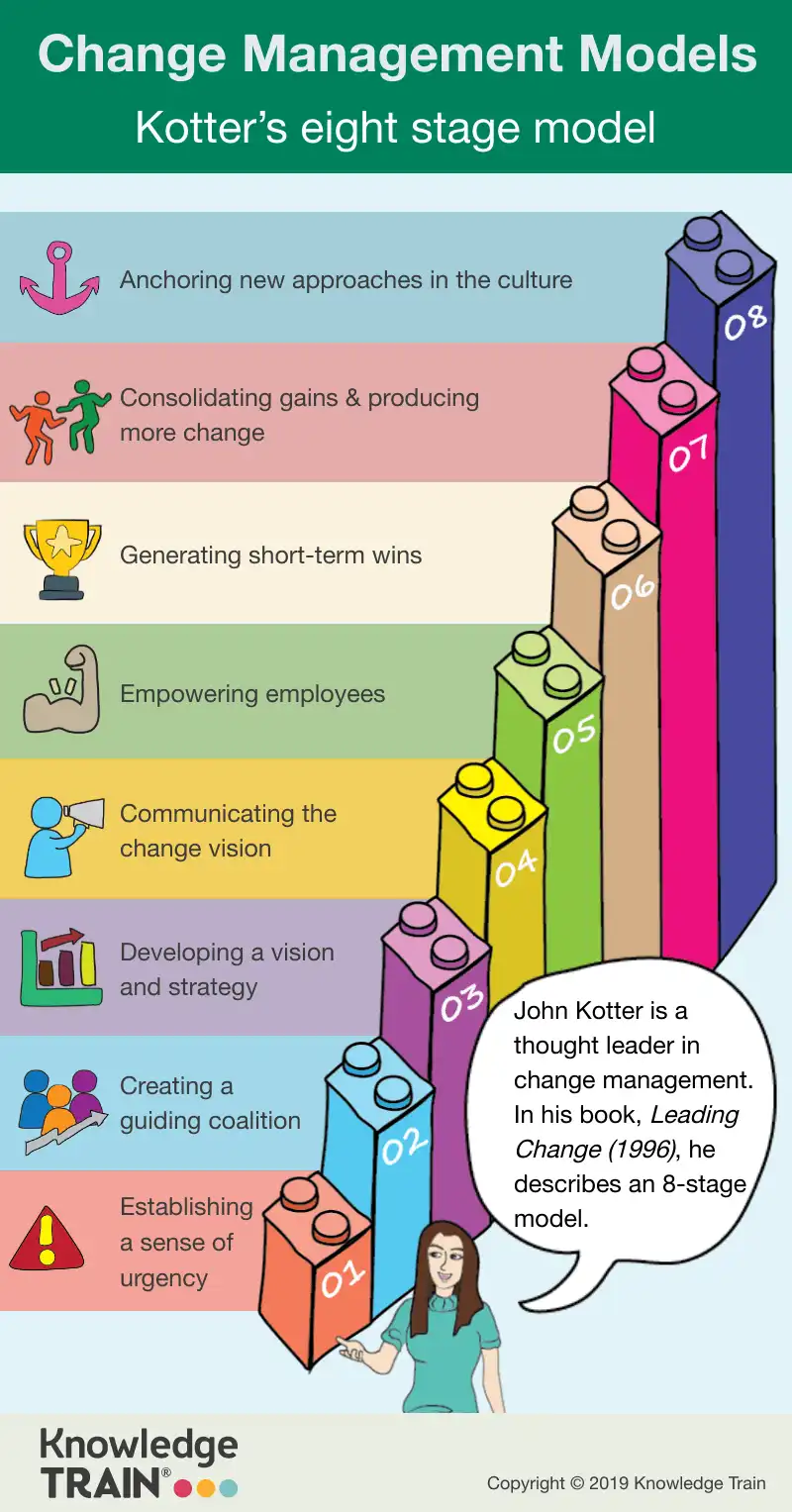
>Infographic<
p>We recommend a consistent study plan and use of official AgilePM Foundation materials, including the syllabus, course handbook, and sample exams.The Kotter change curve has been summarised on this colourful infographic.