Unlocking potential with SMART goals in goal setting to ensure the investment is worthwhile.

Key takeawaysWhat is a business case?
SMART goals turn vague intentions into clear, trackable commitments.A business case is the justification for some activity (e.g. a project) undertaken by your organisation. It weighs up the timescales, costs and risks of doing the activity against the benefits to be gained. Think of it as weighing up the pros and cons and then taking a sensible decision.
- Make goals specific so the action required is unambiguous and easy to start.A business case forms an essential component of the curriculum of the
- Define measurable criteria so progress can be tracked and adjusted early.best project management courses
- Keep goals achievable by balancing ambition with realistic constraints and capability..
- Check relevance to ensure effort supports wider priorities and better resource use.Personal business case
- Add a firm timeframe to create urgency, accountability, and reduce procrastination.You may also use a business case to justify an investment you make in your personal life. For example, when you’re thinking of moving home to another area. You and your spouse will need to understand the costs of moving, the timescales and risks involved, and weigh these up against the benefits to be gained e.g. saving time traveling to your office, or your children able to go to a better school.

Introduction to SMART goalsSuppose you and your spouse are considering moving to a new home. You will need to weigh up the pros and cons of moving. This is done using a business case. You might not call it that, but that’s what it is. Let’s look at an example.

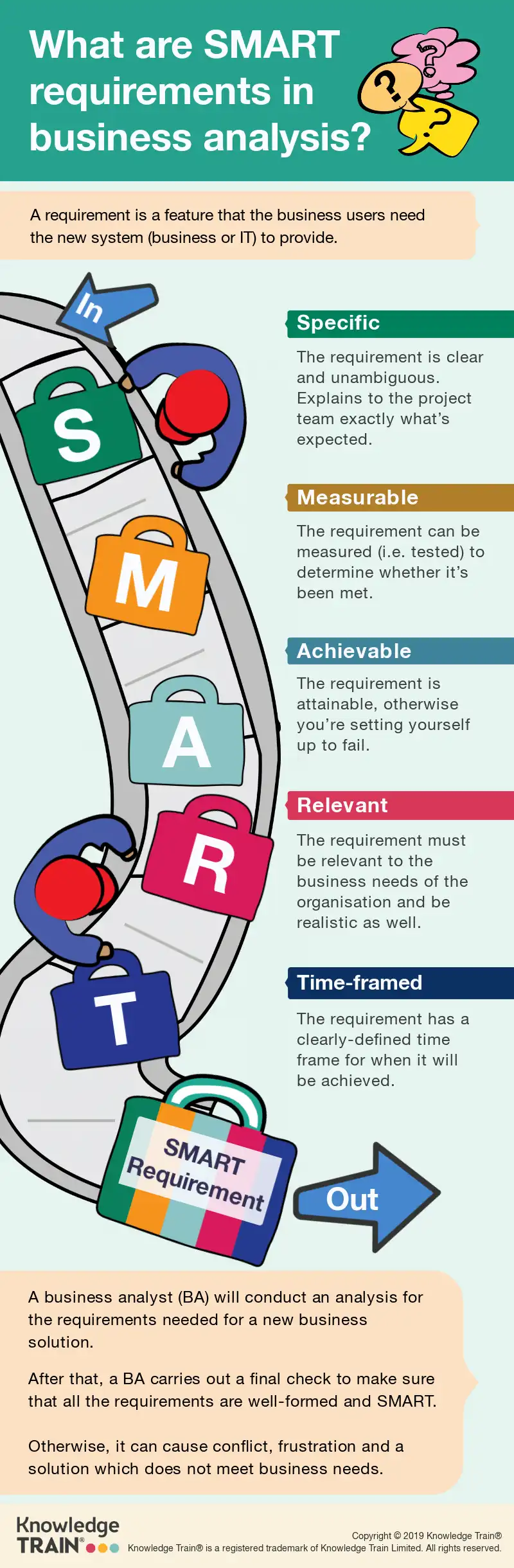
SMART goalsReason are a structured approach to goal setting, ensuring clarity and focus. They are an effective method for setting objectives by making them As you can see from the example, the first thing to be clear about in a business case is the reason for doing the project or activity. In this example, the couple has answered the question SpecificWhy?, In fact, there are two problems here – the local school and John’s long commute.MeasurableOptions considered, A business case should weigh up the competing options which have been considered. After all, there is usually more than one option. Perhaps an alternative option would have been for John to change his job to one nearer their current house. However, this wouldn’t solve the issue with the school.AchievableBenefits, The benefits of a project or activity are the positive things you’re going to get back in return for your investment of time and money. In this case, the kids will get a better education, and John will save time each day.RelevantTimescales, and It’s also important to understand how long the investment of resources will take. This is so that the organisation (or family in this case) knows when the resources will be freed up to work on other Time-boundprojects. This framework aids individuals and organisations in better planning and achieving their aims, ultimately leading to improved productivity and success. or activities.
The concept of SMART goals originated in November 1981, when George T. Doran published it in Management Review journal as a method for clearer and more achievable goal setting. Over time, it has become a widely accepted practice across various fields, from personal development to corporate management.There are usually 2 timescales to consider. First, the timescale of the project or activity – in this case 3 months to find a new house and move there. Second, the time over which the benefits shall be realized. In this case it’s 5 years until the kids leave school.
Adopting SMART goals can provide psychological benefits such as reduced stress and enhanced motivation. Breaking down objectives into manageable parts allows individuals to focus on priorities, leading to more effective approaches to personal and professional challenges.Costs
Understanding the SMART criteriaThe costs of doing the project or activity is the next important bit of information. On this project, the costs of moving to a new house will be £5,000. These are the project costs.
SpecificHowever, the couple will spend an additional £2,000/year for every year over which the business case is calculated. For a project in an organisation, this is usually referred to as the operational costs of maintaining and operating the projects outputs e.g. an IT system. At this point, the couple knows the total costs over the timescales when the benefits shall be realized.
Being RisksspecificFor any activity or project, it’s also important to understand the major risks involved. Risks are the uncertain things which may or may not happen during the period of the investment. There is only one risk identified here, which is the risk that the couple might lose touch with friends who live close to them right now. in goal setting provides a clear direction and purpose. A well-defined goal leaves little room for ambiguity, enabling focused efforts. For instance, instead of saying, “Improve health,” specify, “Exercise for 30 minutes, five times a week.” Clear goals eliminate confusion and provide a roadmap for action.Investment appraisal
MeasurableThe next section is where the costs and timescales and risks are weighed up. For this project, it’s a simple decision for the couple to decide if it’s worth spending money over the next 5 years to give their kids better schooling and to save John 2 hours a day commuting.
Having For an organisation to decide if an investment is worthwhile, however, there are several different ways in which it can decide about the investment.measurableOften in organisations there are rules defined to help business analysts or criteria allows for tracking progress effectively. It is crucial to determine how success will be quantified, whether through numbers, frequencies, or benchmarks. Progress charts, spreadsheets and digital applications support measuring progress. For example, “Increase sales by 10% in three months” is measurable, while “Improve sales” is not.project managers
Achievable write what’s called an investment appraisal. In the next example, we’ll look at one example known as net benefits.
Goals should be Business case example 2: Handheld device projectachievableImagine a heating repair services company that uses a paper-based set of forms filled in by an engineer during site visits. The spare parts required to fix the heater are recorded on a form which is given to staff to process back in the office. They then order the parts, and schedule a follow-up visit for the engineer to fix the heater. to maintain motivation and drive. It’s important to set objectives that are within reach yet still challenging. Balancing ambition with practicality ensures that goals are inspiring but not discouraging. For instance, setting an objective to “Run a marathon in six months” is more realistic than aiming for one in a month with no prior training.Enhance your skills with our expert-led courses
Relevant
Ensuring that goals are relevant aligns them with broader objectives. This ensures that efforts contribute meaningfully to overall ambitions. Prioritisation is key, as it focuses resources on what truly matters. A relevant goal might be “Learn advanced Excel for work efficiency,” aligning personal development with career progression.Instructor-led
Time-boundBetter Business Cases Practitioner (with Foundation) course
Setting time-bound£2,400 +vat goals introduces urgency and accountability. Deadlines motivate action and prevent procrastination. Effective time management involves setting realistic time frames to achieve goals. For example, “Complete the project by the end of the month” is more effective than “Complete the project soon.”
Understanding and applying the SMART criteria can reduce stress and enhance motivation. By breaking down goals into specific, manageable components, individuals can approach challenges with clarity and confidence.See all dates
The Process of writing SMART goalsThe expected benefits of reduced overheads are clearly stated. Benefits should be measurable and quantifiable. That means that the benefits can be measured later. But what about the reduced errors, rescheduled appointments and customer contract cancellations? Aren’t they benefits?
Step-by-step guideWell, these are in fact something else – they’re called outcomes. Outcomes are the results of the changes which come about by using the new handheld devices. The ways you measure the improvements resulting from these outcomes are known as benefits.
Initial brainstormingDis-benefits: Begin by identifying what you truly wish to achieve. Gather your thoughts and list all potential goals. This stage is about exploring possibilities without constraints. Use prompts to consider various aspects and perspectives, ensuring a comprehensive view of your ambitions.This example also contains a dis-benefit which is that the back-office staff morale will be lower due to reduced overtime payments. A dis-benefit, if you’re wondering, is a negative consequence of a project. It’s not the same as a risk which implies something uncertain. A dis-benefit is something which you know will happen because of the project and it has negative consequences for the organisation. It’s the opposite of a benefit!
Tools and templatesSummary: Utilise available tools and templates to streamline goal setting. Templates can provide structured prompts for each SMART criteria, ensuring thorough consideration. Digital tools often offer tracking features to monitor progress, enhancing accountability.A business case is the most important document on any project. That’s because it justifies the investment.
Common mistakes and how to avoid themIt helps an organisation be clear about why a project is needed, and what the results of the investment will be. This is crucial because no organisation has unlimited funds to spend on an unlimited number of projects. Therefore, a business case gives confidence to senior managers when deciding to invest in one project rather than another.
VaguenessHowever, as you have seen in this article, a business case is something which you can find useful when taking major decisions in your own personal life. Remember – a business case doesn’t need to be a lengthy document. It could easily be a few notes scribbled on the back of something or even sent in an email.: Vague goals lack direction and clarity. Avoid ambiguity by being specific about what you aim to achieve. Instead of “Improve communication skills,” specify “Complete a communication skills workshop by the end of the quarter.”Whatever form your business case takes, remember one thing – it will help you or your organisation take sensible decisions about committing time and resources to a project or activity.
Over-ambitionRemember, if you want to learn more about developing a business case, and learn many of the techniques useful for assessing business problems, consider attending a classroom : While ambition is valuable, setting unattainable goals can lead to frustration. Balance ambition with realism. Break larger goals into smaller, manageable parts to maintain motivation and progress.business analyst course
Neglecting time frames.: Without deadlines, goals can languish. Time frames introduce urgency and structure. Incorporate clear deadlines for each goal. For instance, replace “Start a blog” with “Launch a blog by 1st June.”Enhance your skills with our expert-led courses
Relevance overlooked : Ensure goals align with your broader objectives. Irrelevant goals can dilute focus and resources. Regularly review goals for alignment with key priorities, adjusting as necessary to maintain coherence with overall ambitions.
Adopting SMART goals can significantly reduce stress and enhance motivation by providing a structured, clear approach to achieving objectives. By following these guidelines and avoiding common pitfalls, you can set goals that are both inspiring and attainable.
Benefits of using SMART goalsInstructor-led
Enhanced focus and clarityBetter Business Cases Practitioner (with Foundation) course
SMART goals provide a well-defined path, ensuring clarity and focus. By breaking down ambitions into specific, manageable components, individuals and organisations can concentrate efforts effectively. This approach minimises distractions and aligns actions with objectives, fostering a targeted and efficient pursuit of goals.£2,400 +vat
Improved motivation and accountability
SMART goals play a crucial role in boosting See all dates
SMART goals offer a structured and effective approach to achieving ambitions. By ensuring that goals are specific, measurable, achievable, relevant, and time-bound, individuals and organisations can enhance focus, reduce stress, and improve resource management. This method encourages a clear path to success, fostering motivation and accountability. Now is the time to apply this powerful framework. Start setting your own SMART goals today and experience the benefits of structured goal setting in your personal and professional life. strategies?
FAQsIs the
What are SMART goals?project plan
SMART goals are objectives that are aligned with the business case? (e.g. are the costs and timescales in the project plan correctly reflected in the business case?)SpecificAre the benefits clearly identified and justified?, Is it clear how the benefits will be realized?MeasurableIs it clearly defined what will judged a successful outcome?, Is the preferred business option clearly stated, along with the reasons why?AchievableIf the project requires external procurement, is the preferred sourcing option stated, and why?, Is it clearly stated how any necessary funding will be obtained?RelevantDoes the business case include non-financial, as well as financial criteria?, and Does the business case include operations and maintenance costs and risks?Time-boundDoes the business case include project costs and risks?, providing a clear and structured way to achieve targets.Does the business case conform to organisational accounting standards (e.g. break-even analysis and cash-flow conventions)?
How do you measure the success of SMART goals?Are the major risks faced by the project explicitly stated, together with any proposed responses?
Success is measured by evaluating if the goal meets its specific criteria and timeline. Regular progress tracking and outcome assessment are essential to determining achievement.How do you write a good business case?
Can SMART goals be adjusted over time?A good business case must contain certain key information including:
Yes, SMART goals can be adapted as circumstances change. It’s important to review and modify goals to maintain their relevance and achievability, ensuring alignment with evolving priorities.The reasons for doing the project;
What are some common challenges when setting SMART goals?The business options which have been considered, including the base business options of do nothing, so something, or do something else;
Challenges include setting overly ambitious targets, failing to define clear metrics, and overlooking deadlines. Addressing these can enhance goal effectiveness and reduce stress.Project and operational costs;
InfographicProject and operational timescales;