
BCS Business Analysis are a structured approach to goal setting, ensuring clarity and focus. They are an effective method for setting objectives by making them Business Analysis Foundation SpecificLearn the fundamentals of business analysis., Modelling Business Processes MeasurableGain practitioner certificate in modelling business processes., Business Analysis Practices AchievableGain practitioner certificate in business analysis practices., Requirements Engineering RelevantGain practitioner certificate in requirements engineering., and Business Analysis International Diploma Time-boundAll 4 courses bundled into this Diploma certification package.. This framework aids individuals and organisations in better planning and achieving their aims, ultimately leading to improved productivity and success.AgileBA
The concept of SMART goals originated in November 1981, when George T. Doran published it in Management Review journal as a method for clearer and more achievable goal setting. Over time, it has become a widely accepted practice across various fields, from personal development to corporate management.®
Adopting SMART goals can provide psychological benefits such as reduced stress and enhanced motivation. Breaking down objectives into manageable parts allows individuals to focus on priorities, leading to more effective approaches to personal and professional challenges. – Agile Business Analysis
Understanding the SMART criteriaFoundation training
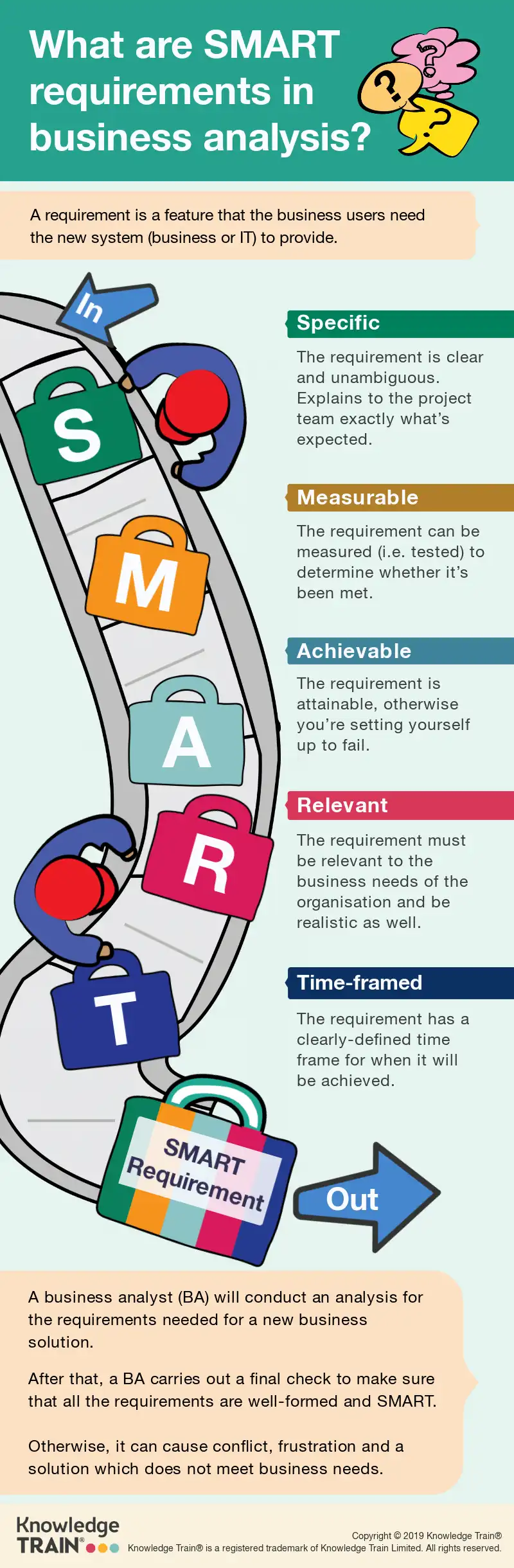
SpecificLearn the fundamentals of Agile Business Analysis.
Being Practitioner specific4-day course including Foundation. in goal setting provides a clear direction and purpose. A well-defined goal leaves little room for ambiguity, enabling focused efforts. For instance, instead of saying, “Improve health,” specify, “Exercise for 30 minutes, five times a week.” Clear goals eliminate confusion and provide a roadmap for action.PMI
Measurable®
Having PMI-PBA measurableSelf-paced course to prepare you for the exam (exam not included). criteria allows for tracking progress effectively. It is crucial to determine how success will be quantified, whether through numbers, frequencies, or benchmarks. Progress charts, spreadsheets and digital applications support measuring progress. For example, “Increase sales by 10% in three months” is measurable, while “Improve sales” is not.Business Analysis Learning Library (BALL)™
AchievableCHANGE MANAGEMENT
Goals should be APMG Change ManagementachievableFoundation to maintain motivation and drive. It’s important to set objectives that are within reach yet still challenging. Balancing ambition with practicality ensures that goals are inspiring but not discouraging. For instance, setting an objective to “Run a marathon in six months” is more realistic than aiming for one in a month with no prior training.Learn the fundamentals of enterprise change management.
RelevantPractitioner
Ensuring that goals are Includes Foundation & Practitioner combined option.relevantPROGRAMME MANAGEMENT aligns them with broader objectives. This ensures that efforts contribute meaningfully to overall ambitions. Prioritisation is key, as it focuses resources on what truly matters. A relevant goal might be “Learn advanced Excel for work efficiency,” aligning personal development with career progression.MSP
Time-bound®
Setting Foundation time-boundLearn the fundamentals of programme management. goals introduces urgency and accountability. Deadlines motivate action and prevent procrastination. Effective time management involves setting realistic time frames to achieve goals. For example, “Complete the project by the end of the month” is more effective than “Complete the project soon.”Practitioner
Understanding and applying the SMART criteria can reduce stress and enhance motivation. By breaking down goals into specific, manageable components, individuals can approach challenges with clarity and confidence.Includes Foundation & Practitioner combined option.
The Process of writing SMART goals_blank
Step-by-step guideAbout
Initial brainstorming_blank: Begin by identifying what you truly wish to achieve. Gather your thoughts and list all potential goals. This stage is about exploring possibilities without constraints. Use prompts to consider various aspects and perspectives, ensuring a comprehensive view of your ambitions.Blog
Refining goals : Once you’ve identified potential goals, refine them to align with the EXPLORE SUBJECTSSMARTSelect your preferred subject. criteria. Assess each goal’s specificity, measurability, achievability, relevance, and time frame. This iterative process helps to ensure each goal is clear and feasible, ready for implementation.
FinalisationPROJECT MANAGEMENT QUALIFICATIONS & WORKSHOPS: With refined goals, proceed to finalise them. Prioritise based on relevance and urgency. Write a concise statement for each goal, encapsulating its essence and intended outcome. This step formalises your commitment and sets the stage for action.Select your preferred qualification or workshop.
Tools and templates : Utilise available tools and templates to streamline goal setting. Templates can provide structured prompts for each SMART criteria, ensuring thorough consideration. Digital tools often offer tracking features to monitor progress, enhancing accountability.PRINCE2 COURSES
Common mistakes and how to avoid themSelect your preferred training course below:
Vagueness : Vague goals lack direction and clarity. Avoid ambiguity by being specific about what you aim to achieve. Instead of “Improve communication skills,” specify “Complete a communication skills workshop by the end of the quarter.”APM COURSES
Over-ambitionSelect your preferred training course below:: While ambition is valuable, setting unattainable goals can lead to frustration. Balance ambition with realism. Break larger goals into smaller, manageable parts to maintain motivation and progress.
Neglecting time framesAGILE PROJECT MANAGEMENT COURSES: Without deadlines, goals can languish. Time frames introduce urgency and structure. Incorporate clear deadlines for each goal. For instance, replace “Start a blog” with “Launch a blog by 1st June.”Select your preferred training course below:
Relevance overlooked : Ensure goals align with your broader objectives. Irrelevant goals can dilute focus and resources. Regularly review goals for alignment with key priorities, adjusting as necessary to maintain coherence with overall ambitions.PRINCE2 AGILE COURSES
Adopting SMART goals can significantly reduce stress and enhance motivation by providing a structured, clear approach to achieving objectives. By following these guidelines and avoiding common pitfalls, you can set goals that are both inspiring and attainable.Select your preferred training course below:
Benefits of using SMART goals
Enhanced focus and clarityBETTER BUSINESS CASES COURSES
SMART goalsSelect your preferred training course below: provide a well-defined path, ensuring clarity and focus. By breaking down ambitions into specific, manageable components, individuals and organisations can concentrate efforts effectively. This approach minimises distractions and aligns actions with objectives, fostering a targeted and efficient pursuit of goals.
Improved motivation and accountabilityP3O COURSES
SMART goals play a crucial role in boosting Select your preferred training course below:motivation and enhancing accountability. The structured nature of SMART criteria ensures that goals are not only clear but also achievable. This clarity in purpose and progress tracking energises individuals, maintaining enthusiasm and commitment. Furthermore, having measurable outcomes fosters a sense of responsibility, as progress can be visibly monitored and assessed.WORKSHOPS
Better resource managementSelect your preferred workshop below:
Efficient use of resources is another significant advantage of setting SMART goals. With clear objectives and timelines, resources such as time, effort, and finances can be allocated more effectively. This alignment reduces wastage and optimises productivity. By prioritising relevant goals, individuals and organisations ensure that their resources are directed towards what truly matters, achieving the best possible outcomes.
Overall, adopting SMART goals can lead to reduced stress and enhanced performance by providing a structured and clear framework for achieving objectives. This method encourages a more strategic and focused approach, ultimately leading to greater success in both personal and professional endeavours.AGILE QUALIFICATIONS
Applying SMART goals in different contextsSelect your preferred qualification.
Personal development
SMART goals are invaluable for AGILE PROJECT MANAGEMENT COURSESpersonal developmentSelect your preferred training course below:, providing a clear framework to achieve self-improvement. For instance, an individual aiming to enhance their communication skills might set a goal to “Attend a public speaking course in the next three months.” By being specific and time-bound, such goals facilitate structured self-growth and ensure progress is measurable and relevant.
Business and professional settingsPRINCE2 AGILE COURSES
In Select your preferred training course below:business and professional environments , SMART goals drive productivity and innovation. A case study example is a marketing team setting a goal to “Increase social media engagement by 20% over the next quarter.” This specificity and measurability help teams focus efforts and allocate resources effectively, ensuring that objectives are met within defined time frames and align with broader business strategies.SCRUM COURSES
Educational contextsSelect your preferred training course below:
In educational settingsAGILE BUSINESS ANALYSIS COURSES