Key takeawaysCompliance Learning Library (CLL)™
PESTLE helps organisations anticipate external change and make steadier strategic choices.IT Learning Library (ITLL)™
- PESTLE examines Political, Economic, Social, Technological, Legal and Environmental forces shaping performance.Business solutionsCopied!
- It supports proactive planning by surfacing opportunities early and highlighting threats that need mitigation._blankKey takeaways
- Using PESTLE to inform SWOT links external conditions to internal strengths and weaknesses for better decisions.AboutSWOT works best when it is specific, balanced, and turned into decisions.
- A useful template captures the key drivers under each factor and assesses likely impact on the organisation._blankUse SWOT to separate internal strengths and weaknesses from external opportunities and threats, so strategy is grounded in reality.
- Regular reviews, often quarterly, keep the analysis current as policies, markets and technology shift.BlogCollect detailed evidence from staff input, market research, and financials to avoid vague, unhelpful statements.
Select your preferred training course below:Government policies and stability,
Government policies are a significant influence on business environments. Changes in taxation, labour laws, or trade restrictions can alter market dynamics. Political stability is equally important, as it fosters a predictable environment for investment. Businesses must monitor policy changes to maintain compliance and align strategies with governmental priorities. Opportunities
Trade regulations and tariffsSCRUM COURSES, and
Trade regulations and tariffs affect businesses entering or expanding in new markets. Import duties may limit market access whilst trade agreements can create opportunities. Understanding these regulations helps businesses navigate international markets effectively, mitigating risks associated with cross-border trade.Select your preferred training course below:Threats
Economic factors facing an organisation. This method provides a structured approach to decision-making by systematically assessing internal and external factors. SWOT analysis was developed in the 1960s and 1970s at Stanford Research Institute by Albert Humphrey, who led a research project funded by Fortune 500 companies. It has since evolved into a staple of strategic planning across various industries. By categorising different aspects of a business, SWOT helps leaders to craft strategies that leverage strengths and opportunities while addressing weaknesses and mitigating threats.
Economic growth and exchange ratesAGILE BUSINESS ANALYSIS COURSESImportance in strategic planning Request a quote
Economic growth is a key indicator of market potential. During periods of growth, consumer spending typically increases, leading to higher demand for goods and services. Exchange rates also play a pivotal role, affecting the cost of imports and exports. Businesses must adapt pricing and sourcing strategies to manage currency fluctuations.Select your preferred training course below:The role of SWOT analysis in strategic planning cannot be overstated. It serves as a foundation for informed decision-making and strategic development.
Inflation and interest rates SWOT analysis enhances clarity
Inflation and interest rates profoundly impact consumer behaviour. High inflation erodes purchasing power, while interest rates influence borrowing costs. Businesses must adjust their pricing strategies to remain competitive and manage debt effectively during fluctuating economic conditions.BUSINESS ANALYSIS QUALIFICATIONS by breaking down complex scenarios into manageable components, providing a clearer picture of the current situation. It guides resource allocation through understanding strengths and weaknesses, helping prioritise resources effectively. The approach stimulates proactive thinking by identifying opportunities and threats, encouraging forward-looking strategies rather than reactive measures.[email protected]
Social factorsSelect your preferred qualification.Psychological benefits
Cultural norms and demographics are also noteworthy. Engaging in a SWOT analysis can reduce stress by providing a structured approach to problem-solving. By mapping out a plan, individuals and teams experience enhanced focus and confidence. The process encourages open discussion and collaboration, which can lead to innovative solutions. This comprehensive approach makes SWOT analysis an invaluable tool in both personal and professional contexts. +44 (0)207 148 5985
Cultural norms and demographics shape consumer preferences and behaviours. Understanding these social factors helps businesses tailor products and marketing strategies to meet the needs of diverse populations. Demographic shifts, such as an ageing population, can also create new market opportunities.BCS BUSINESS ANALYSIS COURSESIn essence, SWOT analysis is not just a list-making exercise; it is a dynamic tool that guides strategic planning and fosters a proactive mindset in navigating challenges and seizing opportunities.Courses
Lifestyle changesSelect your preferred training course below:Conducting a SWOT analysisPROJECT MANAGEMENT
Lifestyle changes, driven by shifts in social values and technological advancements, affect consumer demands. As lifestyles evolve, businesses must innovate to offer products and services that align with emerging trends, such as increased health consciousness or digital engagement. Preparing for the SWOT analysisPRINCE2
Technological factorsAGILE BUSINESS ANALYSIS COURSESConducting a ®
Technological advancementsSelect your preferred training course below:SWOT analysisFoundation
Technological advancements drive business transformation by enhancing operational efficiency and enabling new business models. Companies must stay abreast of technological trends to capitalise on innovation, whether through automation, artificial intelligence, or other emerging technologies. begins with meticulous Learn the fundamentals of the PRINCE2 method.
Research and developmentpreparationCHANGE MANAGEMENT QUALIFICATIONSPractitioner
Investment in research and development (R&D) is crucial for maintaining a competitive edge. Businesses that prioritise R&D can lead in innovation, delivering unique products and services. This focus on R&D supports long-term growth and adaptability in a rapidly changing market.. This stage is crucial to ensure that the analysis is both meaningful and actionable. The Select your preferred qualification.Includes Foundation & Practitioner combined option.
Legal factorsspecificity Association for Project Management (APM)
Employment and labour laws of data collection plays a vital role. General or vague information can lead to ambiguous conclusions that hinder strategic planning. To avoid this, gather detailed and relevant data reflecting the current state of your organisation.APMG CHANGE MANAGEMENT COURSESProject Fundamentals Qualification (PFQ)
Employment and labour laws affect human resources by governing hiring practices, workplace safety, and employee rights. Businesses must ensure compliance with these laws to avoid litigation and foster a fair and productive work environment.Select your preferred training course below:Tools and techniques for gathering informationStart your APM project management career.
Regulatory compliance Information gathering involves several key approaches. Internal surveys and questionnaires help gather employee insights and pinpoint strengths and weaknesses through structured questions. Market research focuses on analysing industry trends and evaluating competitor strategies. Financial analysis includes reviewing statements for economic insights and identifying areas for improvement. SWOT templates help organise thoughts and ensure comprehensive coverage of all aspects.Project Management Qualification (PMQ)
Regulatory compliance is vital for business operations across various sectors. Organisations must follow advertising standards, consumer protection legislation and product safety requirements. By doing so, they protect themselves from legal issues and build consumer trust, ensuring long-term success in the marketplace.PROGRAMME MANAGEMENT QUALIFICATIONSThis preparation reduces stress by providing a clear process to follow. By having a structured approach, individuals can focus on crafting actionable strategies rather than feeling overwhelmed.Advance your APM project management expertise.
Environmental factorsSelect your preferred qualification.Step-by-step guideProject Risk Single Certificate Level 1
Climate change and sustainability Once you have gathered the necessary information, categorise it into the four components of SWOT.Enhance your project risk management skills.
Climate change and MSP COURSESIdentifying strengthsAgilePMsustainabilitySelect your preferred training course below:Strengths are internal factors that provide your organisation with an ® are increasingly important for industries worldwide. Businesses must consider their environmental impact and adopt sustainable practices to meet consumer expectations and regulatory requirements. This focus on sustainability can also result in cost savings and enhanced brand reputation. advantage – Agile Project Management
Environmental regulationsPMI COURSES. These could include a strong brand reputation, a skilled workforce, or proprietary technology. Identifying these elements helps leverage them for strategic gain. Consider unique resources that set your organisation apart from competitors. For instance, a robust R&D department can drive innovation, offering an edge in product development. Acknowledging these strengths is the first step in capitalising on them to enhance your market position.Foundation
Compliance with environmental regulations is essential for legal operation and maintaining a positive public image. Regulations may dictate waste management, emissions, and resource usage. Organisations must adapt processes to meet these standards, reducing their environmental footprint and avoiding legal penalties.Select your preferred training course below:Recognising weaknessesLearn the key principles of Agile Project Management.
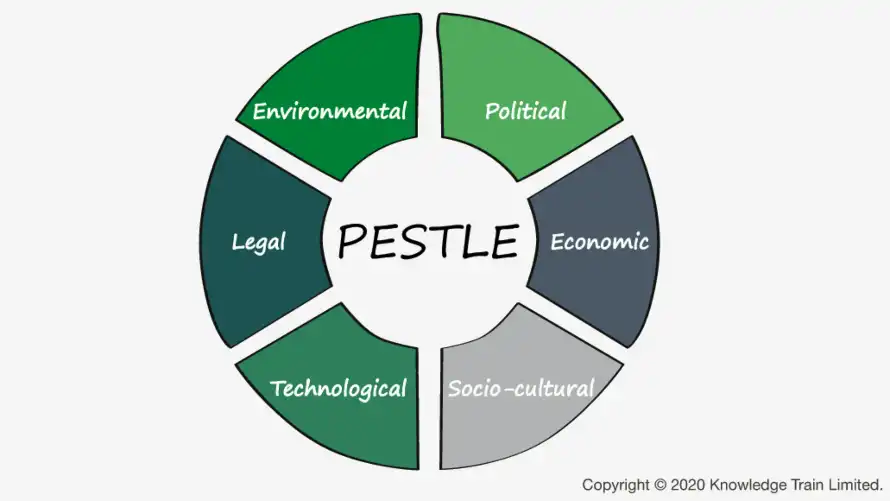
This framework provides businesses with a structured approach to analysing external factors, enabling informed strategic planning. By understanding these components, organisations can position themselves to navigate challenges and seize opportunities effectively. Weaknesses are internal Practitioner
Application of PESTLE analysis in strategic planning Learn the fundamentals of the P3O project management office.Select your preferred training course below:
Identifying opportunities and threats£2,199 +vatPractitioner
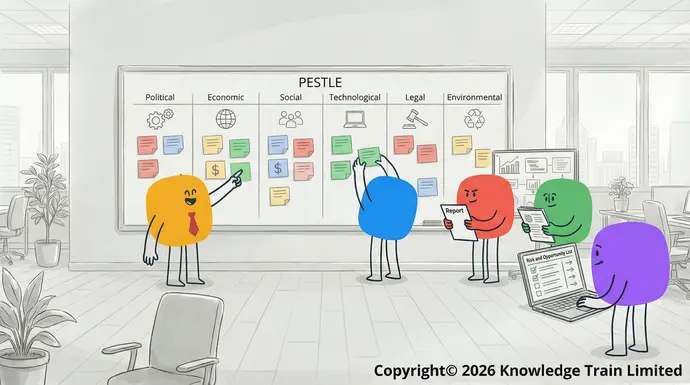
PESTLE analysis is a vital tool for recognising external opportunities and threats. By systematically examining Political, Economic, Social, Technological, Legal, and Environmental factors, businesses can identify potential growth areas and foresee challenges. This analysis enables organisations to adapt their strategies, ensuring they remain competitive. For instance, a change in government policy might present a new market opportunity, while economic downturns could pose threats that need mitigation. Understanding these dynamics allows companies to capitalise on favourable conditions and devise contingency plans for adverse scenarios, thus enhancing their strategic positioning. Includes Foundation & Practitioner combined option.PRINCE2 AGILE COURSES
Integrating PESTLE with SWOT analysis Select your preferred training course below:Workshops
Integrating PESTLE with Self-pacedBCS Business Analysis Practice self-paced online
£749 +vat
MECE framework in SWOT analysis
- Introduction to MECE frameworkThe
- MECE framework stands for “Mutually exclusive, collectively exhaustive”. It is a problem-solving approach used to organise information in a way that ensures clarity and completeness. The framework divides information into distinct, non-overlapping categories that cover all possible scenarios. This approach prevents duplication and omissions, making it a valuable tool in strategic analysis. Its significance lies in its ability to simplify complex data, providing a clear and structured view of the situation at hand. By ensuring that all aspects are covered without redundancy, the MECE framework supports effective decision-making.
- Applying MECE in SWOTApplying the MECE framework to a SWOT analysis involves structuring the four components –
- StrengthsAI Project Governance Framework (AIPGF), Foundation
- WeaknessesLearn the fundamentals of the governance framework., Practitioner
- OpportunitiesIncludes Foundation & Practitioner combined option., and Workshops
ThreatsAI in Project Management
– in a non-overlapping and exhaustive manner.Learn how to use AI tools in everyday project work.
When applying MECE to SWOT analysis, internal factors like strengths and weaknesses must be categorised without overlap. For example, brand reputation and workforce skills should be distinct strengths. External factors such as opportunities and threats should also be categorised distinctly, with clear separation between elements like emerging markets and technological advancements.AGILE
- AgilePM®
- – Agile Project Management
is is
overgeneralisation
. This occurs when the analysis lacks detail and specificity. Vague or broad statements can obscure the real issues and lead to ineffective strategies. For instance, listing “good customer service” as a strength without specifics does not provide actionable insights.ITIL COURSES
To avoid this, focus on precise details. Instead of general statements, identify specific aspects like “high customer retention rate” or “24/7 customer support”. This level of detail helps in understanding the true strengths and weaknesses, allowing for more targeted strategies. Detailed analysis not only clarifies the current situation but also enhances confidence in decision-making, reducing stress associated with ambiguity.Select your preferred training course below:
Ignoring external factors
Another common mistake is LEARNING LIBRARIES
ignoring external factorsSelect your preferred training course topic.
while focusing solely on internal elements. A balanced SWOT analysis considers both internal strengths and weaknesses, as well as external opportunities and threats. Overlooking external factors can result in missed opportunities and unanticipated threats.
To maintain balance, ensure that your analysis gives equal weight to external conditions. This includes market trends, regulatory changes, and competitive dynamics. Incorporating external analysis provides a comprehensive view of the environment, enabling more informed strategic decisions. Addressing both internal and external factors reduces uncertainty, fostering a sense of preparedness and confidence.AI QUALIFICATIONS & WORKSHOPS
Lack of actionable insightsSelect your preferred qualification or workshop.
A SWOT analysis should culminate in
actionable insightsAIPGF COURSES
that inform strategy. However, a common pitfall is failing to translate findings into practical strategies. A list of strengths, weaknesses, opportunities, and threats is of little use without a plan of action.Select your preferred training course below:
To avoid this, ensure that each element of the analysis leads to specific strategic actions. For example, if an opportunity is identified in an emerging market, develop a plan to enter that market. Actionable insights transform the analysis from a theoretical exercise into a strategic tool. This approach not only enhances clarity and direction but also reduces stress by providing a clear path forward.
In summary, avoiding these common pitfalls ensures that a SWOT analysis remains a powerful tool for strategic planning. By focusing on detail, balancing internal and external factors, and ensuring actionable outcomes, organisations can leverage SWOT to its fullest potential. This comprehensive approach not only enhances strategic decision-making but also reduces stress and fosters confidence in navigating future challenges.BCS AI COURSES
Real-world applications of SWOT analysisSelect your preferred training course below:
Case studies
Successful implementationAIPGF COURSESA well-documented success story of SWOT analysis comes from Select your preferred training course below:Starbucks
. The company effectively utilised SWOT to refine its strategy and enhance its market position. By identifying internal strengths such as brand recognition and a loyal customer base, Starbucks capitalised on these assets to expand its global footprint. The company also recognised weaknesses, including high operational costs, and addressed them through efficiency improvements.AI WORKSHOPS