Business analyst certification: What it is and how to get certified

Key takeaways
Business analyst certification validates capability and signals credibility to employers across industries.
- Choose a certification that matches your experience level, career goals, and the roles you want next.
- Expect eligibility checks such as training hours, work experience, and professional references for advanced credentials.
- Prepare using official guides like BABOK, accredited courses, and scenario-based practice exams.
- Budget for exam fees, training, and ongoing renewal costs, with many options available online.
- Certification can improve promotion prospects, salary potential, and access to professional networks and CPD.
What is business analyst certification?
Business analyst certification is the process by which professionals validate their understanding, skills, and experience in business analysis through a recognised credential awarded by authoritative organisations.
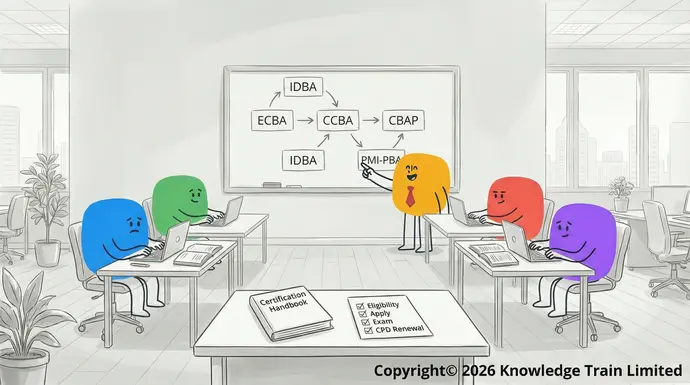
Achieving business analyst certification, such as the Certified Business Analysis Professional (CBAP) from the International Institute of Business Analysis (IIBA), International Diploma in Business Analysis (IDBA) from the BCS, or the PMI Professional in Business Analysis (PMI-PBA) from the Project Management Institute (PMI), demonstrates a thorough mastery of techniques and principles such as those from the Business Analysis Body of Knowledge (BABOK).
These certifications help employers identify qualified candidates and support analysts in career progression, salary increases, and professional recognition.
How to become a certified business analyst
- Assess your requirements: Review your career goals, current experience, and the types of business analysis roles you are interested in before choosing a certification.
- Choose the right certification: Compare key options from the BCS, IIBA, and PMI based on their eligibility requirements, recognition, and suitability to your experience level and industry.
- Check eligibility criteria: Evaluate prerequisites such as education, work experience, and professional development units (PDUs) for your chosen certification.
- Prepare for the exam: Use exam study materials like BABOK, take preparation courses from accredited training providers, and practise with sample questions.
- Apply for certification: Complete your application via the relevant body’s official website (BCS, IIBA or PMI) and submit required documents and payment.
- Schedule and sit the certification exam: Book a suitable date for the exam (via online certification options or test centres) and complete the assessment.
- Maintain your certification: Engage in continuing professional development and renew your credential according to the provider’s certification renewal policy.
Major business analyst certifications
| Certification | Level | Provider | Prerequisites | Exam Format | Exam cost (approx.) | Target Audience |
|---|---|---|---|---|---|---|
| Foundation Certificate in Business Analysis (FCBA) | Entry | BCS | No experience required | 40 multiple choice (1 hr) | £200 | Beginners, recent graduates |
| Practitioner Certificate in Business Analysis Practice (PCBAP) | Intermediate | BCS | Some experience recommended | 40 multiple choice (1 hr) | £250 | Recent graduates |
| Practitioner Certificate in Requirements Engineering (PCRE) | Intermediate | BCS | Some experience recommended | 40 multiple choice (1 hr) | £250 | Recent graduates |
| Practitioner Certificate in Modelling Business Processes (PCMBP) | Intermediate | BCS | Some experience recommended | 40 multiple choice (1 hr) | £250 | Recent graduates |
| International Diploma in Business Analysis (IDBA) | Intermediate | BCS | Some experience recommended | 50 minute oral exam | £1,250 | Recent graduates |
| Entry Certificate in Business Analysis (ECBA) | Entry | IIBA | No experience required | 50 multiple choice (1 hr) | £150 (members) | Beginners, recent graduates |
| Certification of Capability in Business Analysis (CCBA) | Intermediate | IIBA | 3750 hrs BA work exp. (7 yrs) | 130 multiple choice (3 hrs) | £250 (members) | Analysts with 2-3 yrs exp. |
| Certified Business Analysis Professional (CBAP) | Advanced | IIBA | 7500 hrs BA exp. (10 yrs) | 120 multiple choice (3.5 hrs) | £260 (members) | Senior/principal analysts |
| PMI Professional in Business Analysis (PMI-PBA) | Advanced | PMI | Bachelor’s + 3 yrs BA exp., or 5 yrs w/o | 200 multiple choice (4 hrs) | £300 (members) | Project managers/BA leaders |
Certification details and processes
Foundation Certificate in Business Analysis (FCBA)
- Eligibility requirements: No prior experience.
- Exam process: 40 multiple choice questions, held online.
- Preparation resources: Online preparation courses, sample questions.
- Benefits: Entry-level validation, ideal for newcomers to business analysis.
Practitioner Certificate in Business Analysis Practice (PCBAP)
- Eligibility requirements: Some prior business analysis experience it recommended.
- Exam process: 40 multiple choice questions, held online.
- Preparation resources: Online preparation courses, sample questions.
- Benefits: Ideal for those seeking a pathway to the BCS-IDBA certification.
Practitioner Certificate in Requirements Engineering (PCRE)
- Eligibility requirements: Some prior business analysis experience it recommended.
- Exam process: 40 multiple choice questions, held online.
- Preparation resources: Online preparation courses, sample questions.
- Benefits: Ideal for those seeking a pathway to the BCS-IDBA certification.
Practitioner Certificate in Modelling Business Processes (PCMBP)
- Eligibility requirements: Some prior business analysis experience it recommended.
- Exam process: 40 multiple choice questions, held online.
- Preparation resources: Online preparation courses, sample questions.
- Benefits: Ideal for those seeking a pathway to the BCS-IDBA certification.
International Diploma in Business Analysis (IDBA)
- Eligibility requirements: Must have passed the Foundation certificate and 3 Practitioner exams.
- Exam process: 50 minutes oral exam.
- Preparation resources: Online preparation courses for the Foundation certificate and 3 Practitioner courses.
- Benefits: Ideal for experienced business analyst professionals.
Entry Certificate in Business Analysis (ECBA)
- Eligibility requirements: No prior experience; 21 hours of professional training in the last 4 years.
- Exam process: 50 multiple choice questions, held online.
- Preparation resources: BABOK, online preparation courses, sample questions.
- Benefits: Entry-level validation, ideal for newcomers to business analysis.
Certification of Capability in Business Analysis (CCBA)
- Eligibility requirements: 3,750 hours business analysis experience within the past 7 years, 21 PDUs, and two references.
- Exam process: Computer-based, 130 multiple-choice questions, scenario-based.
- Resources: Accredited training providers, BABOK study guides, online courses.
- Benefits: For professionals with 2-3 years’ experience, demonstrates advanced capability.
Certified Business Analysis Professional (CBAP)
- Eligibility requirements: 7,500 hours of business analysis work in the last 10 years, 35 hours professional development, two references.
- Exam process: 120 scenario-based multiple-choice questions, computer-based, 3.5 hours.
- Preparation: Intensive BABOK study, preparation courses, exam study materials.
- Benefits: For experienced analysts, international recognition, often leads to salary increase and senior roles.
PMI Professional in Business Analysis (PMI-PBA)
- Eligibility requirements: Secondary degree (A-levels, etc.) and 5 years business analysis experience, or bachelor’s degree and 3 years’ experience; 35 contact hours training required.
- Exam process: 200 multiple choice questions, 4-hour duration; online or centre-based.
- Preparation resources: PMI-PBA handbook, training courses, online simulators, BABOK.
- Benefits: Widely recognised, ideal for project managers and analysts working in multi-disciplinary environments.
Business analyst certification comparison
| Certification | BCS/IIBA/PMI | Entry Experience | Global Recognition | Maintenance |
|---|---|---|---|---|
| FCBA | BCS | No experience; training required | High | |
| PCBAP | BCS | No experience; training required | High | None |
| PCRE | BCS | No experience; training required | High | |
| Annual renewal | ||||
| CCBA | IIBA | 3,750 hours BA in 7 years | High | PDUs, 3-year cycle |
ional recognition, and typically lead to higher salary opportunities and career advancement.