
Definition of Agile – Unlike some other project management books, this one uses philosophy and strategy to outline what it takes to get through a large software or web development project. The author writes from an experienced background, working on some of Microsoft’s biggest
Agileprojects refers to a set of principles and practices that guide teams in developing software products through incremental delivery, adaptive planning, and continual improvement. Agile emphasises iterative development, close team collaboration, and frequent customer feedback to deliver high-quality solutions quickly and efficiently.; and states that he understands that software development and
Agile methodology at a glanceproject management
| Aspect can be boring, so he likes to make his point using “comedic” means or making jokes at his own expense. | Description3. |
|---|---|
| PurposeGetting Things Done (David Allen) | Deliver working software frequently, respond to change rapidly – A popular book on maximising your productivity and setting priorities even when plans are interrupted. A helpful lesson to anybody of mastering the art of relaxation while increasing productivity. |
| Key values4. | Individuals and interactions, working software, customer collaboration, responding to changeProject Management For Dummies (Stanley E. Portny) |
| Approach – In my experience the “For Dummies” books have always been a fantastic introduction to the chosen subject area. This 4 | Iterative, adaptive, and incrementalth |
| Popular frameworks edition of the book principles of successful | Scrumproject management, Kanban, Extreme Programming (XP) and shows you how to motivate any team to gain maximum productivity, including the latest trend of using social media within your project. |
| Stakeholders5. | Customers, product owners, cross-functional teams, Scrum MastersThe Mythical Man-Month (Frederick P. Brooks Jr) |
Summary of the Agile Manifesto and Its values – The classic book of essays on the human elements of software engineering and project management, with a combination of software engineering facts and thought-provoking opinions.
The 6. Agile ManifestoCritical Chain (Eliyahu M. Goldratt), published in 2001 by 17 software development experts, established the foundation for – A fictional business novel that explores the Theory of Constraints principles and applies them to problems in project management, a follow-up to the author’s previous book ‘The Goal’. A nice text-book alternative!Agile methodologies7. . It promotes four core values and twelve underlying principles to guide teams toward continuous improvement and customer satisfaction.Project Management:
Agile Manifesto: Four values A Systems Approach to Planning, Scheduling and Controlling (Harold R. Kerzner) – The eleventh edition of this book states to be even more aligned to the PMBok
- Individuals and interactions over processes and tools8.
- Working software over comprehensive documentationThe Fast Forward MBA in Project Management (Eric Verzuh)
- Customer collaboration over contract negotiation – Both an excellent desk reference and introductory guide for beginners and experienced alike.
- Responding to change over following a plan9.
Agile principlesThe Lazy Project Manager (Peter Taylor)
Agile is supported by twelve guiding principles, intended to help teams create successful products in an ever-changing environment. These principles inform day-to-day Agile practices. – Fortunately the author is not implying that we do absolutely nothing, but to approach work using the Pareto Principle; that only 20 per cent of the things we do during our working day really matter. Quite an entertaining read that includes a chapter about eating dinosaurs and why the Jungle Book’s ‘Bare Necessities’ should be the productive lazy theme tune. Learn simple techniques to master the art of “productive laziness”.
- Satisfy the customer through early and continuous delivery of valuable software10.
- Welcome changing requirements, even late in developmentManaging Successful Projects With PRINCE2
- Deliver working software frequently, from a couple of weeks to a couple of months®
- Collaborate daily between business people and developers7
- Build thprojects Edition. Known as the around motivated individuals and provide supportPRINCE2 manual
- Convey information face-to-face whenever possible this book wasn’t chosen from the online communities, but I added it in because I think it’s a valuable asset for every project manager. After all,
- Working software is the primary measure of progressPRINCE2
- Maintain a sustainable development pace is the worlds’ most popular project management methodology and is therefore essential reading for all
- Continuous attention to technical excellence and good designproject managers
- Simplicity – the art of maximising the work not done – is essential.
- Self-organising teams produce the best architectures, requirements, and designsEnhance your skills with our expert-led courses
- Regularly reflect and adapt to improve effectiveness
Historical origins and evolution of Agile
The Agile approach originated in the late 1990s as software teams sought alternatives to rigid project management models like the WaterfallInstructor-led model. In 2001, seventeen thought leaders signed Introduction to Project Management coursethe Agile Manifesto , formalising Agile values and sparking the formation of the Agile Alliance. Since then, Agile has evolved beyond software development into £499 +vatproject management , product development, and operations.See all dates
Benefits of Agile
- Flexibility: Respond rapidly to changing customer needs and market conditions.
- Continuous improvement:Instructor-led Regular retrospectives help teams adapt and improve their processes.Project Management Essentials
- Customer satisfaction: Frequent delivery ensures customer requirements are met early and often.£999 +vat
- Transparency: Iterative development and open communication foster stakeholder trust.See all dates
- Reduced risk:Book references Incremental delivery allows for earlier issue detection and correction.Here’s the details of each of the 10 books.
- Enhanced team collaboration:1. Project Management Institute (2021). Cross-functional teams communicate daily to resolve challenges efficiently.A Guide to the Project Management Body of Knowledge: PMBOK
Agile vs waterfall model®
| Aspect Guide | Agile. Seventh Edition. Pennsylvania: Project Management Institute, Inc.. ISBN: | Waterfall978-162825664 |
|---|---|---|
| Process2. Scott Berkun (2008). | Iterative and incrementalMaking Things Happen: Mastering Project Management (Theory in Practice) | Sequential and linear. Sebastopol: O’Reilly Media Inc. 410. ISBN-13: |
| Flexibility978-0596517717 | Adaptive to change3. David Allen (2002). | Resistant to change after initial planningGetting Things Done: The Art of Stress-Free Productivity |
| Customer involvement. New York: Penguin Group. 288. ISBN-13: | High, continuous feedback978-0142000281 | Typically only during requirements and acceptance stages4. Stanley E. Portny (2013). |
| DeliveryProject Management For Dummies | Frequent, partial releases. 4 | Full product delivered at project endth |
| Risk ed. New Jersey: John Wiley & Sons, Inc. 408. ISBN-13: | Problems discovered early978-1118497234 | Issues often found late5. Frederick P. Brooks Jr. (1995). |
Agile frameworks and practicesThe Mythical Man-Month: Essays on Software Engineering, Anniversary Edition
Scrum framework. 2
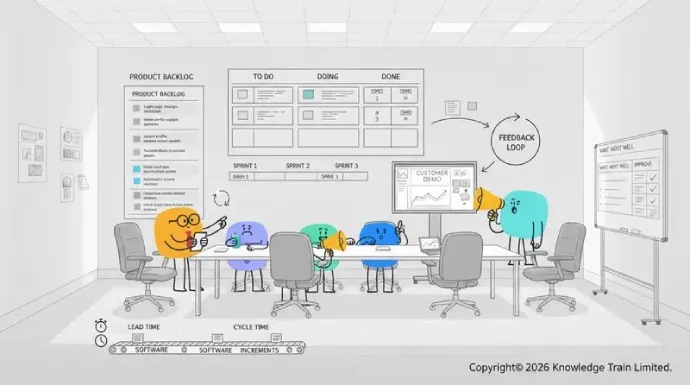
Scrumnd is a widely adopted Agile framework structured around short, timeboxed periods called ed. United States of America: Addison-Wesley Professional. 336. ISBN-13: sprints978-0201835953. Teams maintain a 6. Eliyahu M. Goldratt (1997). product backlogCritical Chain of features and tasks, delivering increments of working software at the end of each sprint. Roles in Scrum include Product Owner, . Massachusetts: The North River Press. 246. ISBN-13: Scrum Master978-0884271536, and Development Team. Daily stand-ups, sprint planning, reviews, and retrospectives reinforce team collaboration and transparency.7. Harold R. Kerzner (2013).
KanbanProject Management: A Systems Approach to Planning, Scheduling and Controlling
Kanban emphasises visualising work, limiting work in progress, and optimising flow. Teams use Kanban boards to track tasks and identify bottlenecks, often integrating continuous improvement practices.. 11
User stories and Product Backlogth
Features are typically described as ed. New Jersey: John Wiley & Sons, Inc. 1296. ISBN-13: user stories978-1118022276 in a product backlog. This backlog is prioritised by the Product Owner and guides the work to be pulled into each sprint or iteration.8. Eric Verzuh (2008).
Agile project managementThe Fast Forward MBA in Project Management
Agile project management. 3 focuses on iterative planning, adaptive resource allocation, and continuous stakeholder engagement. Leaders support self-organising, cross-functional teams, encourage regular customer feedback, and facilitate incremental value delivery.rd
Key concepts: Iterative and incremental delivery ed. New Jersey: John Wiley & Sons, Inc. 480. ISBN-13:
Agile projects proceed in small iterations, each resulting in an incrementally improved product. This iterative approach enables rapid adaptation, regular feedback, and incremental value to stakeholders.978-0470247891
Team collaboration and cross-functional teams9. Peter Taylor (2010).
Agile emphasises collaboration between customers, stakeholders, and team members from diverse disciplines. Cross-functional teams are empowered to make decisions and deliver complete solutions within each iteration.The Lazy Project Manager: How to be twice as productive and still leave the office early
Continuous improvement practices. United Kingdom: Infinite Ideas. 152. ISBN-13:
Agile teams conduct regular retrospectives to identify areas for improvement and adjust their processes. This culture of continuous improvement leads to increased quality, productivity, and team morale over time.978-1906821678
Further Resources10. PeopleCert (2023).
include prioritising customer satisfaction through early and continual delivery, welcoming changing requirements, delivering working software frequently, fostering daily collaboration, supporting motivated teams, preferring face-to-face communication, using working software as the main progress measure, maintaining a sustainable pace, focusing on technical excellence, maximising simplicity, enabling self-organising teams, and reflecting regularly for process improvement.
What is the difference between Agile and waterfall?
Agile is iterative, adaptable, and focuses on incremental delivery with frequent stakeholder feedback. Waterfall{"@context":"https://schema.org","@type":"ImageObject","contentUrl":"https://www.knowledgetrain.co.uk/training-courses/res/images/project-management/pm-books-infographic.webp","description":"Top 10 project management books","license":"https://www.knowledgetrain.co.uk/license","acquireLicensePage":"https://www.knowledgetrain.co.uk/license","creditText":"Knowledge Train","uploadDate":"2023-05-19T03:43:04.000Z","copyrightNotice":"© 2023 Knowledge Train Limited. All rights reserved.","creator":{"@type":"Organization","name":"Knowledge Train","url":"https://www.knowledgetrain.co.uk"}} is linear, sequential, and requires upfront planning, often only allowing changes late in the project cycle.
What are Scrum and Kanban frameworks?Related articles
Scrum is an Agile framework that organises work into fixed-length sprints and uses roles like Product Owner and Scrum Master . Kanban is a visual method for managing workflow, limiting work in progress, and focusing on incremental improvements.
How does Agile improve team collaboration?
Agile improves collaboration through daily communication, cross-functional team structures, and regular stakeholder engagement, ensuring all members align towards shared goals.