What is Agile?Preferences

Key takeaways
Agile combines a mindset with practical routines that help teams deliver value in changing conditions.
- Agile prioritises working software, collaboration, and adapting plans based on frequent feedback.
- Iterative, incremental delivery reduces risk by surfacing issues and learning earlier.The technical storage or access that is used exclusively for statistical purposes.
- Scrum uses timeboxed sprints and clear roles to create a predictable cadence for delivery and review.
- Kanban improves flow by visualising work and limiting work in progress to expose bottlenecks.The technical storage or access that is used exclusively for anonymous statistical purposes. Without a subpoena, voluntary compliance on the part of your Internet Service Provider, or additional records from a third party, information stored or retrieved for this purpose alone cannot usually be used to identify you.
- Healthy Agile adoption relies on clear roles, shared quality standards, and sustainable pace.
- Measure outcomes and flow with metrics like lead time and defect rate, then refine through retrospectives.
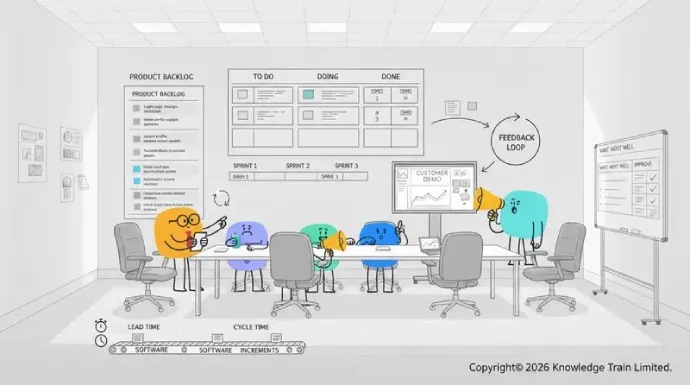
Definition of Agile
AgileTo provide the best experiences, we use technologies like cookies to store and/or access device information. Consenting to these technologies will allow us to process data such as browsing behavior or unique IDs on this site. Not consenting or withdrawing consent, may adversely affect certain features and functions. refers to a set of principles and practices that guide teams in developing software products through incremental delivery, adaptive planning, and continual improvement. Agile emphasises iterative development, close team collaboration, and frequent customer feedback to deliver high-quality solutions quickly and efficiently.
User stories and Product Backlog
Features are typically described as user stories in a product backlog. This backlog is prioritised by the Product Owner and guides the work to be pulled into each sprint or iteration.
Agile project management
Agile project management focuses on iterative planning, adaptive resource allocation, and continuous stakeholder engagement. Leaders support self-organising, cross-functional teams, encourage regular customer feedback, and facilitate incremental value delivery.
Key concepts: Iterative and incremental delivery
Agile projects proceed in small iterations, each resulting in an incrementally improved product. This iterative approach enables rapid adaptation, regular feedback, and incremental value to stakeholders.
Team collaboration and cross-functional teams
Agile emphasises collaboration between customers, stakeholders, and team members from diverse disciplines. Cross-functional teams are empowered to make decisions and deliver complete solutions within each iteration.
Continuous improvement practices
Agile teams conduct regular retrospectives to identify areas for improvement and adjust their processes. This culture of continuous improvement leads to increased quality, productivity, and team morale over time.
FAQs
What is Agile methodology?
Agile methodology is a set of practices and values that promote adaptive planning, evolutionary development, early delivery, and continual improvement. Agile methods empower teams to respond quickly to change and collaborate closely with stakeholders.
What are the 12 principles of Agile?
The 12 Agile principles include prioritising customer satisfaction through early and continual delivery, welcoming changing requirements, delivering working software frequently, fostering daily collaboration, supporting motivated teams, preferring face-to-face communication, using working software as the main progress measure, maintaining a sustainable pace, focusing on technical excellence, maximising simplicity, enabling self-organising teams, and reflecting regularly for process improvement.
What is the difference between Agile and waterfall?
Agile is iterative, adaptable, and focuses on incremental delivery with frequent stakeholder feedback. Waterfall is linear, sequential, and requires upfront planning, often only allowing changes late in the project cycle.
What are Scrum and Kanban frameworks?
Scrum is an Agile framework that organises work into fixed-length sprints and uses roles like Product Owner and Scrum Master. Kanban is a visual method for managing workflow, limiting work in progress, and focusing on incremental improvements.
How does Agile improve team collaboration?
Agile improves collaboration through daily communication, cross-functional team structures, and regular stakeholder engagement, ensuring all members align towards shared goals.