What is Agile?

- Offers a holistic view of all projects, leading to better-informed decisions based on comprehensive data and insights. Respond rapidly to changing customer needs and market conditions.Benefits realization
- Continuous improvement:Goes beyond just completing Regular retrospectives help teams adapt and improve their processes.projects
- Customer satisfaction: on time and budget, focusing on achieving the desired outcomes and ensuring that the anticipated benefits are realized and sustained. Frequent delivery ensures customer requirements are met early and often.Increased flexibility
- Transparency:Provides a framework that can adapt to changes in the business environment or organizational strategy, ensuring projects remain relevant and aligned. Iterative development and open communication foster stakeholder trust.Consistency and standardization
- Reduced risk:By adopting a standardized approach, organizations can ensure consistency in the delivery and quality of projects across the board. Incremental delivery allows for earlier issue detection and correction.Continuous improvement
- Enhanced team collaboration:Facilitates a culture of learning and improvement by regularly reviewing performance, capturing Cross-functional teams communicate daily to resolve challenges efficiently.lessons learned
Agile vs waterfall model, and implementing best practices across all projects.
| AspectValue for money | AgileEnsures that investments in individual projects culminate in the desired benefits, yielding a positive return on investment for the organization. | WaterfallBoosted morale and team cohesion |
|---|---|---|
| ProcessWith clear objectives and coordinated efforts, teams have a clearer sense of purpose, leading to increased motivation and collaboration. | Iterative and incrementalIn essence, | Sequential and linearprogramme management |
| Flexibility offers organizations a structured and strategic approach to managing multiple projects, ensuring not just their successful delivery but also the realization of broader business objectives and benefits. | Adaptive to changeEnhance your skills with our expert-led courses | Resistant to change after initial planning |
| Customer involvement | High, continuous feedback | Typically only during requirements and acceptance stagesInstructor-led |
| DeliveryMSP Practitioner (with Foundation) course | Frequent, partial releases | Full product delivered at project end£1,899 +vat |
| Risk | Problems discovered earlySee all dates | Issues often found late |
Agile frameworks and practices
Scrum framework
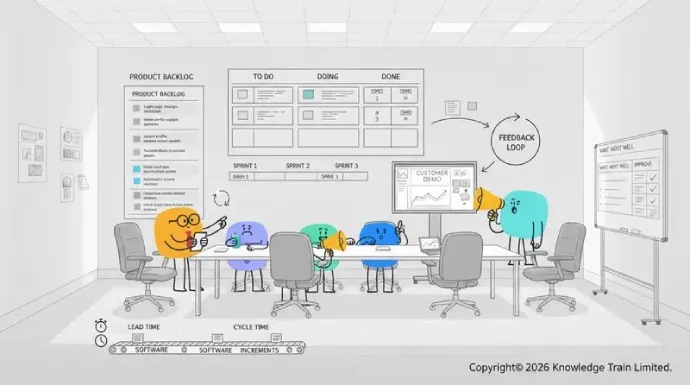
ScrumSelf-paced is a widely adopted Agile framework structured around short, timeboxed periods called MSP Practitioner (with Foundation) self-paced onlinesprints . Teams maintain a £1,399 +vatproduct backlog of features and tasks, delivering increments of working software at the end of each sprint. Roles in Scrum include Product Owner, Scrum Master , and Development Team. Daily stand-ups, sprint planning, reviews, and retrospectives reinforce team collaboration and transparency.Instructor-led
KanbanMSP Foundation course
Kanban emphasises visualising work, limiting work in progress, and optimising flow. Teams use Kanban boards to track tasks and identify bottlenecks, often integrating continuous improvement practices.
User stories and Product Backlog£1,299 +vat
Features are typically described as user storiesSee all dates in a product backlog. This backlog is prioritised by the Product Owner and guides the work to be pulled into each sprint or iteration.Summary
Agile project managementProgrammes represent unique yet interrelated aspects of strategic organizational management. Managing and integrating programmes within broader
Agile project managementportfolios focuses on iterative planning, adaptive resource allocation, and continuous stakeholder engagement. Leaders support self-organising, cross-functional teams, encourage regular customer feedback, and facilitate incremental value delivery. provides organizations with a competitive edge, amplifying benefits realization and enhancing investment returns.
Key concepts: Iterative and incremental deliveryEnterprises that prioritize
Agile projects proceed in small iterations, each resulting in an incrementally improved product. This iterative approach enables rapid adaptation, regular feedback, and incremental value to stakeholders.programme management
Team collaboration and cross-functional teams and adopt standardized methodologies are best positioned to garner superior advantages in a progressively competitive landscape.
Agile emphasises collaboration between customers, stakeholders, and team members from diverse disciplines. Cross-functional teams are empowered to make decisions and deliver complete solutions within each iteration.Subscribe to our exclusive offers and promotions
Continuous improvement practices
Agile teams conduct regular retrospectives to identify areas for improvement and adjust their processes. This culture of continuous improvement leads to increased quality, productivity, and team morale over time.Subscribe now