
- official Scrum Guide .
- Select the appropriate Scrum certification: Choose between entry-level certifications such as Professional Scrum Master (PSM) or Certified ScrumMaster (CSM) , or advanced certificates aligned to your career goals.
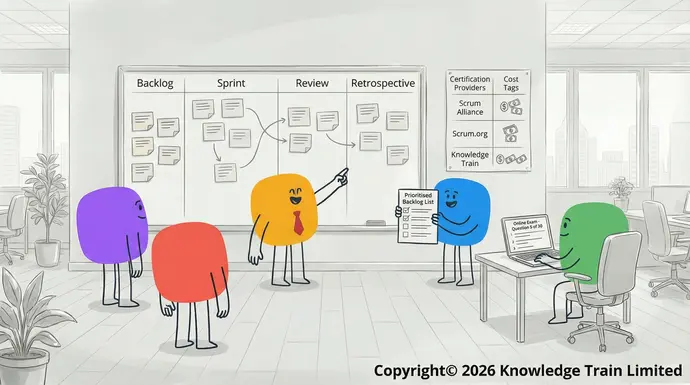
- Choose an Accredited Provider: Consider reputable bodies like Scrum.org , Scrum Alliance , PMI (Project Management Institute) , and Scaled Agile Framework (SAFe) .
- Fulfil certification requirements: Meet any prerequisites (e.g., training, experience, or coursework). Many certifications require completing Scrum training from recognised providers.
- Exam Preparation: Practise with sample questions, mock exams, and utilise e-learning resources such as Scrum Essentials . Consider joining study groups and participating in workshops or Scrum courses .
- Pass the Scrum exam: Register and sit the examination online or at an authorised test centre.
- Update credentials and plan career advancement: Once certified, update your CV and LinkedIn profile. Leverage your credential for career progression or new job opportunities in Agile environments.
Types of Scrum certifications
Scrum certification can be categorised by role and expertise level. The main categories include:
- Scrum Master certification – Focuses on facilitating Scrum Teams and processes. Common options: Professional Scrum Master (PSM) and Certified ScrumMaster (CSM) .
- Scrum Product Owner certification – For those driving product vision and managing product backlogs.
- Scaled Agile Framework (SAFe) certification – Tailored for professionals working in large, complex organisations needing to scale Agile practices.
- Agile certification – Broader certifications covering various Agile frameworks, Agile project management occasionally including Scrum .
Comparison of Scrum certification providers
| Provider | Popular certifications | Exam structure | Costs (approx.) | Global recognition |
|---|---|---|---|---|
| Scrum.org | Professional Scrum Master (PSM), Professional Scrum Product Owner (PSPO) | Multiple choice, online, no formal course required | £150–£200 per exam plus £900 or more (training) | Very high |
| Scrum Alliance | Certified ScrumMaster (CSM), Certified Scrum Product Owner (CSPO) | Multiple choice, requires accredited training | £900 or more (course + exam) | Very high |
| PMI | PMI-Agile Certified Practitioner (PMI-ACP) | Multiple choice, requires Agile experience/hours | £500 for training plus exam fee | High |
| Scaled Agile (SAFe) | SAFe Scrum Master, SAFe Advanced Scrum Master | Online proctored, requires official training | £900 or more (course + exam) | Growing |
| Knowledge Train | Scrum Essentials | Online | £500 (course + exam) | Growing |
Note: costs can fluctuate based on location and training format. Check provider websites for the latest fees: Scrum.org , Scrum Alliance , PMI , Scaled Agile .
Certification requirements & training
Each provider has specific certification requirements :
- Scrum.org: No mandatory training; demonstration of knowledge via exam.
- Scrum Alliance: Must attend an accredited course before attempting the Certified ScrumMaster (CSM) or Certified Scrum Product Owner (CSPO) exams.
- PMI: Agile project experience and prerequisite hours needed.
- SAFe: Completion of official classroom or remote training required.
Recommended Scrum training includes accredited workshops, online courses , and interactive sessions.
Value and career benefits of Scrum certification
Holding a Scrum certification signals verified expertise in the Agile methodology and is associated with career advancement . According to global salary data, certified Scrum Masters and Product Owners command higher salaries and are preferred by employers seeking to implement or scale Agile frameworks. Certification validates your commitment to best practices in Agile project management .