Cost reduction: > is a registered mark of the DevOps Institute. “PMI”, “PMBOK Eliminating waste and inefficiency. ul>®
Increased efficiency: li>The characteristics of projects Guide”, “PMP” and “CAPM” are registered marks of Project Management Institute, Inc. Knowledge Train Scrum Essentials™, Business Learning Library (BLL)™, Business Analysis Learning Library (BALL)™, Agile Learning Library (ALL)™, IT Learning Library (ITLL)™, and Compliance Learning Library (CLL)™ are trademarks of Knowledge Train Limited. All rights reserved. Simplifying processes and streamlining value streams. >Knowledge Train Ltd is an Introducer Appointed Representative of NewDay Cards Ltd for the Newpay finance product provided by NewDay Ltd. NewDay Cards Ltd acts as a credit broker, not a lender. We will introduce you exclusively to Newpay finance products provided by NewDay Limited under this Introducer Appointed Representative arrangement. Finance available from other lenders is not covered by this arrangement. NewDay Ltd and Newday Cards Ltd are authorised and regulated by the Financial Conduct Authority (ref nos 690292 and 682417 respectively).
Higher quality: li>How projects differ from business as usual Reducing variation and defects, resulting in improved products and services. >
Customer satisfaction: You want to become a business analyst?li>Common project management terminology Delivering consistently high value and reliability. >
Business transformation: Simon Buehringli>Project manager skills Enabling organisations to achieve a culture of 19 Feb 2026>Searchcontinuous improvement li>The project life cycle
Aligning project objectives with business goals
< Optimising assembly lines, reducing defects, and speeding up changeovers. li>Project scope
< Minimising medical errors, streamlining patient flows, and shortening waiting times. li>Stakeholder management
< Improving order fulfilment and inventory management. li>Estimating
Scheduling work
Critical path techniqueProject plans. Earning >Manage Consentcertification li>Tracking progress demonstrates expertise in applying > To provide the best experiences, we use technologies like cookies to store and/or access device information. Consenting to these technologies will allow us to process data such as browsing behavior or unique IDs on this site. Not consenting or withdrawing consent, may adversely affect certain features and functions.process improvement li>Project reporting , data-driven analysis, and leadership skills. Courses are available through universities, professional bodies, and online providers, often referencing the body of knowledge set by recognised accreditation organisations. Certifications can significantly enhance career prospects in management, operations, and > quality assuranceli>Managing changes Unlock your creative and organisational potential with mind maps .>
li>Improving your project management practices.
>
>","about":"Introduction to Project Management course","abstract":"
Learn the main phases of the project life cyclePreferences
Get familiar with common project management terminology
Practise simple tools for planning, estimating, and tracking work
Lean Six Sigma methodology and continuous improvement
Lean Six Sigma is a powerful methodology for continuous improvement in companies worldwide. It combines Lean and Six Sigma principles to identify and eliminate waste, streamline Lean processes, and improve productivity. Lean certification and Six Sigma certification programmes provide essential training and skills for individuals and managers. These Lean and Six Sigma tools support problem solving and operational excellence in digital and production environments.
Lean Six Sigma training and certification programmes
Lean Six Sigma training includes techniques like Value Stream Mapping, Kanban, Kaizen, and DMAIC. Certification programmes such as White Belt Certification, Six Sigma Black Belt, and Six Sigma Green Belt are available. Lean Six Sigma Black Belt and Green Belt levels focus on advanced Lean improvement and analytical skills. Courses use different formats, including video, digital, and in-person training.
Lean Six Sigma application in global organisations
Lean Six Sigma application is relevant for organisations in various regions, including Europe, Asia, and Africa. Companies and government agencies use Lean Six Sigma implementation to achieve sustainable results and enhance efficiency. Lean Six Sigma practitioners lead projects and use tools and techniques to improve quality with Lean manufacturing, reduce costs, and drive revenue.
Lean Six Sigma concepts and solutions for industry
Lean Six Sigma methodologies are suitable for employees, students, and leaders wanting to grow their skill set. Certification programs address the needs of different industries, including marketing, accounting, and production speed improvement. Lean Six Sigma concepts and Lean Six Sigma solutions are established as reliable ways to build organisational capability and enhance company performance.
Lean Six Sigma process improvement and measurable goals
Lean Six Sigma projects require the use of Six Sigma tools, Six Sigma methods, and Lean practices. Six Sigma strategies and Six Sigma principles are applied to achieve measurable goals. Lean Six Sigma process improvement is fundamental for companies striving for excellence and higher profitability. Programmes are available in English, French, Spanish, and other languages to support diverse participants and preferences.
What is Lean Six Sigma?
Lean Six Sigma is a methodology that combines the principles of Lean manufacturing and Six Sigma to improve efficiency and quality in business processes. Lean Six Sigma focuses on eliminating waste, reducing variability, and enhancing customer satisfaction, thereby driving operational excellence. By integrating tools from both Lean and Six Sigma, Lean Six Sigma provides a structured approach to problem-solving, enabling organizations to optimize processes, reduce costs, and increase profitability. Lean Six Sigma practitioners use data-driven techniques and statistical analysis to identify areas for improvement, ensuring that Lean Six Sigma projects deliver sustainable results. The implementation of Lean Six Sigma requires commitment from leadership and engagement from all levels of the organization, as Lean Six Sigma fosters a culture of continuous improvement and accountability. Organizations adopting Lean Six Sigma often experience significant improvements in process performance and customer satisfaction, making Lean Six Sigma a valuable strategy for achieving competitive advantage.
Lean Six Sigma overview
Lean Six Sigma provides a structured approach to process improvement that focuses on reducing waste and variation.
Lean Six Sigma combines Lean thinking with Six Sigma statistical rigour to improve outcomes and efficiency.
This article explains principles, benefits, methodology and capability development for senior leaders and improvement teams.
The guidance is practical, evidence based and oriented to organisations seeking measurable operational improvement.
Throughout the article you will see references to Lean Six Sigma approach and common Lean Six Sigma techniques used in practice.
Benefits
Organisations deploy Lean Six Sigma to reduce defects, lower cost and improve customer satisfaction in measurable ways.
Benefit realisation is tracked through clear metrics, which make the case for continued investment and scaling of programmes.
Beyond direct cost savings, Lean Six Sigma improves delivery predictability, cycle time and overall service quality.
The combination of speed (Lean) and variation reduction (Six Sigma) delivers outcomes that single approaches struggle to match.
Case examples frequently show rapid returns when projects are selected and governed with clarity and executive sponsorship.
Benefits of Lean Six Sigma
Financial benefits are often the headline metric but operational improvements such as capacity gain and error reduction matter equally.
Improved process capability increases customer trust and reduces the need for corrective actions and rework.
Lean Six Sigma drives capability uplift across teams through training and repeatable project practices.
Greater consistency in output supports compliance and regulatory reporting where required by the business.
Organisational learning from projects accelerates subsequent initiatives and reduces time to value.
Strategic alignment and ROI
Linking projects to strategic priorities ensures scarce resources are used where they create the most value.
Benefit tracking and transparent reporting make return on investment visible to executives and stakeholders.
Regular portfolio reviews promote reinvestment in the most effective projects and help prioritise future work.
Methodology
A clear methodology provides a repeatable path from problem definition to sustained improvement across the organisation.
Methodology documents standardise templates, roles and review points across the improvement programme.
Embedding methodology into training and tools reduces variation in how projects are executed and evaluated.
Methodology should evolve with lessons from live projects to remain relevant and effective.
Lean Six Sigma principles balance quick wins with longer, more complex deliverables in a coherent way.
DMAIC
DMAIC structures projects into Define, Measure, Analyse, Improve and Control to ensure focus and deliverables.
Define establishes scope, customers and expected benefits so teams start with a clear brief.
Measure collects data to create a reliable baseline and to identify the magnitude of issues to address.
Analyse uses statistical and root cause methods to prioritise causes that most affect performance.
Improve pilots solutions, tests changes and measures impact before scale up across the value stream.
Control embeds standard work, control plans and monitoring to maintain gains over time.
DMAIC governance checkpoints
Governance checkpoints should verify that measures are reliable and that proposed solutions align with expected benefits.
Clear exit criteria at each phase reduce the risk of premature closure and wasted effort on poorly scoped projects.
DMADV
DMADV is the design framework used where incremental fixes are insufficient and a new design is required.
It focuses on customer requirements, robust design, verification and performance prediction before launch.
Design validation tests prototypes and ensures the new process meets capability and compliance needs.
Risk assessment and failure modes are central to DMADV so the new design is resilient in operation.
Cross-functional teams and stakeholder engagement reduce handoff issues during complex design work.
When to use DMADV
Use DMADV for greenfield processes, major redesigns or when existing processes cannot meet future capability needs.
DMADV reduces costly retrofits by validating designs before broader deployment and handover to operations.
Tools and techniques
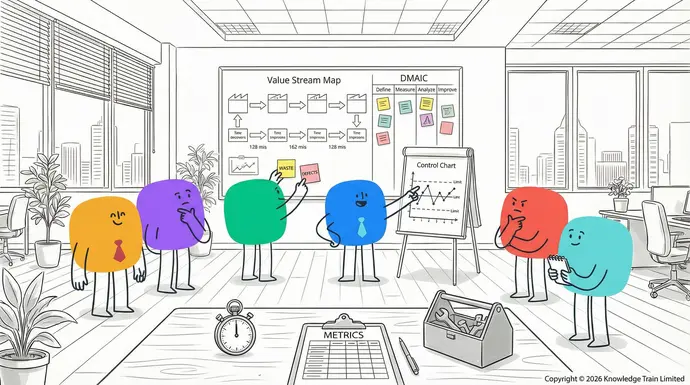
Tools include value stream mapping, statistical process control, control charts and root cause analysis.
Kaizen events, rapid improvement workshops and pilot testing are common techniques for delivering quick impact.
Measurement systems analysis and capability studies are necessary to ensure data used for decisions is reliable.
Choosing the right set of tools for the problem prevents over-engineering and focuses teams on high-impact actions.
Effective tool deployment pairs technical skill with coaching so teams can apply methods in context.
Statistical tools
Control charts visualise variation over time and distinguish common cause from special cause variation for better decisions.
Capability indices such as Cp and Cpk quantify how well a process meets specification and inform prioritisation.
Design of experiments helps teams understand the effects of multiple factors and identify robust solutions.
Statistical literacy at practitioner level improves analysis quality and the choice of countermeasures.
Key measurement practices
Establishing a clear measurement plan before data collection prevents scope drift and ensures relevance of results.
Baselining with cLean data allows teams to quantify waste and measure the impact of improvements accurately.
Measurement system analysis (MSA) confirms whether instruments and procedures are suitable for the project’s needs.
Operational techniques
Value stream mapping identifies bottlenecks, handoffs and non-value steps that constrain performance end-to-end.
5S and workplace organisation reduce search time and make abnormal conditions obvious to teams.
Cross-training staff and flexible resourcing help reduce delays and balance workload variations across processes.
Standard work and visual controls sustain gains by making expectations clear and observable at the team level.
Lean Six Sigma techniques in practice
Combining Lean tools with Six Sigma analysis enables both rapid cycle time reductions and sustainable quality improvement.
Kaizen events are effective for localised problems while DMAIC projects are suited to larger, systemic issues.
Operational flow and waste reduction
Optimising operational flow eliminates unnecessary movement, waiting time and duplication that create hidden costs.
Waste reduction initiatives improve throughput, reduce queue lengths and align resources to value creation steps.
Continuous flow techniques minimise delays and promote a stable process rhythm across departments.
Identifying bottlenecks through process mapping and time analysis supports efficient scheduling and balanced workloads.
Standardising work instructions sustains flow efficiency and helps visualise improvement opportunities.
Process variation and control limits
Monitoring process variation enables teams to distinguish between common and special causes of deviation.
Control limits provide an early warning system that supports proactive decision-making and risk mitigation.
Capability analysis converts variation data into quantifiable performance indicators for management review.
Establishing clear tolerance boundaries prevents over-adjustment and stabilises long-term process behaviour.
Team members who contribute to projects in any industry
, PRINCE2® Agile, RESILIA®, and the Swirl logo are registered trademarks of the PeopleCert group. Used under licence from PeopleCert. All rights reserved. AgilePM® and AgileBA
® are registered trademarks of Agile Business Consortium Limited. All rights reserved. The APMG International AgilePM and Swirl Device logo, APMG International AgileBA and Swirl Device Logo, APMG International Change Management and APMG International Better Business Cases and Swirl Device logo are trademarks of The APM Group Limited, used under permission of The APM Group Limited. All rights reserved. Better Business Cases™ is a trademark of Her Majesty’s Treasury. All rights reserved. DevOps Foundation
® is a registered mark of the DevOps Institute. “PMI”, “PMBOK® Guide”, “PMP” and “CAPM” are registered marks of Project Management Institute, Inc. Knowledge Train Scrum Essentials™, Business Learning Library (BLL)™, Business Analysis Learning Library (BALL)™, Agile Learning Library (ALL)™, IT Learning Library (ITLL)™, and Compliance Learning Library (CLL)™ are trademarks of Knowledge Train Limited. All rights reserved.Knowledge Train Ltd is an Introducer Appointed Representative of NewDay Cards Ltd for the Newpay finance product provided by NewDay Ltd. NewDay Cards Ltd acts as a credit broker, not a lender. We will introduce you exclusively to Newpay finance products provided by NewDay Limited under this Introducer Appointed Representative arrangement. Finance available from other lenders is not covered by this arrangement. NewDay Ltd and Newday Cards Ltd are authorised and regulated by the Financial Conduct Authority (ref nos 690292 and 682417 respectively).
Knowledge Train is a Better Business Cases Accredited Training Organization.
Knowledge Train is a P3O Accredited Training Organization.Knowledge Train is an AgilePM Accredited Training Organization.
Knowledge Train is a Lean Six Sigma Accredited Training Organization.BCS accredited training partner for Business Analysis. Knowledge Train is a Change Management Accredited Training Organization.
Knowledge Train is an MSP Accredited Training Organization.
AXELOS Peoplecert accredited training organisation for ITIL (IT Infrastructure Library).AXELOS Peoplecert accredited training organisation for ITIL (IT Infrastructure Library).Knowledge Train is an AIPGF Accredited Training Organization.Knowledge Train is an AIPGF Accredited Training Organization. WHAT YOU WILL GETOur courses and workshops include:Certification exam(s) where applicableAccredited training course materialsExpert, experienced trainers to support you
Course manual where applicable.SELF-PACED ONLINE TRAINING COURSESSelf-paced online training courses (e-learning) include:
Certification exam(s) where applicableAccredited training course materialsSupport from expert, experienced trainersLatest educational technology.BUSINESS SOLUTIONS TO HELP ORGANISATIONS IMPROVE Consultancy services Staff development Compliance trainingThe technical storage or access is strictly necessary for the legitimate purpose of enabling the use of a specific service explicitly requested by the subscriber or user, or for the sole purpose of carrying out the transmission of a communication over an electronic communications network. Apprenticeship training Custom e-Learning development
The technical storage or access is required to create user profiles to send advertising, or to track the user on a website or across several websites for similar marketing purposes.Find out morePreferences