
quality management, and ITIL v3 certification, healthcare, and business transformation initiatives globally. Developed from the synthesis of Japanese Kaizen and American quality approaches, it has evolved into a standard methodology driving continuous improvement and measurable results.Dependencies by either:
History and origins in your projects can help you anticipate potential risks and challenges, clarify project foundations, and address problems and interdependencies with greater clarity.by self-studying with an
Lean Six Sigma arose from two foundational movements. The importance of RAID in project management cannot be overstated. By incorporating RAID into your ITIL Foundation online courseLeanproject management practices. originated in the Japanese automotive sector, notably at Toyota, emphasising waste elimination (, you can improve your decision-making process, allocate resources more efficiently, and increase transparency within your projects. This approach provides project teams with the tools and techniques necessary to tackle complex projects with more confidence and precision.ITIL v3 certification levelsMudaIn this article, we will explore the components of RAID, discuss how to implement it in your projects, and analyse the benefits and challenges associated with it. We will also examine real-world case studies and consider future trends in the field. Whether you are a seasoned To gain ITIL v3 certification requires you to pass examinations at the following levels:) and value stream optimisation. project manager1. ITIL v3 Foundation certificationSix Sigma or new to the industry, this comprehensive guide will equip you with the insights and knowledge you need to apply RAID in your projects for greater success.To start your ITIL certification journey, you must start with was pioneered by Motorola in the 1980s as a statistical method to reduce process defects and variability. The integration of both methods occurred in the late 1990s and early 2000s, driven by the need for faster, more consistent, and cost-effective improvements across industries. Today, Lean Six Sigma is recognised as a leading standard in ITIL Foundationquality managementUnderstanding the RAID framework. This certification serves as an introduction to and The RAID framework is an essential ITILbusiness process improvement and covers these topics:project management worldwide.Service management as a practice; tool that consists of four components: Risks, Assumptions, Issues, and Dependencies. Each component serves a distinct purpose in helping project teams anticipate and mitigate potential challenges that may arise during the project lifecycle. In this section, we will break down each component, discussing their roles, sub-components, and practical tips for effectively managing them in your projects.
Lean vs Six Sigma: Key differences & synergyThe ITIL service lifecycle;Risks
- Lean:Generic concepts and definitions;A risk in project management refers to an uncertain event or condition that, if it occurs, has a potential impact on the project’s objectives. It’s important for Focuses on eliminating non-value-add activities, reducing cycle times, and streamlining the Key principles and models;project managersvalue streamSelected processes; to identify, assess, and prioritise risks to minimise their potential impact on the project’s success. Here are some examples of to enhance efficiency.Selected functions;project risks
- Six Sigma:Selected roles;: Uses statistical tools to reduce variation and defects, with a goal of near-perfection (fewer than 3.4 defects per million opportunities).Technology and architecture;Budget overruns
While Lean targets speed and flow, and Competence and training.Scope creepSix SigmaThey can enrol in a classroom or Resource shortages. focuses on quality and consistency, their integration in Lean Six Sigma delivers synergistic results. This combined approach accelerates online courseAssessing and prioritising risks involve determining the likelihood and impact of each risk on the project’s goals. continuous improvement. To gain Project managers, enables ITIL Foundation certification can use various prioritisation techniques such as risk matrices, expected monetary value (EMV) analysis, or decision trees to identify which risks require immediate attention and resources.data-driven decision making they must pass the Assumptions, and ensures customer satisfaction by improving quality and reducing costs simultaneously.ITIL Foundation examAssumptions are statements or beliefs that a project team accepts as true without concrete evidence to support them at the time of making the decision. They play a critical role in
Key principles and objectives.project planning
- Customer focus:If you become ITIL certified at Foundation level, you can then consider pursuing higher ITIL certifications., as they provide a basis for decision-making and help to highlight areas of uncertainty within a project. Some examples of project assumptions include: Prioritising customer satisfaction and requirements.ITIL Foundation is worth 2 credit points.Availability of specific resources
- Definition of value:2. ITIL v3 Practitioner certificationStakeholder support Identifying value from the customer’s perspective and mapping the ITIL Practitioner certification teaches you how to apply the ITIL framework. It does it by:Stable market conditions.value streamExplaining the Continual Service Improvement (CSI) approach to structure improvement initiatives;Validating assumptions is an ongoing process that should take place throughout the project lifecycle. Project managers should ensure assumptions are well-documented and reviewed regularly to verify their continued validity..Covering three key areas crucial for improvement initiatives:Issues
- Waste reduction:Organizational Issues in project management refer to problems or obstacles that have already occurred and are currently affecting the project’s progress. Identifying and categorising issues early on is crucial for effective issue management and helps in minimising their impact on the project. Some ways to identify and categorise issues include: Systematically eliminating non-value-add activities (e.g., inventory, overproduction, waiting).Change ManagementRegular team meetings
- Variation reduction:;Progress reports Decreasing process variability and defects through statistical analysis (Measurement and Metrics;Stakeholder feedback.control chartsCommunication.Once identified, project managers should establish a structured approach for issue resolution, which may include:, ITIL v3 Foundation or an ITIL 4 Foundation certificate is a perquisite for the ITIL Practitioner exam. ITIL Practitioner is not a prerequisite for the ITIL v3 Intermediate level certifications.Clear ownership assignmentroot cause analysisThe ITIL Practitioner examination is open book and consists of multiple-choice questions based on a scenario.Root cause analysis).ITIL Practitioner is worth 3 credit points.Action plan development.
- Continuous improvement:3. ITIL v3 Intermediate certificationsResolving issues in a timely manner is essential for keeping the project on track and within budget. Project managers should ensure that issues are addressed as soon as they are identified, and their resolutions are well-documented for future reference. Fostering a culture of ongoing process optimisation (Kaizen).Intermediate levels come in two sets of modules:Dependencies
- Empowered teams:Service Lifecycle Modules (worth 3 credit points each):Dependencies in project management refer to the relationships between various project tasks or activities, where the start or completion of one task is reliant on another. Recognising and managing these dependencies is crucial to project planning, scheduling, and execution. Some examples of project dependencies include: Engaging staff at all levels in change efforts and improvement Service Strategy (SS);Mandatory dependencies (logical relationships between tasks)projectsService Design (SD);Discretionary dependencies (preferred sequences of tasks).Service Transition (ST);External dependencies (dependencies on factors outside of
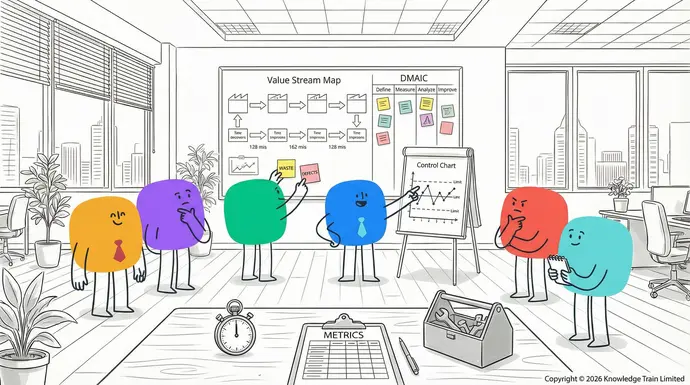
Lean Six Sigma methodology: The DMAIC approachService Operation (SO);project control
The core improvement cycle in Lean Six Sigma is Continual Service Improvement (CSI).).DMAICService Capability modules (worth 4 credit points each):Some methods for managing dependencies include:: Define, Measure, Analyse, Improve, Control. This structured, data-driven framework provides steps for effectively identifying, solving, and sustaining process improvements.Operational Support and Analysis (OSA);Mapping dependencies
| DMAIC phasePlanning, Protection and Optimization (PPO);Using | DescriptionRelease, Control and Validation (RCV);project management software | Common toolsService Offerings and Agreements (SOA).Communicating with stakeholders. |
|---|---|---|
| DefineITIL intermediate certifications are a stepping stone from either Foundation or Practitioner and enable you to get sufficient credit points to gain Expert certification.By understanding and implementing the RAID framework in project management, project managers can gain a more comprehensive view of their projects, allowing them to better anticipate and manage potential risks, assumptions, issues, and dependencies. With the right tools and techniques, RAID can help to improve the overall success of your projects and provide a more structured approach to managing complex projects. | Clarify project objectives, customer requirements, and process scope.4. ITIL v3 Expert certificationEnhance your skills with our expert-led courses | Project charter, SIPOC diagrams, Voice of the Customer (VoC)You can earn ITIL Expert certification after gaining 22 credit points. The way to do that is to sit a MALC (Managing Across the Lifecycle) Exam. MALC tests your ability to integrate your ITIL knowledge in real-world settings. |
| MeasurePassing the MALC exam is worth 5 credit points. The MALC exam’s prerequisite is 17 credit points gained from either Lifecycle, Capability or Practitioner modules. 2 of the credit points must come from Foundation certification. | Map the current process and gather data on performance.5. ITIL v3 Master certification | Process mapping, data collection, capability analysisThis certification shows that you can apply ITIL in an organisation. Every ITIL Master candidate will select a different range of personal experiences. That’s why there is no fixed syllabus for this qualification.Instructor-led |
| AnalyseIn the exam, you must explain and justify:Introduction to Project Management course | Identify root causes of variation, defects, or waste.How you would select and apply elements of the ITIL Framework such as: | Root cause analysis, ITIL knowledge; or,£499 +vatfishboneITIL principles; or, diagram, statistical reviewITIL methods; or,See all dates |
| ImproveITIL techniques; or, | Develop and implement solutions to address causes.supporting management techniques; | Kaizen events, brainstorming, pilot testingto achieve desired business outcomes in one or more practical assignments. |
| ControlTo be eligible for the ITIL Master certification, you must:Instructor-led | Sustain improvements and monitor with controls.have achieved the ITIL Expert certificate;Project Management Essentials | Control charts, standard operating procedures, auditshave worked in IT service management for at least five years in a leadership, managerial, or higher management role. |
By following DMAIC, teams adopt a Enhance your skills with our expert-led courses£999 +vatdata-driven improvement mindset, supported by rigorous See all datesprocess mapping Implementing RAID analysis in projects, measurement, analysis, and proven solutions.Instructor-ledRAID analysis is a project management technique used to identify and manage potential risks, assumptions, issues, and dependencies in a project. Effective implementation of RAID analysis can help project teams make informed decisions, mitigate risks, and enhance project success. In this blog, we will explore how to implement RAID analysis in your projects successfully.
- Accelerating claims processing and reducing transaction errors.Benefits of RAID in project management
FAQs akeholder confidence
What is Lean Six Sigma used for? RAID analysis can also enhance transparency and stakeholder confidence in a project by:
Lean Six Sigma is used to systematically improve organisational processes by reducing waste, minimising variation, improving quality, and increasing customer satisfaction across industries such as manufacturing, healthcare, finance, and logistics. Sharing a clear and comprehensive overview of the project status and challenges
What is the difference between Lean and Six Sigma?Microsoft Office training – does your project team need it?Enabling regular and proactive updates to the stakeholders
Lean focuses on waste reduction and improving process flow, while Demonstrating a proactive and responsible approach to Six SigmaSimon Buehringproject management concentrates on reducing defects and process variation using statistical methods. Lean Six Sigma merges both for more comprehensive improvements.27 Apr 2026.
What are the five phases of DMAIC? This transparency builds trust and confidence among stakeholders, enhancing overall project support.
The DMAIC phases are: Define (problem and customer requirements), Measure (current performance), Analyse (identify root causes), Improve (implement solutions), and Control (maintain improvements).Assess whether your project team needs Microsoft Office training to boost productivity and project outcomes. Read more to decide if it’s essential.Better alignment with organisational strategies
Is Lean Six Sigma certification valuable? RAID analysis can help in aligning
Yes, projectsLean Six Sigma certification with the organisational strategies and priorities by: is highly valued in many industries as it provides in-demand skills in process improvement, data analysis, and Identifying potential conflicts or synergies between the project and the organisational objectives, policies, or initiativesquality management Identifying opportunities for collaboration or support from other projects, programmes, or departments, boosting career opportunities and organisational effectiveness. Supporting strategic decision-making at the project and portfolio levels.
How does Lean Six Sigma differ from other methodologies like TQM or Agile? RAID analysis is a simple yet powerful tool that can help project managers and teams in delivering successful outcomes and creating value for their organisations.
Lean Six Sigma combines structured statistical analysis and waste reduction for process optimisation. While Total Quality Management (TQM) emphasises overall cultural change and 5 reasons to study ITIL Foundation onlineChallenges and limitations of RAID analysisAgile Although RAID analysis provides many benefits, it’s essential to understand that it may have some potential drawbacks in certain contexts. Let’s explore some of the limitations and challenges associated with RAID analysis. targets iterative Simon BuehringPotential for overcomplication in smaller projects
Lean Six Sigma methodology and continuous improvement
Lean Six Sigma is a powerful methodology for continuous improvement in companies worldwide. It combines Lean and Six Sigma principles to identify and eliminate waste, streamline Lean processes, and improve productivity. Lean certification and Six Sigma certification programmes provide essential training and skills for individuals and managers. These Lean and Six Sigma tools support problem solving and operational excellence in digital and production environments.
Lean Six Sigma training and certification programmes
Lean Six Sigma training includes techniques like Value Stream Mapping, Kanban, Kaizen, and DMAIC. Certification programmes such as White Belt Certification, Six Sigma Black Belt, and Six Sigma Green Belt are available. Lean Six Sigma Black Belt and Green Belt levels focus on advanced Lean improvement and analytical skills. Courses use different formats, including video, digital, and in-person training.
Lean Six Sigma application in global organisations
Lean Six Sigma application is relevant for organisations in various regions, including Europe, Asia, and Africa. Companies and government agencies use Lean Six Sigma implementation to achieve sustainable results and enhance efficiency. Lean Six Sigma practitioners lead projects and use tools and techniques to improve quality with Lean manufacturing, reduce costs, and drive revenue.
Lean Six Sigma concepts and solutions for industry
Lean Six Sigma methodologies are suitable for employees, students, and leaders wanting to grow their skill set. Certification programs address the needs of different industries, including marketing, accounting, and production speed improvement. Lean Six Sigma concepts and Lean Six Sigma solutions are established as reliable ways to build organisational capability and enhance company performance.
Lean Six Sigma process improvement and measurable goals
Lean Six Sigma projects require the use of Six Sigma tools, Six Sigma methods, and Lean practices. Six Sigma strategies and Six Sigma principles are applied to achieve measurable goals. Lean Six Sigma process improvement is fundamental for companies striving for excellence and higher profitability. Programmes are available in English, French, Spanish, and other languages to support diverse participants and preferences.
What is Lean Six Sigma?
Lean Six Sigma is a methodology that combines the principles of Lean manufacturing and Six Sigma to improve efficiency and quality in business processes. Lean Six Sigma focuses on eliminating waste, reducing variability, and enhancing customer satisfaction, thereby driving operational excellence. By integrating tools from both Lean and Six Sigma, Lean Six Sigma provides a structured approach to problem-solving, enabling organizations to optimize processes, reduce costs, and increase profitability. Lean Six Sigma practitioners use data-driven techniques and statistical analysis to identify areas for improvement, ensuring that Lean Six Sigma projects deliver sustainable results. The implementation of Lean Six Sigma requires commitment from leadership and engagement from all levels of the organization, as Lean Six Sigma fosters a culture of continuous improvement and accountability. Organizations adopting Lean Six Sigma often experience significant improvements in process performance and customer satisfaction, making Lean Six Sigma a valuable strategy for achieving competitive advantage.
Lean Six Sigma overview
Lean Six Sigma provides a structured approach to process improvement that focuses on reducing waste and variation.
Lean Six Sigma combines Lean thinking with Six Sigma statistical rigour to improve outcomes and efficiency.
This article explains principles, benefits, methodology and capability development for senior leaders and improvement teams.
The guidance is practical, evidence based and oriented to organisations seeking measurable operational improvement.
Throughout the article you will see references to Lean Six Sigma approach and common Lean Six Sigma techniques used in practice.
Benefits
Organisations deploy Lean Six Sigma to reduce defects, lower cost and improve customer satisfaction in measurable ways.
Benefit realisation is tracked through clear metrics, which make the case for continued investment and scaling of programmes.
Beyond direct cost savings, Lean Six Sigma improves delivery predictability, cycle time and overall service quality.
The combination of speed (Lean) and variation reduction (Six Sigma) delivers outcomes that single approaches struggle to match.
Case examples frequently show rapid returns when projects are selected and governed with clarity and executive sponsorship.
Benefits of Lean Six Sigma
Financial benefits are often the headline metric but operational improvements such as capacity gain and error reduction matter equally.
Improved process capability increases customer trust and reduces the need for corrective actions and rework.
Lean Six Sigma drives capability uplift across teams through training and repeatable project practices.
Greater consistency in output supports compliance and regulatory reporting where required by the business.
Organisational learning from projects accelerates subsequent initiatives and reduces time to value.
Strategic alignment and ROI
Linking projects to strategic priorities ensures scarce resources are used where they create the most value.
Benefit tracking and transparent reporting make return on investment visible to executives and stakeholders.
Regular portfolio reviews promote reinvestment in the most effective projects and help prioritise future work.
Methodology
A clear methodology provides a repeatable path from problem definition to sustained improvement across the organisation.
Methodology documents standardise templates, roles and review points across the improvement programme.
Embedding methodology into training and tools reduces variation in how projects are executed and evaluated.
Methodology should evolve with lessons from live projects to remain relevant and effective.
Lean Six Sigma principles balance quick wins with longer, more complex deliverables in a coherent way.
DMAIC
DMAIC structures projects into Define, Measure, Analyse, Improve and Control to ensure focus and deliverables.
Define establishes scope, customers and expected benefits so teams start with a clear brief.
Measure collects data to create a reliable baseline and to identify the magnitude of issues to address.
Analyse uses statistical and root cause methods to prioritise causes that most affect performance.
Improve pilots solutions, tests changes and measures impact before scale up across the value stream.
Control embeds standard work, control plans and monitoring to maintain gains over time.
DMAIC governance checkpoints
Governance checkpoints should verify that measures are reliable and that proposed solutions align with expected benefits.
Clear exit criteria at each phase reduce the risk of premature closure and wasted effort on poorly scoped projects.
DMADV
DMADV is the design framework used where incremental fixes are insufficient and a new design is required.
It focuses on customer requirements, robust design, verification and performance prediction before launch.
Design validation tests prototypes and ensures the new process meets capability and compliance needs.
Risk assessment and failure modes are central to DMADV so the new design is resilient in operation.
Cross-functional teams and stakeholder engagement reduce handoff issues during complex design work.
When to use DMADV
Use DMADV for greenfield processes, major redesigns or when existing processes cannot meet future capability needs.
DMADV reduces costly retrofits by validating designs before broader deployment and handover to operations.
Tools and techniques
Tools include value stream mapping, statistical process control, control charts and root cause analysis.
Kaizen events, rapid improvement workshops and pilot testing are common techniques for delivering quick impact.
Measurement systems analysis and capability studies are necessary to ensure data used for decisions is reliable.
Choosing the right set of tools for the problem prevents over-engineering and focuses teams on high-impact actions.
Effective tool deployment pairs technical skill with coaching so teams can apply methods in context.
Statistical tools
Control charts visualise variation over time and distinguish common cause from special cause variation for better decisions.
Capability indices such as Cp and Cpk quantify how well a process meets specification and inform prioritisation.
Design of experiments helps teams understand the effects of multiple factors and identify robust solutions.
Statistical literacy at practitioner level improves analysis quality and the choice of countermeasures.
Key measurement practices
Establishing a clear measurement plan before data collection prevents scope drift and ensures relevance of results.
Baselining with cLean data allows teams to quantify waste and measure the impact of improvements accurately.
Measurement system analysis (MSA) confirms whether instruments and procedures are suitable for the project’s needs.
Operational techniques
Value stream mapping identifies bottlenecks, handoffs and non-value steps that constrain performance end-to-end.
5S and workplace organisation reduce search time and make abnormal conditions obvious to teams.
Cross-training staff and flexible resourcing help reduce delays and balance workload variations across processes.
Standard work and visual controls sustain gains by making expectations clear and observable at the team level.
Lean Six Sigma techniques in practice
Combining Lean tools with Six Sigma analysis enables both rapid cycle time reductions and sustainable quality improvement.
Kaizen events are effective for localised problems while DMAIC projects are suited to larger, systemic issues.
Operational flow and waste reduction
Optimising operational flow eliminates unnecessary movement, waiting time and duplication that create hidden costs.
Waste reduction initiatives improve throughput, reduce queue lengths and align resources to value creation steps.
Continuous flow techniques minimise delays and promote a stable process rhythm across departments.
Identifying bottlenecks through process mapping and time analysis supports efficient scheduling and balanced workloads.
Standardising work instructions sustains flow efficiency and helps visualise improvement opportunities.
Process variation and control limits
Monitoring process variation enables teams to distinguish between common and special causes of deviation.
Control limits provide an early warning system that supports proactive decision-making and risk mitigation.
Capability analysis converts variation data into quantifiable performance indicators for management review.
Establishing clear tolerance boundaries prevents over-adjustment and stabilises long-term process behaviour.
Analysing variation patterns helps predict future trends and guides preventive maintenance planning.
Capability
Capability building ensures the organisation can repeat successes and maintain improvements over time.
Training, coaching and certified pathways provide the structural support teams need to deliver projects consistently.
Centres of excellence or capability hubs provide governance, templates and technical support to project teams.
Succession planning for key roles such as green belts and black belts reduces risk when people move on.
Performance metrics for capability include project cycle time, benefit realisation and uptake rates across the business.
Training and roles
White belt and yellow belt introduce fundamentals; green belt focuses on project delivery and black belts coach programmes.
Master black belt provides statistical depth and leads the capability centre that supports scaling across functions.
Practical, coached project work accelerates competence beyond classroom learning and embeds skills in real problems.
Certification recognises attainment and helps organisations benchmark internal capability levels effectively.
Coaching and mentoring
Coaching ensures that technical tools are applied appropriately and that projects remain focused on delivering business value.
Mentoring from experienced practitioners accelerates learning and reduces common implementation mistakes.
Knowledge and governance
Capturing templates, case studies and standard artefacts reduces duplication of effort and speeds project start-up.
Communities of practice help transfer tacit knowledge across teams and preserve lessons learned from projects.
Governance cadence defines review points, escalation paths and sponsor engagement for healthy portfolio management.
Methodology documents standardise templates, roles and review points to ensure consistent delivery quality.
Embedding capability into operations
Handover documentation and control plans ensure operations can sustain improvements without ongoing project support.
Incorporating improvement responsibilities into job descriptions encourages continuous problem solving across roles.
Continuous improvement culture
A continuous improvement culture embeds problem-solving behaviour and empowers employees to challenge waste daily.
Leadership communication reinforces that improvement is everyone’s responsibility, not a project phase.
Recognition programmes highlight success stories and motivate others to engage in small-scale change.
Cross-functional collaboration ensures innovation emerges from diverse perspectives and shared ownership.
Embedding improvement discussions into regular team meetings keeps performance awareness high.
Leadership commitment and sustainability
Leadership commitment provides direction, funding and consistency for Lean Six Sigma initiatives.
Governance forums monitor progress, manage interdependencies and remove barriers that slow down execution.
Aligning improvement goals with strategic objectives builds credibility and secures ongoing investment.
Sustainability comes from integrating metrics into performance management systems and accountability reviews.
Visible executive sponsorship encourages a culture of evidence-based decision making and long-term discipline.
Customer value and stakeholder engagement
Understanding customer value defines what processes must deliver and where efficiency gains matter most.
Stakeholder engagement ensures that improvement priorities align with service expectations and regulatory requirements.
Voice of the customer analysis provides insight into preferences, complaints and latent needs that drive design changes.
Integrating stakeholder feedback into design reviews accelerates acceptance of new processes and technology.
Customer satisfaction metrics close the loop between operational performance and perceived quality.
Risk management and error proofing
Risk assessment identifies potential failure points before they lead to costly disruption or rework.
Error proofing uses visual cues, standard procedures and automation to prevent mistakes at source.
Failure mode and effects analysis (FMEA) quantifies risk severity and likelihood to guide preventive actions.
Embedding lessons from near misses creates resilience and strengthens the organisation’s learning system.
Proactive risk management transforms reactive correction into planned, data-informed prevention.
Results
Results should be measured in both operational metrics and financial impact to reflect full value delivered.
Regular benefit realisation reviews help validate assumptions and inform decisions about scaling and reinvestment.
Successful programmes show both quick wins and longer term capability uplift that reduces future cost to serve.
Balanced scorecards and dashboards make comparisons across projects straightforward for leadership teams.
Organisations that maintain a pipeline of projects convert capability into sustained operational advantage.
Examples of value delivered
Projects that reduce cycle time often free capacity that can be redeployed to growth or customer service improvements.
Defect reduction initiatives reduce warranty and rework costs while improving net promoter scores for customers.
Supplier collaboration projects improve end-to-end capability and reduce bottlenecks in complex value chains.
Transparency of results increases organisational confidence and generates support for further investment.
Measuring and reporting impact
Define benefits in financial and non-financial terms to capture the full contribution of projects to organisational goals.
Use consistent metrics and attribution methods so leaders can compare project performance objectively.
Dashboards that combine leading and lagging indicators allow rapid assessment of project health and trajectory.
Periodic validation of benefit calculations prevents overclaiming and increases trust in reported outcomes.
Performance metrics and continuous evaluation
Performance metrics track efficiency, quality, cost and delivery performance in real time.
Balanced scorecards integrate leading and lagging indicators to measure short-term output and long-term outcomes.
Continuous evaluation ensures improvements remain aligned with business priorities and customer requirements.
Dashboards and statistical trend analysis make deviations visible early, enabling faster corrective action.
Periodic review of measurement systems confirms data accuracy and avoids performance distortion over time.
Conclusion
Lean Six Sigma is a strategic capability that combines Lean speed with Six Sigma rigour to deliver measurable operational improvement.
For durable results, organisations must invest in measurement systems, capability development and strong governance.
Start with clear strategic alignment, choose projects with measurable potential and protect time for coached project work.
Maintain focus on data quality and capability so reported benefits are reliable and repeatable across the portfolio.
When applied with discipline and executive support, Lean Six Sigma transforms performance in ways that are visible and sustainable.