
{ "@context": "http://schema.org", "@type": "Course", "name": "Cyber Security Awareness self-paced online", "description": "Complete online at your own pace (Self-paced)", "image": "https://www.knowledgetrain.co.uk/training-courses/res/logos/knowledge-train-logo.svg", "url": "https://www.knowledgetrain.co.uk/it/cyber-security/cyber-security-courses/cyber-awareness-training-course", "provider": { "@type": "Organization", "name": "Knowledge Train", "logo": { "@type": "ImageObject", "url": "https://www.knowledgetrain.co.uk/it/cyber-security/cyber-security-courses/cyber-awareness-training-course" } }, "assesses": "This first principle requires Lean practitioners to deduce what a customer wants from a product. Often customers won’t have a solid idea or may be unable to articulate what they want. This may be due to a lack of industry knowledge, a lack of technical knowledge, or a desire to use new, untested technology.<
h3>Learning outcomesThere are several methods that can be used to discover value. We can use our industry knowledge of consumers, software, and technology to create better solutions. Or we can gather relevant information through surveys and interviews.
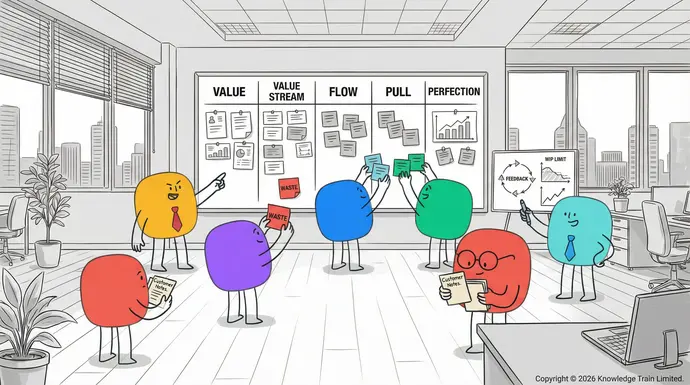
3>2. Map the value stream<
p>Candidates gain an understanding of:Next, Lean practitioners must map each of the steps it will take to deliver the product. This helps teams understand which processes may produce waste. Once found, the team finds ways to eliminate those steps or reduce them as much as possible.
>Value streams are often displayed visually and without a lot of technical jargon so that all involved can get a clear and concise idea of what is required to create the finished product.<
ul>3. Create flow<
li>Once the most obvious sources of waste are eliminated, the next step is ensuring the processes that create value can proceed without delays or disruptions.<
span>The purpose, benefits, and key terms of cyber resilienceThis requires that staff be trained in multiple skills, creating cross-functional teams, which can help balance the workload among all staff.
>Creating adequate workflow prevents bottlenecks and delays in development. It can also improve office morale by keeping everyone working at a steady pace without harsh deadlines and sudden changes to development.
>4. Establish pull<
li>A pull system limits inventory and work in progress (WIP) items by only producing enough to meet customer demand. This prevents tasks, staff or components from sitting idle, waiting for someone to come around and begin the next phase of development.<
span>Risk management and the key activities needed to address risks and opportunitiesPull systems have been proven to be effective and are used in many modern >project management methodologies>.<
li>The most well-known is the Kanban system – In a pull system, completed tasks are placed in a pool of resources. When a developer finishes a task, they then look at the pool and pull out the next highest priority task they can complete.<
span>The purpose of an online security management system and how best practices and standards can contribute5. Seek perfection
>Lean teaches that there is always a process to be improved or a wasteful to be eliminated. Organisations that implement Lean can only do so successfully by creating an environment of learning and experimentation that promotes personal and professional improvement.
>Lean and Agile<
li>It is common for Lean and its variants to be referred to by the umbrella term <span>Cyber resilience transitionLean Agile>.
>Agile<li> refers to any management method that aligns with the ideas first outlined in the <span>Cyber resilience operationAgile Manifesto>, written to improve those processes and existing methods deemed inadequate for use in software development. >Agile describes three primary concepts common to all contemporary <li>Agile methods<span>Cyber resilience continual improvement.: an iterative approach to development, short feedback loops, and a disciplined >project management process>. >",
"learningResourceType": "presentation",
"teaches": "While you may think that Lean is derived from Agile, it is, in fact, the opposite – <h3>CurriculumAgile is rooted in Lean3>.< 4>The concepts that together create what we know of as Lean Manufacturing first originated in 1940’s post-war Japan, decades before Agile made its introduction.< p>This RESILIA Foundation course covers the following topics:During this time, demand for many products in the Japanese economy was low, so automotive manufacturer Toyota determined that actual sales rather than production targets should drive work schedules. >This meant avoiding costly over-production by building products to order, <ul>pulling<li>Introduction to cyber resilience them onto the market rather than target-driven >push<li>The benefits of cyber resilience manufacturing. >The term Lean Manufacturing was first coined in 1988 by engineer John Krafcik in his article <li>Risk management overviewTriumph of the Lean Production System>. It was later elaborated upon by James Womack, Daniel T. Jones, and Daniel Roos in the early ‘90s.< li>The purpose of risk managementThe basic >Lean Manufacturing principles<h4>RESILIA FoundationLean manufacturing
- >Determine value<
- li>Components of a management systemMap the value stream
- >Establish a workflow<
- li>The relevance of common management standards to cyber resilienceEstablish a >pull<li>What cyber resilience strategy is intended to achieve system
- >Focus on perfection.<
li>What cyber resilience design is intended to achieveWhat is different are the finer details such as “What is value?” or “What creates waste?” In manufacturing, waste is created by worn-out machinery, transportation costs, poorly engineered components, or excess inventories.
>In modern industries, waste may refer to bloated software with additional features that do not provide value to users or an online registration procedure that is convoluted and time-consuming.<
li>What cyber resilience transition is intended to achieveAgile principles
>At a very basic level, Lean and Agile are almost indistinguishable.<
li>What cyber resilience operation is intended to achieveIn Agile software development, teams apply an iterative approach to software delivery. Developers first create a minimum viable product which, though it may lack many planned features, can be put into work and immediately start generating value for customers.
>Similarly, Lean encourages teams to deliver fast by managing workloads and limiting the amount of WIP (work-in-process) to improve focus and reduce development time. Both Lean and Agile teams manage flow by working in cross-functional teams and delivering one iteration at a time.<
li>Identifying cyber resilience activities that should be aligned with IT service strategyLean also encourages this in its definition of waste – if you’re making something that doesn’t meet your customers’ needs, it is a waste. Short feedback loops help eliminate activities that do not provide value.
>Agile methods<li>The purpose and key features of the control objectives rely on disciplined governance that encourages frequent review and learning. This approach helps developers discover valuable insights after each release that can then be applied to improve the quality of future iterations.
>The Lean principle of “Build Quality In” encourages businesses to automate any process prone to human error so that developers can focus on
li>The seven-step improvement process and cyber resilience improvementsImplementing Lean management
>Adopting Lean into your development model isn’t as simple as learning the <li>How to use the ITIL CSI approach to plan cyber resilience improvement.Lean principles>. It’s a lengthy process that might fail without adequate guidance and preparation. You may want to consider soliciting the help of professional >", "about": "Cyber Security Awareness self-paced online course", "abstract": "change managers<p>Cyber Security Awareness self-paced online to help ease the transition to Lean. course with 12 months access, exam and certification
", "courseCode": "CSAO", "coursePrerequisites": "None.", "educationalCredentialAwarded": "RESILIA Foundation certification", "audience": { "@type": "Audience", "name": "
RESILIA Foundation certification shows that you understand how decisions impact upon good and bad cyber resilience within your organisation.
While the decision to adopt lean is usually a top-down decision, always bear in mind that sudden change is likely to meet resistance. Lean is, fundamentally, an organisational culture. Adopting Lean requires a change management process that fosters positive outcomes through coaching and mentoring as opposed to merely directive top-down change.