
Key takeaways
Lean improves outcomes by defining value, removing waste, and building a culture of continual improvement.
- Start by clarifying what customers value, using research when needs are unclear.Search
- Map the end-to-end value stream to expose wasteful steps and simplify delivery.
- Create smooth flow by reducing bottlenecks and building cross-functional capability.
- Use pull systems and WIP limits, such as Kanban, to match work to real demand.
- Seek perfection through learning, feedback loops, and automation that builds quality in.
- Implement Lean deliberately, with training and change management to reduce risk and resistance.
IntroductionLatvia
Lean can be as diverse and complex as those who make up the teams that use it. To learn more about Lean and Lean certifications, make sure to see our LithuaniaLean Six Sigma online coursesLuxemburg.Malta
The 5 Lean management principlesNetherlands
It is worth noting that Lean has been adapted to fit very niche contexts in many varied industries. PolandLean management principlesPortugal detailed below may vary in number and thought depending on which industry you work in and which projects Lean is applied to.Romania
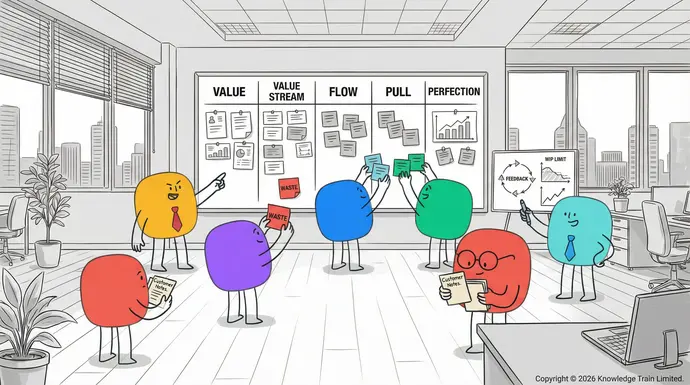
Some versions of Lean may detail up to as many as 9 Lean principles, but for this example, we’ll stick with the most basic five Lean principles:Slovakia
1. Identify valueSlovenia
This first principle requires Lean practitioners to deduce what a customer wants from a product. Often customers won’t have a solid idea or may be unable to articulate what they want. This may be due to a lack of industry knowledge, a lack of technical knowledge, or a desire to use new, untested technology.Spain
There are several methods that can be used to discover value. We can use our industry knowledge of consumers, software, and technology to create better solutions. Or we can gather relevant information through surveys and interviews.Sweden
2. Map the value stream
It is common for Lean and its variants to be referred to by the umbrella term Lean Agile .What is a P30 qualification?
Agile refers to any management method that aligns with the ideas first outlined in the Agile ManifestoWhat is a P3O certificate?, written to improve those processes and existing methods deemed inadequate for use in software development.
Agile describes three primary concepts common to all contemporary Agile methodsWhat is a PMO certificate?: an iterative approach to development, short feedback loops, and a disciplined project management process .What is a PMO qualification?
While you may think that Lean is derived from Agile, it is, in fact, the opposite – Agile is rooted in Lean .What is P3M?
Lean manufacturing
The concepts that together create what we know of as Lean Manufacturing first originated in 1940’s post-war Japan, decades before Agile made its introduction.
During this time, demand for many products in the Japanese economy was low, so automotive manufacturer Toyota determined that actual sales rather than production targets should drive work schedules.What is P3O in project management?
This meant avoiding costly over-production by building products to order, pulling them onto the market rather than target-driven What is P3O Practitioner?push manufacturing.
The term Lean Manufacturing was first coined in 1988 by engineer John Krafcik in his article What is the best certification for a PMO?Triumph of the Lean Production System . It was later elaborated upon by James Womack, Daniel T. Jones, and Daniel Roos in the early ‘90s.
The basic What is the full form of P3O?Lean Manufacturing principles do not differ very much from the principles used in Lean managementWhat is the p30 Foundation qualification? today:
- Determine value
- Map the value streamWhat is the P3M3 maturity model?
- Establish a workflow
- Establish a pullWhat is the P3O approach? system
- Focus on perfection.
What is different are the finer details such as “What is value?” or “What creates waste?” In manufacturing, waste is created by worn-out machinery, transportation costs, poorly engineered components, or excess inventories.What is the P3O PMO structure?
In modern industries, waste may refer to bloated software with additional features that do not provide value to users or an online registration procedure that is convoluted and time-consuming.
Agile principles
At a very basic level, Lean and Agile are almost indistinguishable.What is the P3O qualification?
In Agile software development, teams apply an iterative approach to software delivery. Developers first create a minimum viable product which, though it may lack many planned features, can be put into work and immediately start generating value for customers.
Similarly, Lean encourages teams to deliver fast by managing workloads and limiting the amount of WIP (work-in-process) to improve focus and reduce development time. Both Lean and Agile teams manage flow by working in cross-functional teams and delivering one iteration at a time.
Agile{"@context":"https://schema.org","@type":"FAQPage","mainEntity":[[{"@type":"Question","name":"How do you qualify for PMO?","url":"https://www.knowledgetrain.co.uk/project-management/pmo/pmo-faqs/how-do-you-qualify-for-pmo","acceptedAnswer":{"@type":"Answer","text":"< promotes short feedback loops so that developers only do work that meets the latest business requirements.p>To qualify for a
, you'll need a Bachelor's degree, experience in projects, and key skills such as communication and problem-solving. PMO positions offer a range of opportunities to develop project management expertise, understand < rely on disciplined governance that encourages frequent review and learning. This approach helps developers discover valuable insights after each release that can then be applied to improve the quality of future iterations.a href='https://www.knowledgetrain.co.uk/programme-management/programme-management-courses/portfolio-management'>portfolio management
, and enhance project processes.
stands for Portfolio, Programme and Project Offices. P3O integrates principles and techniques to support the implementation of projects or
- stands for is Portfolio, Programme and Project Management Offices. P3O is a methodology developed by the UK Cabinet Office, offering guidance on creating a structure for portfolios,
programmes
and